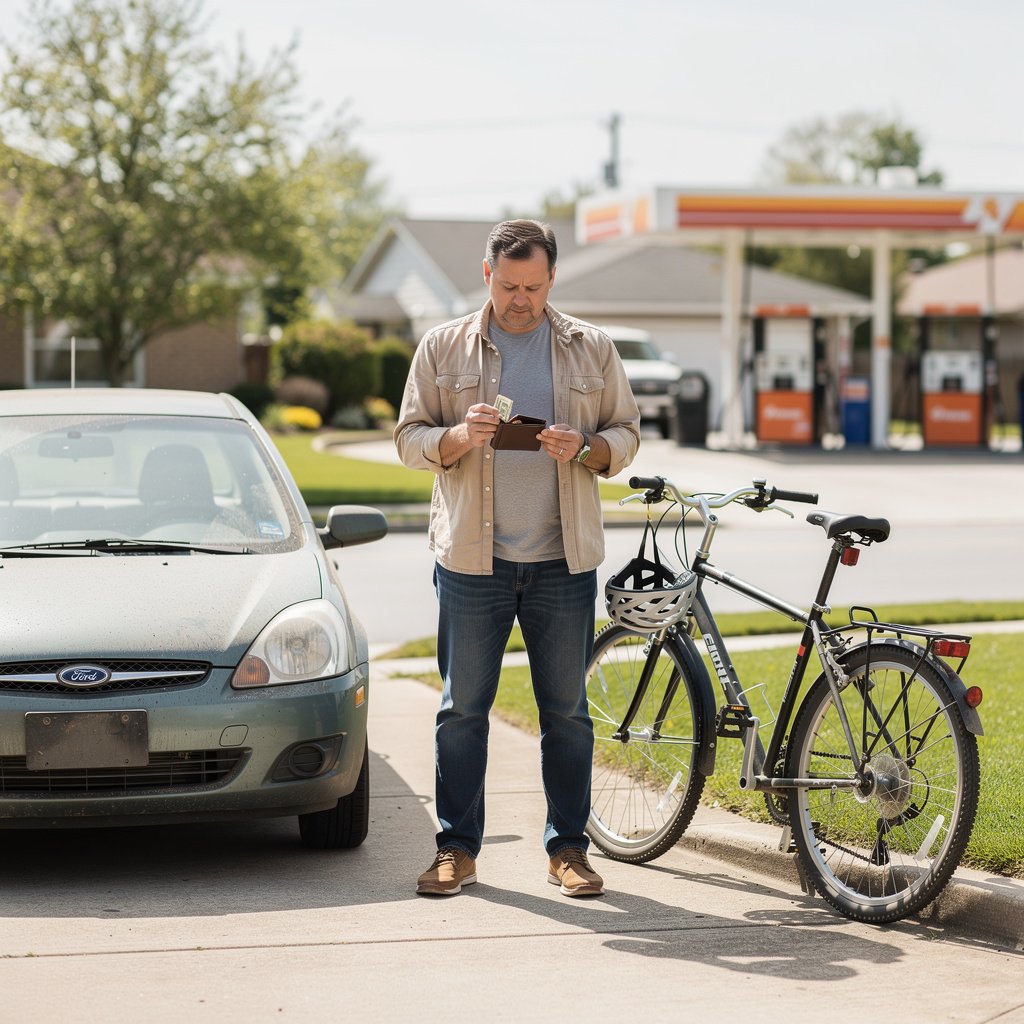
What to Do If You Need Transportation but Cannot Afford Gas
When the gas money is gone, the problem is usually not the whole month. It is the specific days between now and the next paycheck, and which trips you cannot skip. This guide helps you do three things: shrink the fuel you need, find rides and local help for the trips that remain, and avoid the high-cost loans that turn a short gap into losing the car.
Rank the trips and count the miles
Start with a short list of the trips that protect your income, your health, your food and your children's school. Write the round-trip distance next to each one, and mark which could move online, go to a closer location or be combined. Then estimate the gas. A made-up example: a 20-mile round-trip commute on 10 workdays is 200 miles. At 25 miles per gallon that is 8 gallons, and at $3.50 a gallon (an assumed price) it is $28. That number is smaller than the fear of an empty tank, and it tells you what you must find.
The U.S. Department of Energy's tips include combining errands into one trip, since a warm engine runs more efficiently. Its Fuel Economy Guide says many short trips from a cold start can use twice as much fuel as one multipurpose trip covering the same distance. Drive your most fuel-efficient vehicle when you have a choice, and ask your employer whether you can telecommute or stagger your hours to avoid stop-and-go traffic, as the Department suggests.
Use the free fuel savers
fueleconomy.gov, the federal fuel economy site, lists habits that cost nothing:
- Drive smoothly. Aggressive driving, meaning speeding and rapid acceleration and braking, can lower gas mileage by roughly 15 to 30 percent at highway speeds and 10 to 40 percent in stop-and-go traffic.
- Watch highway speed. The 2026 Fuel Economy Guide says each 5 mph you drive over 60 mph can reduce fuel economy by about 7 percent.
- Avoid idling. Idling can use a quarter to a half gallon of fuel per hour, and restarting takes only about 10 seconds' worth of fuel.
- Check tire pressure. Under-inflated tires can lower mileage by about 0.2 percent for every 1 psi drop in average pressure. Use the number on the door-jamb sticker, not the maximum on the tire. See tire pressure and fuel economy.
- Remove weight and roof cargo. An extra 100 pounds can reduce mileage by about 1 percent, and a large roof cargo box can cut it by 6 to 17 percent on the highway.
These help, but they will not replace an empty tank, so combine them with the options below.
Line up rides and shared trips
Ask coworkers who live near you about carpooling, and share the gas cost; the Department of Energy lists carpools, public transit, walking and cycling for short distances among ways to cut fuel use. Check your local transit agency for fares and reduced-fare programs. For more ideas on cutting the cost of getting to work, see how to lower commuting costs fast and how gas mileage changes the real cost of owning a car.
Ask 211 and local agencies about transportation help
The 211 network says transportation is one of the most common needs that go unmet for its callers. United Way and 211 have also partnered with a rideshare company so that 211s in select cities have provided free or discounted rides for employment, health care and other needs, so ask whether your local 211 offers anything like it. Call 211 or search your local site, and see how to use 211 to find help with bills, food and housing.
At the federal level, the Department of Transportation describes human service transportation programs that include reimbursing taxi or public transportation use, providing bus tokens and reimbursing gas and vehicle costs, but the available help depends on your area and eligibility. A community action agency may be another place to ask; how to use community action agencies for emergency help explains how to find yours. For help with food, rent and utilities so more of your money can go to fuel, see how to find same-day help for food, rent and utilities.
Avoid the title loan
When you are stuck, a car title loan can look like a fast fix. The FTC says these are short-term loans, often 15 or 30 days, secured by your vehicle, where monthly finance fees can be as high as 25 percent, or an APR of about 300 percent. In its example, borrowing $1,000 for 30 days at a 25 percent fee means repaying $1,250, and rolling it over brings the total to $1,500 after 60 days, plus other fees. If you cannot repay, the lender may repossess the car, which would end your transportation entirely. Some lenders also install a GPS and a starter-interrupt device.
The FTC lists alternatives: ask creditors for more time, borrow from a credit union (some federal credit unions offer payday alternative loans), ask a community bank about a smaller loan, check for small bank loans or lines of credit up to $1,000, get help from a nonprofit credit counselor, ask family and friends, or contact local charities and churches. More options appear in emergency cash options that are safer than payday loans and how to avoid payday loans when you need cash.
Keep the car legal while you stretch
Do not drop insurance to afford gas. A lapse can bring fines, a registration problem and higher rates later; what happens if you miss a car insurance payment explains why. And if the car payment is the real squeeze, call the lender early, as described in what to do if you cannot pay your car payment.
Sources:
- Gas Mileage Tips: Driving More Efficiently, FuelEconomy.gov
- Gas Mileage Tips: Keeping Your Vehicle in Shape, FuelEconomy.gov
- 2026 Fuel Economy Guide, FuelEconomy.gov
- Fuel-Saving Tips for Drivers, U.S. Department of Energy
- Our Partners, 211.org
- Executive Report to the President, Federal Transit Administration
- What To Know About Payday and Car Title Loans, FTC

Written by TheDigitalLife Editorial Team
Edited by R. K. Tiwari
Owner & Editor
R. K. Tiwari is the owner and editor of TheDigitalLife. He checks each guide against official U.S. sources before it is published.
About the editor and our editorial standards