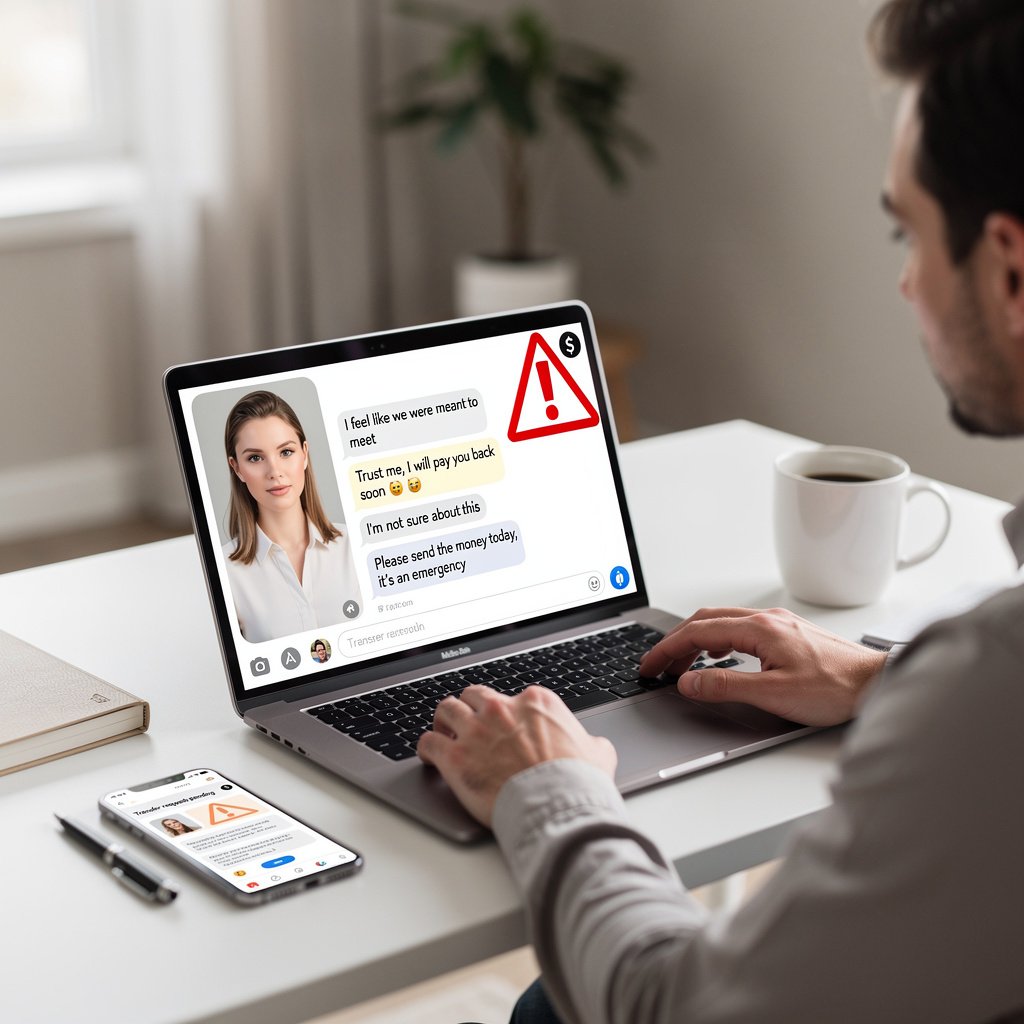
AI Romance Scam: Warning Signs Before You Send Money
Romance fraud rarely begins with a request for money. It begins with attention. A new contact remembers small details, sends thoughtful messages at predictable times, and seems unusually compatible. Generative AI can help one operator maintain that performance across many conversations, polish messages in another language, alter photographs, or produce a plausible voice note. The technology improves the disguise; it does not change the underlying transaction.
The point at which a relationship becomes a financial proposition deserves a complete reset. That includes a request for an emergency payment, a gift-card code, access to a bank account, help receiving a package, or an invitation to a crypto platform. Affection is not a substitute for independent verification.
A polished conversation is cheap to manufacture
Long, grammatically consistent messages once felt like evidence that a person was investing real time in a relationship. They are no longer a reliable test. A scammer can generate replies based on a victim’s interests, translate them, and maintain a detailed profile of prior conversations. Photos can be stolen or altered, while a brief video can be staged, prerecorded, face-swapped, or avoided with a believable technical excuse.
Look at the pattern of the relationship instead of judging a single message. Romance fraud often moves a conversation away from the dating or social platform, creates intense emotional closeness quickly, and keeps an in-person meeting permanently out of reach. The person may claim to be deployed, working offshore, managing an overseas project, or dealing with a family crisis. The story changes just enough to explain why a meeting cannot happen and why money is suddenly necessary.
The FTC’s romance-scam guidance identifies common requests such as travel expenses, medical bills, visa costs, gift cards, wires, payment apps, and cryptocurrency. The FTC’s simplest boundary is also the clearest: do not send money or gifts to a romantic interest you have not met in person.
The FTC's rule for this situation fits in one line: do not send money or gifts to someone you have not met in person. Its list of common cover stories includes living abroad, working on an oil rig, serving in the military and working for an international organization, each of which explains why a meeting never happens.
Separate identity checks from the person’s evidence
A passport photo, employee badge, military image, or screenshot of a bank balance can be fabricated. Do not ask the person to provide more proof and then treat whatever arrives as verification. Conduct checks they do not control.
Reverse-search profile photos and crop different parts of an image before searching again. Search distinctive sentences from their biography or messages in quotation marks. Compare names, locations, occupations, and timelines across accounts. An image connected to another name is a serious warning; a search with no match proves nothing.
For a live call, request an ordinary, spontaneous interaction rather than a dramatic identity test. Ask the person to discuss a recent shared conversation, change location, or arrange another call later. Even then, treat video as one data point. Never disclose private authentication answers, identity documents, or financial information merely to make the other person “prove” trust in return.
Bring in someone outside the relationship. A trusted friend is not emotionally invested in preserving the story and may notice inconsistencies that are easy to rationalize from inside it. If the new contact tries to isolate you from people who question the relationship, that reaction is itself useful information.
Checks from the FTC and CFTC guidance:
- Run a reverse image search on the profile photos. A photo tied to another name, or details that do not match, points to a scam.
- Search the job or story the person gave together with the word "scammer".
When romance turns into an investment account
Some operations take weeks before introducing money. The contact casually mentions successful crypto or foreign-exchange trades, offers to teach a low-risk method, and directs the victim to a particular site. The account may initially permit a small withdrawal. Later deposits appear to grow quickly until a large withdrawal triggers a demand for tax, verification funds, or a security deposit.
The CFTC’s advisory on online financial romance fraud describes this grooming pattern and warns about recommended trading sites that accept cryptocurrency, easy early profits, and accounts that become locked unless the victim pays more. A balance controlled by the same people who solicited the deposit is not an independently verified asset.
Do not use a link supplied by the contact to check a license or trading firm. Find the relevant regulator independently and confirm the exact legal entity and individual. Check the domain’s age and history. A registration record created recently does not fit a claim that the platform has served investors for many years.
Never transfer additional money to “unlock” an account. Legitimate taxes are not normally collected by sending crypto to a wallet chosen in a private chat, and a withdrawal does not become safer because the platform calls a new payment compliance, liquidity, or insurance.
The CFTC's advice is to treat easy profits as a warning sign, keep the conversation on the dating or social platform, and keep money out of a long-distance relationship. It also suggests checking the trading site's registration date with ICANN Lookup, to see how long the site has existed.
If you suspect the relationship is fraudulent
Preserve the evidence before blocking the account. Save the profile URL, user ID, phone numbers, email addresses, messages, voice notes, images, payment instructions, bank details, and crypto wallet addresses. Export the conversation if the platform permits it. Record the dates of requests and payments and keep the original files; repeated screenshots can lose useful context.
Then stop sending money and contact the payment provider. Explain precisely how the transfer occurred and that you believe the recipient used a fraudulent relationship. Ask about a recall, reversal, fraud investigation, or freeze of the receiving account. Results depend on timing and payment method, but a prompt, accurate report is more useful than negotiating with the scammer.
Report the profile to the dating or social platform. File a report with the FTC at ReportFraud.gov and, where the scheme involved online financial loss, the FBI’s IC3. If identity documents, a Social Security number, or account credentials were shared, use IdentityTheft.gov to build a recovery plan and change reused passwords from a trusted device.
Do not agree to receive or forward money, open accounts, buy cryptocurrency for the person, or accept packages on their behalf. Those requests can turn a victim into a money mule or expose the victim to additional financial and legal harm.
Expect the story to fight back
When challenged, the operator may become angry, threaten self-harm, send a dramatic hospital message, produce a sudden travel booking, or accuse you of never trusting them. A second supposed person—a doctor, lawyer, commanding officer, customs official, or family member—may join the conversation to support the crisis. Multiple accounts do not mean multiple independent witnesses.
After contact ends, someone may offer to recover the lost money for a fee. They may know private details because the original group retained the victim list. Do not pay a recovery service that guarantees success, and never provide a crypto seed phrase or one-time code. Verify attorneys through the relevant state bar and government staff through a telephone number published on the agency’s official site.
Feeling embarrassed is common, but secrecy helps the criminal, not the victim. These schemes are designed to exploit normal hopes and attachments over time. A clear report to the bank, platform, and authorities is the practical next step; proving that the relationship “meant something” is not a condition for asking for help.
Related guides: romance scam: what to do if you sent money, military romance scam: warning signs and recovery steps and AI investment scam: how fake trading bots trick victims.
This article offers general consumer information and is not legal or financial advice.
Sources:
- What To Know About Romance Scams, FTC Consumer Advice
- Customer Advisory: Six Warning Signs of Online Financial Romance Frauds, Commodity Futures Trading Commission
- ICANN Lookup, domain registration data
- ReportFraud.ftc.gov, Federal Trade Commission
- Internet Crime Complaint Center (IC3), Federal Bureau of Investigation
- IdentityTheft.gov, Federal Trade Commission

Written by TheDigitalLife Editorial Team
Edited by R. K. Tiwari
Owner & Editor
R. K. Tiwari is the owner and editor of TheDigitalLife. He checks each guide against official U.S. sources before it is published.
About the editor and our editorial standards