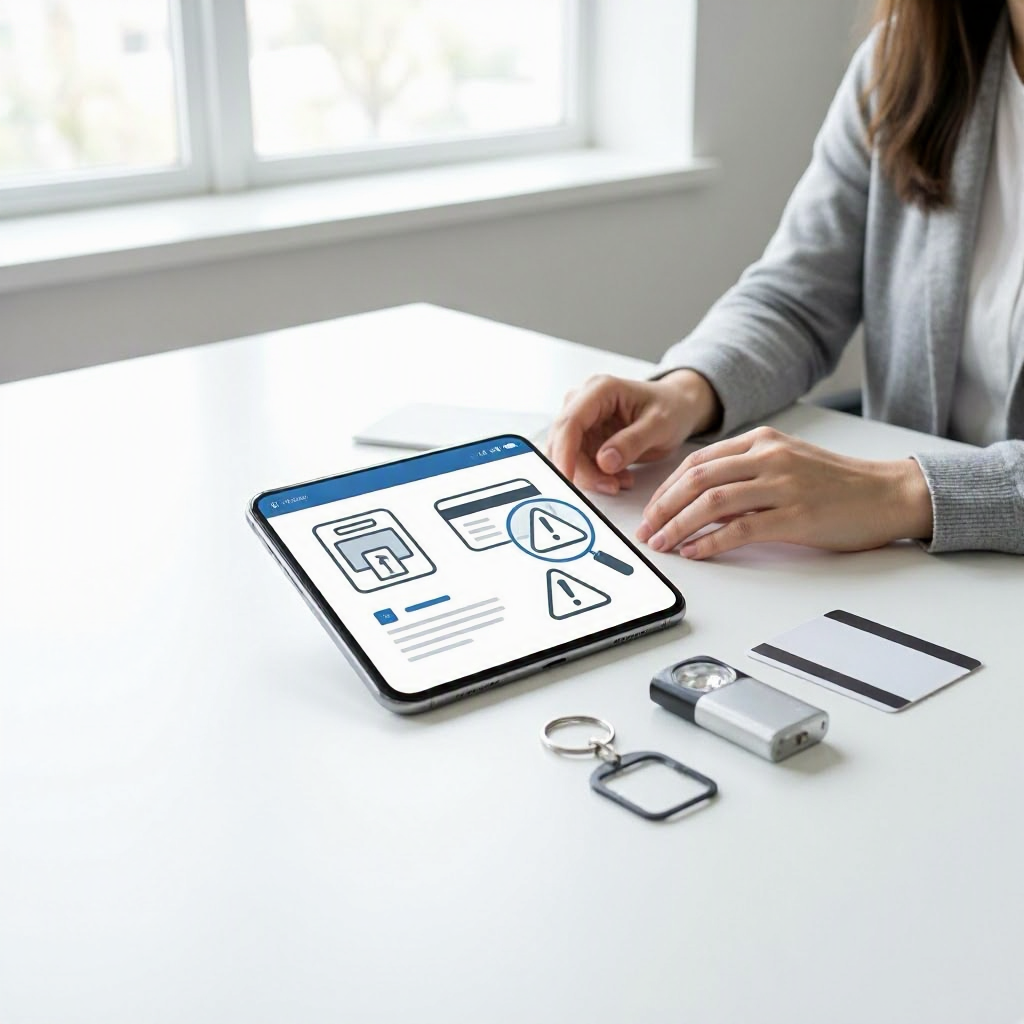
ATM Skimming Scam: How to Spot It and What to Do
An ATM can complete a normal withdrawal while a second, hidden system records the card and PIN. That is what makes skimming difficult to notice at the moment it happens. The fraudulent withdrawal may occur later, in another place, after the criminal copies the captured data to another card or uses the credentials in a different scheme.
Physical inspection helps, but no visual check can guarantee that a terminal is safe. The strongest protection combines a brief terminal check, protected PIN entry, account alerts, and a fast response to unfamiliar activity.
What a skimming setup collects
A skimmer reads data from a card’s magnetic stripe. It may sit over or inside a card slot, attach along exposed cables, or be installed within a compromised terminal. The PIN can be captured by a tiny camera aimed at the keypad or by a false keypad layer that records presses.
The FBI’s skimming overview explains that devices also target point-of-sale terminals and fuel pumps. Some store captured information for later retrieval; others transmit it wirelessly.
A transaction that succeeds does not prove the reader was clean. Conversely, a loose component is not something to test further. Move away from the terminal and report it to the owner or bank without handling a suspected device.
Inspect the ATM before inserting a card
Choose a machine in a well-lit, monitored location, preferably at a bank branch. Compare the card slot and keypad with nearby machines of the same model. Look for parts that are crooked, unusually thick, differently colored, scratched, loose, or blocking normal graphics.
Gently check the edges of the card reader and keypad for movement; do not pry or remove anything. Look above and beside the keypad for small openings or objects positioned like a camera. Be alert when a stranger offers help, asks you to re-enter a PIN, or crowds the machine.
Cancel the transaction if the card does not enter smoothly, the screen behaves unexpectedly, or the machine retains the card. Contact the bank using a number from its official app, website, or the back of another card—not a sticker newly placed on the ATM.
Reduce what a hidden device can capture
Cover the keypad fully with the other hand while entering the PIN. This blocks many camera angles even when the reader itself is compromised. Do not speak the PIN or store it with the card.
Use contactless access when the bank and ATM support it and you have verified the official wallet or banking method. At fuel pumps, the FBI recommends choosing pumps close to the attendant, using tap when available, running a debit card as credit when possible, or paying inside.
Set real-time withdrawal and purchase alerts. Low alert thresholds shorten the time between fraud and discovery. Review account activity independently after travel or use of an unfamiliar terminal.
The FBI puts the cost of skimming to consumers and financial institutions at more than $1 billion a year. Its tips for card users:
- Use a fuel pump close to the store and in view of an attendant, or pay inside
- Cover the keypad when you enter a PIN
- Tap to pay when the card and the terminal allow it
- Avoid a card reader that looks loose, damaged or unusual
- Prefer a chip card, and consider a credit card over a debit card linked to your accounts
- Turn on account alerts
Respond immediately to an unauthorized withdrawal
Lock or freeze the card through the official banking app if that feature is available, then call the bank. Report the specific withdrawal, state that you still possess the card if true, and ask for the card to be replaced and the PIN changed. Obtain a case number.
Write down the amount, posting date, ATM location, terminal identifier, and your last legitimate use. Preserve receipts, alerts, travel records, and any photograph of the suspicious terminal. Do not return alone to confront anyone or retrieve a device.
Federal protections and deadlines differ between credit and debit transactions. The FTC’s guide to lost, stolen, ATM, and debit cards emphasizes prompt reporting and explains that potential liability can depend on how quickly an electronic-transfer problem is reported. Follow the bank’s written-error procedure and review provisional-credit communications carefully.
The same FTC guide sets out how much of a debit or ATM card loss can fall on you when the card itself was lost or stolen:
| When you report | Most you can lose |
|---|---|
| Before anyone uses the card | $0 |
| Within 2 business days of learning of the loss or theft | $50 |
| After 2 business days, but within 60 calendar days of the statement being sent | $500 |
| More than 60 calendar days after the statement was sent | Everything taken, and possibly more |
If only the card number was copied and you still hold the card, which is the usual result of skimming, the FTC says you are not responsible for transactions you did not authorize as long as you report them within 60 calendar days after the statement is sent. Once you report, Regulation E gives the bank 10 business days to decide whether an error occurred.
Report the terminal and protect connected accounts
Notify the ATM owner and, if different, your own financial institution. A credible report should identify the machine and time without publicly posting a full card number or bank statement. The FBI directs skimming reports to IC3; local police may also be appropriate when money was taken or a physical device is visible.
If the incident involved an EBT card, contact the state benefits agency immediately because replacement and reimbursement rules differ by program and state. Change the PIN before the next benefit deposit when instructed and review the full transaction history.
Skimming alone does not usually expose every online-account password, but a fake support follow-up might. Ignore callers who know transaction details yet request a one-time code or ask you to move money to a “safe” account.
Related guides: debit card fraud: what to do if money is missing and credit card fraud: first steps.
Improve future withdrawal security
Use familiar bank-operated ATMs, avoid isolated standalone machines, and inspect the terminal each time. Keep separate cards or lower limits for cash access when that fits your banking needs. Turn off international or ATM access temporarily if the issuer offers those controls and you do not need them.
The practical objective is not to become an expert at spotting electronics. It is to make capture harder, detect misuse quickly, and give the bank a clear report while recovery options are still open.
This article is general consumer information and not legal advice.
Sources:
- Skimming, Federal Bureau of Investigation
- Lost or Stolen Credit, ATM, and Debit Cards, FTC Consumer Advice
- Regulation E, section 1005.11: Procedures for resolving errors, CFPB
- Internet Crime Complaint Center (IC3), Federal Bureau of Investigation

Written by TheDigitalLife Editorial Team
Edited by R. K. Tiwari
Owner & Editor
R. K. Tiwari is the owner and editor of TheDigitalLife. He checks each guide against official U.S. sources before it is published.
About the editor and our editorial standards