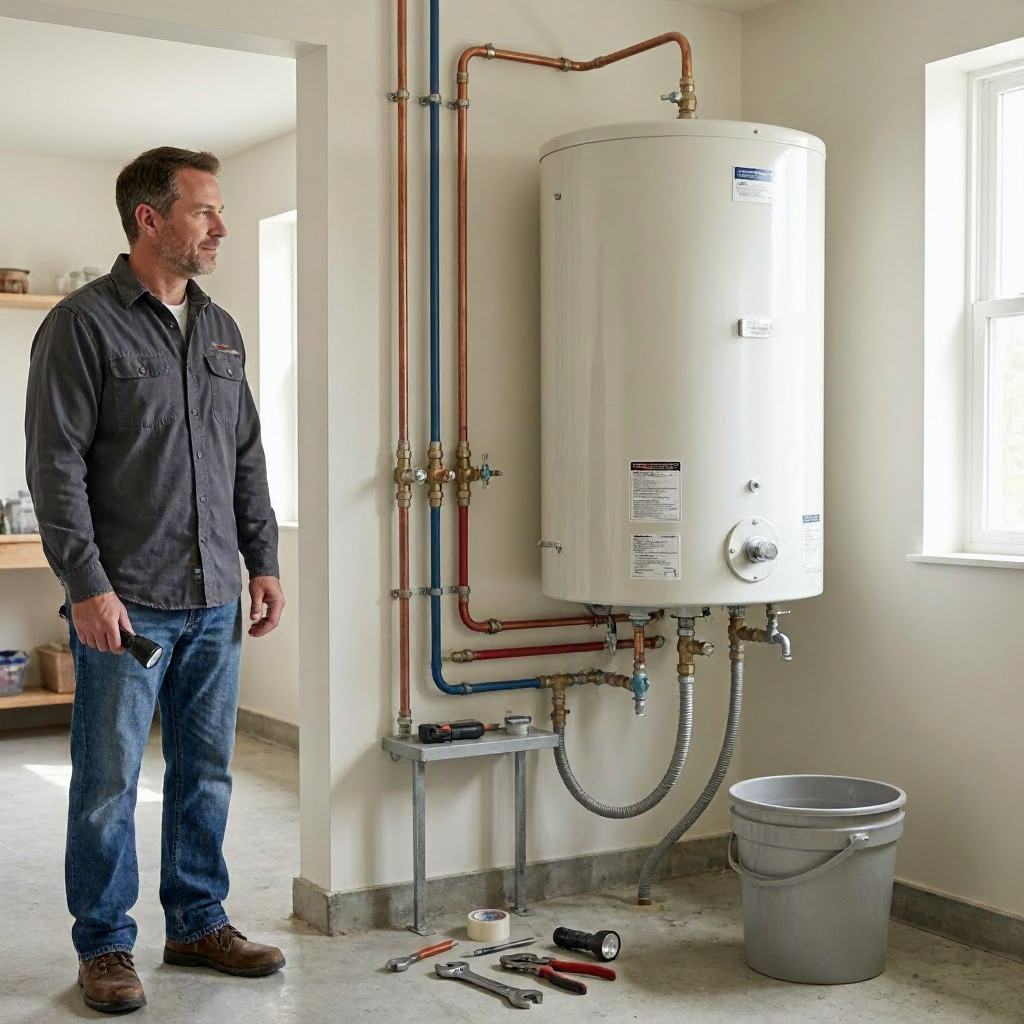
Water Heater Repair Cost: When to Fix and When to Replace
When a water heater stops making hot water, leaks, or starts to make noise, the question is not only what is wrong but whether it is worth fixing. Some repairs are small and sensible. Others are a poor use of money on a tank that is near the end of its life. This guide covers the common failures, safety limits you should never skip, and a simple method to decide between repair and replacement.
What water heating costs you
The Department of Energy says water heating accounts for about 18 percent of home energy use, typically the second-largest energy expense after heating and cooling. That share is why an inefficient or failing heater matters even when it still works, and why upgrading can pay back over time. See our guide to heat pump water heater installation and incentives if you are considering a more efficient replacement.
Safety first: scalds, leaks and gas
Three things should never wait.
- Active leaks from the tank. A tank that is leaking from the body cannot be repaired. Shut off the cold water supply to the heater, turn off the power or gas, and call a plumber. Leaks at fittings or the relief valve are a different matter and may be repairable.
- Gas smell or a flame that looks wrong. Leave the house and call the gas utility or emergency number from outside. Do not light or relight a gas heater if you smell gas.
- Hot water that is too hot. The Consumer Product Safety Commission's tap water scald fact sheet says adults can suffer third-degree burns in about 2 seconds at 150°F, about 6 seconds at 140°F and about 30 seconds at 130°F. At 120°F, burns are possible after about 5 minutes. It names children under five and older adults as most at risk and recommends 120°F, or the lowest setting that meets your needs. To check the temperature, use a thermometer at the tap, and for gas heaters the CPSC says to test first thing in the morning or at least two hours after water use.
Never remove, cap or block the temperature-and-pressure relief valve. It is a safety device. If it drips or discharges repeatedly, call a plumber.
Common failures and what they usually mean
No hot water on an electric heater. Possible causes include a tripped breaker, a failed heating element or a bad thermostat. Elements and thermostats are repairable parts, but they involve live voltage, so many homeowners hire an electrician or plumber.
Not enough hot water. One failed element in a two-element tank, sediment in the tank, a broken dip tube or a thermostat set too low can all reduce capacity.
Gas heater will not stay lit. A thermocouple, flame sensor, pilot assembly or gas control valve may be failing. Gas work calls for a licensed professional.
Rumbling or popping. This is often sediment on the bottom of the tank. Flushing may help, but ask a pro before aggressively flushing an old tank, because disturbing sediment can expose leaks.
Rusty or discolored hot water. If it appears only from the hot tap, the tank or the anode rod may be deteriorating. Rust from both hot and cold taps points to the pipes.
Water around the base. Check connections, the relief valve discharge pipe, the drain valve and condensation. A leak from the tank itself means replacement.
Rotten-egg odor. Often related to bacteria reacting in the tank, particularly with well water. A plumber can recommend treatment, including anode changes.
Repair or replace: a decision method
No single rule fits every case, so use a simple comparison:
- Find the age. The serial number on the label normally encodes the manufacture date. The manufacturer can decode it for you.
- Get the repair quote in writing, including parts and labor.
- Get a replacement quote in writing that includes the new unit, removal of the old one, venting or code upgrades, permit and disposal.
- Compare the repair cost with the replacement cost. A common rule of thumb is to lean toward replacing when a repair costs a large share of a new installation and the heater is already old. This is a rule of thumb, not a standard, so use it as a prompt, not a decision.
- Add the energy factor. A newer, more efficient unit can lower running costs, and a heater that wastes energy raises them every month.
- Consider reliability. If this is the second repair in a short time on an aging tank, replacement is likely the better value.
Repairs make the most sense when the unit is relatively young, the failure is a single replaceable part such as an element, thermostat, thermocouple or valve, and the tank is not leaking.
What affects the cost
- The failed part. Thermostats, elements and valves cost differently, and gas controls are generally more expensive than simple valves.
- Fuel type. Electric, natural gas, propane and heat pump models need different technicians and parts.
- Access and location. An attic or tight closet adds labor time.
- Code upgrades. Replacing a heater may require expansion tanks, venting changes, drain pans or seismic straps, depending on local rules.
- Labor. Hourly rates vary by area. The BLS plumbers outlook gives national pay data.
- Emergency timing. After-hours calls can cost more.
- Permits. Replacement can require a permit; see our guide to home repair permit costs.
An illustrative water heater repair estimate
These numbers are examples. A 12-year-old electric tank loses hot water because of a failed lower element. Repair: $30 for the part and 1 hour of labor at $120, so $150. A replacement quote comes to $1,500 installed. At 10 percent of the cost, the repair looks sensible, but the tank is old and the plumber notices rust at the base. Ask whether the tank shows signs of leaking or corrosion, and how long the repair is likely to hold. If the plumber says the tank is sound, repair; if not, spend toward replacement. Ask for the reasoning in writing.
Maintenance that avoids repairs
- Set the thermostat to 120°F unless a medical or equipment need requires otherwise.
- Test the relief valve according to the manufacturer's instructions.
- Look at the tank and connections every few months for moisture or rust.
- Keep the area around a gas heater clear and make sure combustion air and venting are unobstructed.
Sources: US DOE: Water heating; CPSC: Tap water scalds; BLS: Plumbers, pipefitters and steamfitters.

Written by TheDigitalLife Editorial Team
Edited by R. K. Tiwari
Owner & Editor
R. K. Tiwari is the owner and editor of TheDigitalLife. He checks each guide against official U.S. sources before it is published.
About the editor and our editorial standards