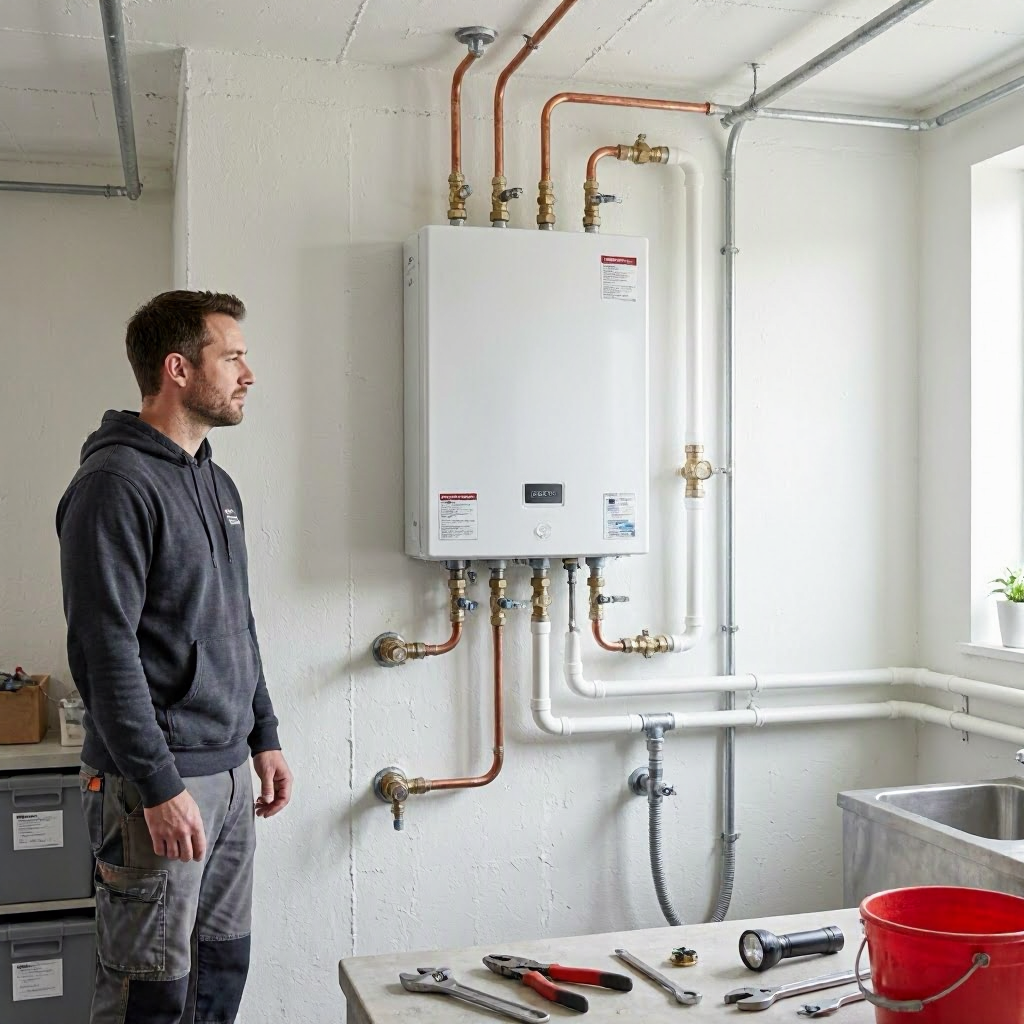
Tankless Water Heater Installation Cost: Is It Worth It?
Considering a switch to a tankless water heater can be a smart move for your home's energy efficiency and your utility bills. These units heat water on demand, which can eliminate the standby energy loss of a traditional tank. However, the decision isn't just about the unit's price tag.
The true cost hinges on your home’s existing setup and local codes. This guide will walk you through the installation costs, who to contact, and the steps to protect your investment and warranty. Our goal is to help you make an informed decision without overpaying.
Tankless water heaters can reduce energy use by heating water only when needed, but installation costs are often much higher than a simple tank replacement. The final price depends on your fuel type, needed flow rate, required venting, gas line capacity, electrical upgrades, and local permit rules. Always start by contacting a licensed local plumber experienced with tankless systems.
Additional reference details:
- Item: Typical cost , Detail: $1,400 to $3,900 for installation, with labor from $600 to $1,900.
- Item: Best first contact , Detail: A licensed local plumber experienced with tankless systems.
- Item: Main safety warning , Detail: Stop using the unit and call a licensed pro or emergency service if you smell gas, have active flooding, smell electrical burning, or see hot TPR discharge.
- Item: Warranty proof needed , Detail: Receipt, serial/model number, install date, installer invoice, photos, and permit/inspection record.
- Item: When to call a pro , Detail: For all gas connections, venting, electrical upgrades, complex installations, and warranty-related service.
Who should I call first
- Who should I call first? A licensed plumber is your best first contact for installation, service, and diagnosis.
- What will it cost? Expect a wide range from $1,400 to $3,900, heavily influenced by required upgrades to gas lines, venting, or electrical panels.
- What proof is needed for warranty? Keep your receipt, installer invoice, photos of the rating plate, and any permit or inspection records.
- Which state or local office should I check? Contact your state's licensing board for plumbers and your local city/county building department.
- What are the warning signs? An installer without a license, pressure for full payment upfront, or a quote that excludes permits or haul-away.
- When should I avoid DIY? Avoid DIY for all gas work, major electrical upgrades, and any installation where you want to preserve the manufacturer's warranty.
Additional reference details:
- Item: Main customer question , Details: What will this cost, who should I call, and how do I avoid overpaying or losing warranty?
- Item: Best first contact , Details: Licensed local plumber; brand support if under warranty; retailer if purchase or delivery issue.
- Item: Estimated cost range , Details: $1,400-$3,900 typical range for tankless installation.
- Item: Labor charges , Details: $600-$1,900 for labor; $150-$2,500 for a tank-to-tankless conversion.
- Item: Installation contact , Details: Licensed plumber, licensed gas contractor, or licensed electrician (for electrical upgrades).
- Item: Official brand contacts , Details: Rheem, A. O. Smith, Bradford White, Rinnai, Navien, Noritz, Takagi, State Water Heaters.
- Item: Retailer contacts , Details: Home Depot: 1-800-466-3337. Lowe's Installation: 1-877-465-6937.
- Item: Warranty documents needed , Details: Receipt, serial/model number, install date, installer invoice, photos, permit/inspection record.
- Item: State agency to check , Details: Your state's plumbing licensing board and local city/county building department.
- Item: Safety warning , Details: For gas smell, active flooding, electrical burning smell, or hot TPR discharge: stop use and call a pro/emergency service.
- Item: Important URLs , Details: Manufacturer support pages, state license lookup tools, local building department websites.
Call a Pro If: You smell gas, see active flooding, or smell electrical burning. Stop using the heater immediately and call a licensed professional or emergency service.
The national planning range for a complete tankless water heater installation is $1,400 to $3,900. A whole-house gas tankless unit often costs more than a simple point-of-use electric model. The price is highly variable and depends on your specific home.
Here are the key cost components:
- Tank to Tankless Conversion Labor: $150 to $2,500. This wide range exists because converting from a tank system may require changes to gas lines, venting, electrical systems, and water piping.
- Tankless Labor Only: $600 to $1,900 for the basic installation labor, not including necessary upgrades.
- Descaling/Maintenance: $150 to $250 for a typical tankless flush or descale. Homes in hard-water areas may need this service more frequently.
- Gas Line/Venting Upgrade: This is often the reason quotes increase significantly. A licensed professional must assess and quote this separately.
- Electrical Tankless Upgrade: High-amperage electric tankless units can require new circuits or panel work, necessitating a call to a licensed electrician.
Average Cost: The typical installed cost for a tankless water heater is between $1,400 and $3,900, but local quotes will vary.
These are national estimates. Your final cost will be shaped by your city, local codes, fuel type, permit rules, water pressure, and the timing of the job. Always get a detailed, written quote.
While a knowledgeable homeowner might handle minor maintenance like flushing with a dedicated kit, most tankless installation and repair work should be left to professionals.
When DIY May Be Possible:
- Performing routine descaling if you follow the manufacturer's manual precisely and have the proper pump and hoses.
- Simple troubleshooting using the unit’s error code display (with the manual in hand).
When to Call a Licensed Professional:
- Any work involving natural gas or propane connections, venting, or combustion air.
- Upgrading electrical circuits or the main service panel for an electric tankless unit.
- The initial installation, especially if you want to preserve the full manufacturer’s warranty.
- Any diagnosis for a potential warranty claim; manufacturers often require a professional's report.
The risks of DIY are high. Improper gas work can lead to carbon monoxide poisoning or fire. Incorrect electrical work can cause shock or fire. Perhaps most importantly, a DIY installation often voids the manufacturer's warranty, leaving you fully responsible for any future repairs or replacements.
Knowing who to call saves time and money. Match your situation to the right expert.
- For installation, leaks, or general service: Contact a licensed plumber experienced with tankless sizing and local codes.
- For gas line sizing and venting: Contact a licensed gas contractor or plumber.
- For electrical upgrades for an electric tankless or heat pump unit: Contact a licensed electrician.
- For warranty-sensitive diagnostics: Contact a brand-authorized service provider.
- For product returns, delivery, or store-installation issues: Contact the retailer (e.g., Home Depot or Lowe's).
- For warranty registration or parts support: Contact the manufacturer directly after gathering your model and serial numbers.
Warranty Documents Needed: Always keep your purchase receipt, installation invoice, a photo of the serial/model number plate, and any permit or inspection records.
Use this table to reach the correct support channel. Always verify contact details on official websites before calling.
| Brand / Route | Phone / Contact | Official Website | Use This For |
|---|---|---|---|
| Home Depot | 1-800-466-3337 | homedepot.com/customer-service | Product return, order issue, store installation, receipt, or delivery issue. |
| Lowe's | Installation: 1-877-465-6937 Customer Care: 1-800-445-6937 | lowes.com/l/help | Installation scheduling, product order, delivery, store issue, warranty paperwork. |
| Rheem | 1-800-432-8373 | rheem.com/warranties | Warranty registration, verification, parts, model/serial support. |
| A. O. Smith | 877-552-0010 (common support) | hotwater.com/support | Warranty status, product manuals, repair service locator. |
| Bradford White | Tech (Pros): 800-334-3393 Warranty: 800-531-2111 | bradfordwhite.com/contact | Warranty questions, pro technical support. Consumers should start with a plumber. |
| Rinnai | 800-621-9419 | rinnai.us/support/warranty | Tankless product warranty and service process. |
| Navien | 800-519-8794 (option 2) | navieninc.com/support | Tankless/boiler technical support and warranty. |
| Noritz | 1-866-766-7489 | noritz.com/contact-us | Tankless technical support and warranty registration. |
| Takagi | 888-882-5244 | takagi.com/support | Tankless technical support, parts, and warranty help. |
| State Water Heaters | 877-552-0010 | statewaterheaters.com/support | Product support, documents, warranty verification. |
Follow these steps to navigate a warranty or refund claim efficiently.
- Stop and Assess: If there is an immediate danger (gas smell, flooding, electrical smell), stop using the unit and call a licensed professional or emergency service first.
- Gather Your Documents: Collect your purchase receipt, installation invoice, serial number, model number, installation date, photos of the rating plate, photos/videos of the problem, and the permit/inspection record if applicable.
- Contact the Correct Party: Start with the seller (retailer, installer) for return or delivery problems. For product defects, contact the manufacturer.
- Get a Professional Diagnosis: Many manufacturers require a written diagnosis from a licensed plumber or authorized technician before approving warranty parts.
- Submit Your Claim: Provide all your gathered documentation to the warranty department. Be prepared to answer questions about maintenance, like descaling records.
- If Denied: If the claim is denied, request the reason in writing. Common denials are due to improper installation, lack of maintenance, freeze damage, or unauthorized modifications.
State-Specific or Local Checks
Water heater work is regulated by state and local rules. A legal quote in one city may be non-compliant in another. Always verify locally before hiring.
| State / Area | What to Do Before Hiring | Agency or Office to Check |
|---|---|---|
| California | Verify contractor through CSLB; ask for a C-36 plumbing license. | CSLB license lookup and local building department. |
| Texas | Verify plumber through Texas State Board of Plumbing Examiners. | TSBPE and local building department. |
| Florida | Check DBPR/CILB licensing; confirm local water heater permit. | Florida DBPR and local building department. |
| New York City | Work usually needs a Licensed Master Plumber to file for permits. | NYC Department of Buildings. |
| Illinois | Use IDPH plumbing licensing resources; confirm local permits. | Illinois Department of Public Health and local building department. |
| Washington | Verify plumbing contractor through L&I. | Washington L&I Verify tool and local building department. |
| Massachusetts | Check the Board of State Examiners of Plumbers and Gas Fitters. | Mass.gov license check and local inspector. |
| New Jersey | Verify master plumber through NJ Consumer Affairs. | NJ State Board of Examiners of Master Plumbers. |
| Georgia | Verify through Georgia Secretary of State licensing resources. | Georgia SOS Professional Licensing and city/county permitting. |
| All Other States | Verify the plumber's state license and call your local permit office. | State licensing board + local building department. |
Do Not Ignore: Always call your city or county building department to ask if a permit and inspection are required for water heater work.
Protect yourself by asking these questions before you approve any quote or pay a deposit.
- What exact model and capacity are you installing?
- Is this a repair, replacement, warranty job, or code upgrade?
- What labor rate, service fee, permit fee, and disposal fee are included?
- Will the work be performed by a licensed plumber or authorized installer?
- What happens if the city inspector requires additional work?
- What parts and labor warranty do you provide in writing?
- Who do I contact if the new heater fails within 30 days?
These warning signs should make you stop and reconsider the contractor.
- No license number, no business address, or refusal to say who will pull the permit.
- Pressure to pay the full amount before work starts.
- The quote does not include the model, size, labor, permit, old-unit haul-away, or required code upgrades (like an expansion tank or drain pan).
- The installer says permits are "never needed" without checking your city/county rules.
- Advice to remove a faulty unit before taking photos or recording the model/serial number for a warranty claim.
- For gas units, the installer ignores questions about proper venting, combustion air, gas line sizing, or carbon monoxide safety.
Practical Step-by-Step Guidance
Follow this sequence for a smooth, compliant installation.
- Get Multiple Quotes: For non-emergency work, get at least three written quotes from licensed plumbers.
- Verify and Compare: Check each contractor's state license and call your local building department about permit requirements. Compare the scope, equipment model, and warranty-not just the lowest price.
- Ask Key Questions: Use the question list above during your quote comparisons.
- Secure the Job: Once you select a contractor, ensure the written contract includes all agreed-upon details: model, labor, fees, permit responsibility, and warranty paperwork.
- Document Everything: Upon completion, get the installer's invoice showing the installation date. Take photos of the installed unit and its serial number plate. Keep a copy of the passed inspection report if applicable.
- Register and Maintain: Register the warranty with the manufacturer. Schedule and document annual maintenance, like descaling, as recommended.
Frequently Asked Questions
Should I call a plumber, electrician, or the brand first? Call a licensed plumber first for leaks, replacement, gas connections, or general service. Call an electrician only for clear electrical issues like breaker problems. Call the brand only after you have your model number, serial number, and a plumber's diagnosis.
Can I claim warranty if I installed the heater myself? Maybe, but warranty claims can be denied or limited if installation did not follow the manufacturer's manual and local codes. If you DIY, keep meticulous records: invoice, serial number photo, installation photos, and any permit record.
Can a big-box store handle the installation? Home Depot and Lowe's may coordinate installation through independent installers. You must still confirm the installer's licensing, who pulls the permit, what is included, and the warranty paperwork before approving the job.
Should I get three quotes? Yes, for non-emergency work. Compare the full scope, license, permit responsibility, equipment model, and warranty-not just the bottom-line number.
What is the most common reason for high installation costs? The need to upgrade gas lines or venting for a gas tankless unit is often the main factor that increases a quote beyond the base equipment and labor cost.
This article uses publicly available cost guides, official manufacturer support pages, retailer information, and state/local licensing resources. Key sources include:
- HomeAdvisor and Angi cost guides for water heater installation and repair.
- Energy.gov guides on selecting and maintaining water heaters.
- Official support and warranty pages for Rheem, A. O. Smith, Bradford White, Rinnai, Navien, Noritz, Takagi, and State Water Heaters.
- Contact pages for Home Depot and Lowe's.
- Official state licensing board websites for California, Texas, Florida, New York City, Illinois, Washington, Massachusetts, New Jersey, and Georgia.
Final Reminder: Always re-check current prices, local codes, brand warranty terms, and official contact information before proceeding. Rules and contacts can change.
This guide provides planning information based on public sources. Costs, codes, and contacts vary by location and change over time. For your specific project, you must verify details with licensed professionals, official brand support, your retailer, your state licensing board, and your local city or county building department. Use this information to ask informed questions and make confident decisions for your home.

About the TDL Expert Panel
TDL Expert Panel · TheDigitalLife Editorial Team
TDL Expert Panel is the editorial team behind TheDigitalLife. The team researches, reviews, and creates practical guides to help everyday readers make better decisions about home repair costs, refunds, AI tools, digital safety, productivity, and useful online resources. Each guide is written to be clear, useful, and easy to understand.