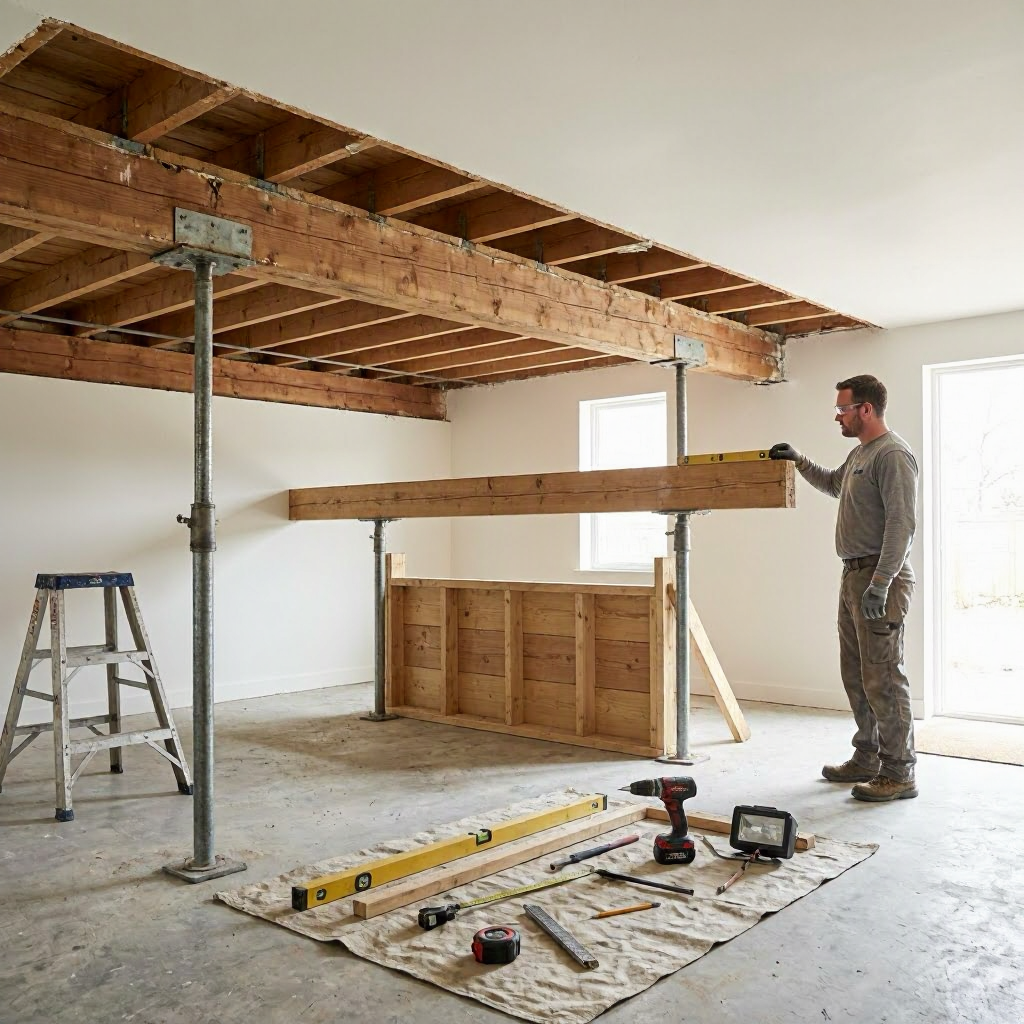
Structural Beam Replacement Cost
Facing a sagging floor, a cracked beam, or a remodel that involves removing a wall can be daunting. The immediate question is often about cost, but the process involves much more. This guide is designed to help you, the homeowner, understand the full scope of replacing a structural beam.
You’ll learn what professionals are involved, how to plan for costs, and the critical steps for permits and inspections. Our goal is to help you navigate this significant repair with confidence and ensure your home remains safe and sound.
Replacing a structural beam typically costs between $1,500 and $10,000 or more. The final price depends heavily on the beam type, the span it must cover, access to the area, and the need for temporary supports, engineering, and finish repairs. You will need to involve several professionals, starting with a structural engineer for any work involving a load-bearing element.
| Item | Detail |
|---|---|
| Typical cost | $1,500 - $10,000+ |
| Best first contact | Structural Engineer |
| Main safety warning | Never remove or cut a structural beam without temporary support and an engineer-approved plan. |
| Warranty proof needed | Invoices, receipts, warranty docs, permits, inspection records |
| When to call a licensed professional | For any structural work, load-bearing wall changes, or beam replacement |
Who to call first: A licensed structural engineer is t
- Who to call first: A licensed structural engineer is the best first step for evaluation and plans.
- What it will cost: Plan for a wide range, influenced by materials (LVL or steel), labor for multiple trades, and finish work.
- What proof is needed for warranty: Keep all invoices, product receipts, contracts, and permit/inspection records.
- Which office to check: Your local city or county building department for permit requirements.
- Warning signs: A contractor who discourages an engineer, avoids permit talk, or demands full payment upfront.
- When to avoid DIY: Cosmetic work may be DIY, but structural beam replacement is not a DIY project.
| Field | Recommended Detail |
|---|---|
| Main customer question | Price, labor, contacts, warranty steps for Structural Beam Replacement Cost. |
| Best first contact | Structural Engineer |
| Estimated cost range | $1,500 - $10,000+ |
| Labor charges | Structural engineer, general contractor, carpenter/steel fabricator, and other trades if needed. |
| Warranty claim documents | Invoices, product receipts, warranty documents, installation contract, permits, inspection records. |
| State/local agency to check | City/county building department and state contractor license board (e.g., CSLB for CA, DBPR for FL). |
| Safety warning | Do not remove or cut a structural beam without temporary support and an engineer-approved replacement. |
| Important URLs | California CSLB: cslb.ca.gov Florida DBPR: myfloridalicense.com NYC DOB: nyc.gov |
Main Cost Range: $1,500 - $10,000+ depending on beam type, span, access, temporary support, engineering, and finish repairs.
The total cost to replace a structural beam is a sum of many parts. It’s not just the beam itself. A realistic planning range is $1,500 to $10,000 or more. A detailed quote should break down each of these line items.
Here’s what to expect for each major component of the job:
Additional reference details:
- Line Item: Engineer Visit/Report , Typical Planning Range / Note: $350 - $800
- Line Item: LVL Beam Replacement , Typical Planning Range / Note: $1,500 - $6,000+
- Line Item: Steel Beam Install , Typical Planning Range / Note: $2,500 - $10,000+
- Line Item: Temporary Support/Demolition , Typical Planning Range / Note: $500 - $3,000+
- Line Item: Finish/Trade Repairs , Typical Planning Range / Note: $1,000 - $10,000+
Labor involves multiple professionals: a structural engineer for the plan, a general contractor to coordinate, a carpenter or steel fabricator for the beam install, and potentially electricians, plumbers, or HVAC technicians if their systems are in the way.
The exact quote changes based on your location, the difficulty of access, the material chosen, the severity of damage, whether it’s an emergency, disposal costs, permit fees, and any hidden damage found once work begins. A low quote may be missing critical items like permits or disposal. A high quote can be reasonable for difficult multi-story access, premium materials, or included warranties.
This is a critical distinction for your home’s safety and your financial protection.
DIY is not recommended for structural beam replacement. The risks are far too high. Incorrect work can cause settlement, sagging floors, or even partial collapse. It will almost certainly fail inspection, creating problems when you sell your home. Cosmetic maintenance, like painting, may be a DIY task, but the structural work itself is not.
Hiring a licensed professional is essential. A qualified team ensures the work meets building codes, passes inspections, and is covered by appropriate warranties and insurance. They have the skills to install temporary supports safely and handle unforeseen issues. The complexity of coordinating an engineer, permits, multiple trades, and finish work makes this a job for experienced pros.
DIY Is Usually Safe Only If: You are performing cosmetic maintenance, like painting. The structural work itself requires a licensed professional.
Knowing who to call first saves time and prevents mistakes. Your first contact depends on your situation.
- Structural Engineer: This is your best first call if you suspect a structural issue or are planning to remove a wall. They provide the stamped drawings or written letter required for permits. Never proceed without their approval for beam work.
- Licensed General Contractor: They coordinate the entire project-demolition, temporary supports, beam installation, trades, permits, inspections, and finish work like drywall and painting.
- Architect/Designer: Useful if the beam replacement is part of a larger remodel that changes the room’s layout, egress, or ceiling design.
- City/County Building Department: Contact them to confirm permit and inspection requirements before any demolition begins.
- Insurance Carrier: Call first if the damage is sudden and from a covered event like a storm, fallen tree, fire, or vehicle impact. Do not authorize permanent repairs until you speak with them, if it is safe to wait.
For verifying licenses and understanding local rules, use these official resources. Always search for professionals by their trade and license type, not just by company name.
- California Contractor License Check: Verify licenses through the Contractors State License Board (CSLB) at cslb.ca.gov.
- Florida License Search: Use the Department of Business and Professional Regulation (DBPR) at myfloridalicense.com.
- New York City (NYC) Permits: For structural changes, check the Department of Buildings (DOB) site: nyc.gov. Plans may need submission via DOB NOW.
Proper documentation is the key to a successful warranty or insurance claim. Follow these steps to protect yourself.
- Document Everything Immediately: Take clear, date-stamped photos and video of the damaged area before anything is disturbed. Get both wide shots and close-ups.
- Collect All Paperwork: Gather invoices, product receipts, warranty documents, the installation contract, permits, inspection records, and any prior maintenance records.
- Contact the Correct Party:
- - For sudden damage (storm, tree, fire), call your homeowners insurance carrier before permanent repairs, if safe.
- - For product defects, contact the manufacturer or retailer named on your paperwork. Ask for their claim form and required proof.
- - For workmanship problems, notify the installing contractor in writing. Request a written plan to fix the issue.
- Report Unsafe or Unlicensed Work: For permit problems or suspected unlicensed contracting, contact your local building department and state contractor board.
- Ask Detailed Warranty Questions: For structural work, ask if the warranty is transferable, if annual service is required, what is excluded (like drainage issues), and what fees apply for future service calls.
Warranty Documents Needed: Invoices, product receipts, warranty documents, installation contract, permits, and inspection records.
State-Specific or Local Checks
Building rules vary. Use this as a starting checklist, but always verify with your local authorities before signing a contract.
- California: Verify the contractor’s license through the CSLB. Foundation, structural, and seismic work often require permits and engineered plans.
- Florida: Use the DBPR to verify contractors. Coastal, flood-zone, and wind-load issues can affect permit and repair requirements.
- Texas: Foundation repair licensing is mostly local. Ask for engineer involvement, city permits, and details on transferable warranties.
- New York / NYC: Structural changes commonly need DOB filing and permits. A Professional Engineer or Registered Architect may need to submit plans.
- Expansive-Clay States: In TX, CO, OK, KS, and parts of the Midwest, ask how the contractor will address soil moisture, drainage, and tree roots before work begins.
Asking the right questions separates qualified professionals from risky operators. Get answers to these in writing.
- Did a licensed structural engineer review the scope? Is a written engineering letter or stamped drawing included?
- How will change orders be priced if hidden damage is found?
- Who is responsible for pulling and paying for permits?
- What is included in the warranty? Is it transferable? Are there annual fees or common exclusions?
- What is the detailed payment schedule? Is a traceable payment method acceptable?
- Can you provide proof of license, insurance, and workers’ compensation?
- Do you have recent local references for similar structural work?
Watch for these warning signs when speaking with contractors. Any one is a reason to pause and reconsider.
- The "One-Call Miracle": A contractor recommends an expensive solution (like piers) without discussing drainage, soil, or engineer review.
- No Permit Discussion: The contractor avoids or dismisses the need for permits for structural or excavation work.
- Vague or "Lifetime" Warranty: The warranty sounds good but is not transferable, has service fees, or excludes movement caused by drainage or soil.
- Incomplete Quote: The written quote lacks specifics like beam size, material brand, pier count, or engineering assumptions.
- Discourages an Engineer: The contractor tries to talk you out of hiring a structural engineer.
- Full Payment Upfront: The contractor demands full payment before work begins. A reasonable deposit is normal; paying everything upfront is risky.
Practical Step-by-Step Guidance
Follow this sequence to manage your beam replacement project safely and effectively.
- Assess and Document: Identify the problem (sagging, cracks, water damage). Take extensive photos and videos.
- Call a Structural Engineer: This is your first professional call for an evaluation and plans.
- Verify Local Requirements: Contact your city/county building department to understand permit needs for the engineer’s plan.
- Get Multiple Quotes: For any non-emergency job over $1,000, get at least two or three written quotes from licensed contractors. Ensure they are bidding on the same scope.
- Check Licenses and References: Verify each contractor’s license with your state board and ask for local references.
- Review and Sign a Detailed Contract: The contract should include scope, materials, labor, permits, disposal, warranty, timeline, payment schedule, and a process for hidden damage.
- Manage Payments Wisely: Pay by a traceable method. Avoid full upfront payment. Make the final payment only after passing inspection, cleanup is done, and you have all warranty documents.
- Keep a Project File: Maintain all documents-contract, permits, inspection sign-offs, invoices, and warranty info-for future reference or resale.
Call a Pro If: You see active leaks, electrical/fire hazards, bowing walls, major structural movement, or unsafe conditions.
Frequently Asked Questions
Should I get more than one quote? Yes. For any non-emergency structural work, get at least two or three written quotes. Ensure each quote is based on the same scope, materials, and permit assumptions for a fair comparison.
Should I pay the full amount upfront? No. A reasonable deposit is common, but paying the full amount before work starts is a major risk. Use a traceable payment method and follow the payment schedule in your contract. Final payment should come after successful inspection and cleanup.
Can a home warranty cover this? Maybe, but home warranty contracts have many exclusions and specific pre-approval rules. You must call your warranty company before any non-emergency work begins if you hope for reimbursement.
Can insurance cover this? Insurance is most relevant for sudden and accidental damage like from a storm, hail, falling tree, burst pipe, or fire. Normal wear and tear, poor maintenance, and gradual water seepage are typically excluded.
What should be in the written quote? A proper quote includes: scope of work, materials list, labor breakdown, permit responsibilities, disposal, warranty terms, project timeline, exclusions, hidden-damage pricing, payment schedule, and cleanup details.
Do I need a structural engineer? For beam work, load-bearing wall changes, bowing walls, settlement, or major cracks, an engineer is strongly recommended and is often required by your local building department to obtain a permit.
Can I DIY this? Cosmetic maintenance may be possible, but structural work, foundation repair, and beam replacement should be handled by qualified professionals. The risks of causing costly or dangerous structural failure are too high.
This guide was compiled using information from industry cost guides and official state agencies for verification. Key sources include:
- HomeAdvisor guides on load-bearing wall removal and structural engineer costs.
- Angi guide on wall removal costs.
- Official license check websites for California (CSLB), Florida (DBPR), and New York City (DOB).
Please note: Prices, contact numbers, warranty rules, and local building codes change. Always use the links provided to verify the most current information from official sources before making decisions or hiring contractors.
This guide is for general planning and informational purposes only. It is not a substitute for professional advice. For structural, electrical, insurance, or safety decisions, you must consult licensed local professionals.
Always verify contractor licenses with your state board, confirm permit requirements with your local building department, and review all warranty and contract terms carefully before starting work. Your due diligence is the best protection for your home and your investment.

About the TDL Expert Panel
TDL Expert Panel · TheDigitalLife Editorial Team
TDL Expert Panel is the editorial team behind TheDigitalLife. The team researches, reviews, and creates practical guides to help everyday readers make better decisions about home repair costs, refunds, AI tools, digital safety, productivity, and useful online resources. Each guide is written to be clear, useful, and easy to understand.