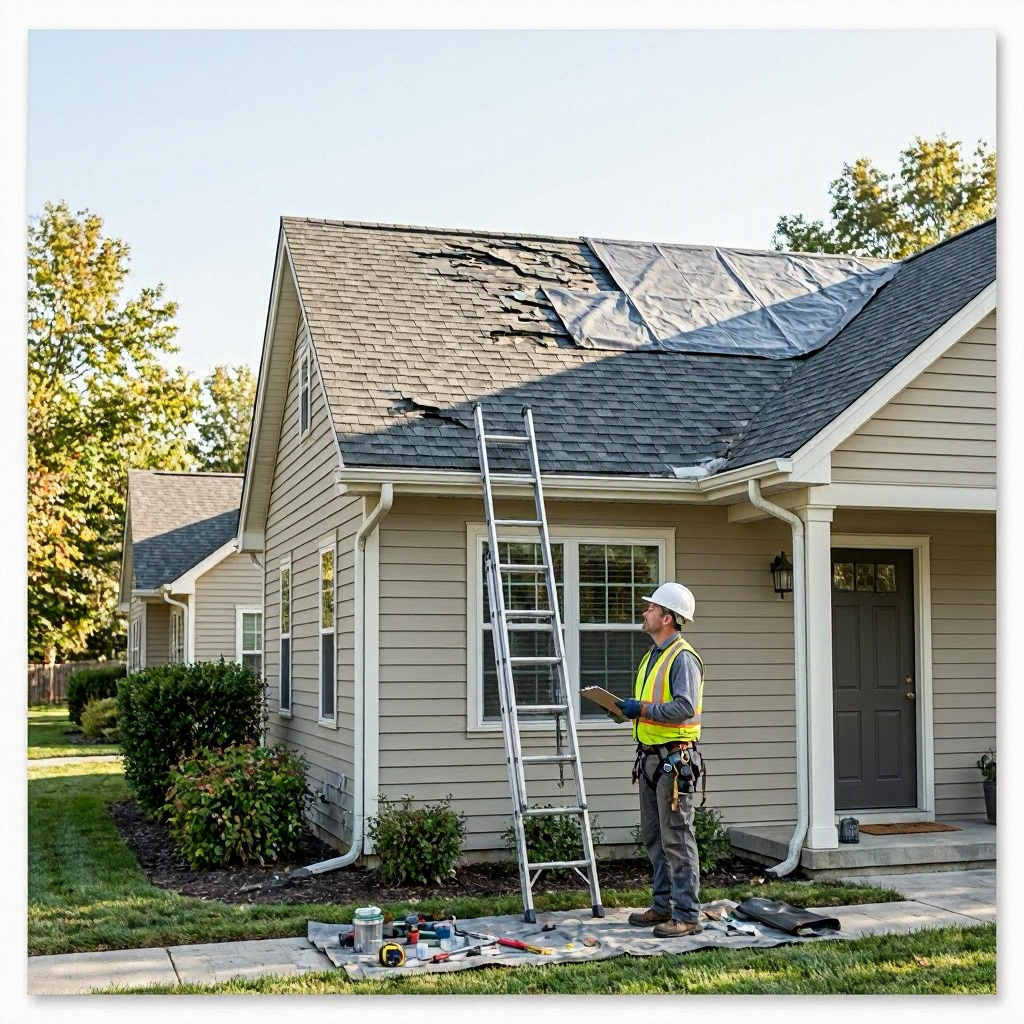
Storm Damage Roof Repair Cost
Storm damage to your roof can be a stressful and confusing situation. You’re often dealing with leaks, wind damage, or fallen limbs while trying to figure out your next steps. This article will help you navigate the practical side of storm damage roof repair, from understanding realistic costs to knowing who to call first.
It covers how to document the damage for insurance, what to look for in a contractor, and the important state checks you shouldn't skip. Our goal is to give you a clear, calm guide so you can make informed decisions without feeling rushed or pressured.
For common repairs like replacing a few shingles or fixing flashing, you can expect to pay between $394 and $1,961. If you have an active leak, emergency tarping may cost $200 to $1,000 or more to temporarily stop water entry. Full roof replacement often ranges from $5,892 to $13,273.
Here is a brief summary of key facts to help you get oriented.
| Item | Detail |
|---|---|
| Typical cost | $394 – $1,961 for common repairs |
| Pro service cost | Full replacement often $5,892 – $13,273 |
| Best first contact | Licensed local roofer or storm restoration contractor |
| Main safety warning | Call a pro for active leaks, sagging structures, or electrical hazards. |
| Warranty proof needed | Photos, receipts, warranty documents, installation contract |
| When to call a pro | For structural issues, high-access work, or any insurance claim repair. |
Here are the most urgent questions homeowners have after a storm.
- Who should I call first? A licensed local roofer or storm restoration contractor.
- What will it cost? Common repairs range from $394 to $1,961; full replacement is often $5,892 to $13,273.
- What proof is needed for warranty? Date-stamped photos, product receipts, warranty documents, and installation contracts.
- Which office should I check? Your city or county building department and your state's contractor license board.
- What are the warning signs? A contractor who pressures you to sign immediately or asks for full cash payment upfront.
- When should I avoid DIY? When there's an active leak, structural damage, or work that involves ladders and high access.
Call a Pro If: You have an active leak, electrical hazard, bowing wall, or major structural movement.
Use this table as a quick guide to contacts and costs.
| Field | Recommended Detail |
|---|---|
| Main customer question | Storm Damage Roof Repair Cost |
| Best first contact | Licensed roofer / storm restoration contractor |
| Estimated cost range | $394-$1,961 common repair; full replacement $5,892-$13,273 |
| Labor charges | Emergency tarping, tree removal, decking, and interior cleanup are often separate line items. |
| Official brand contacts | GAF: 1-800-458-1860; Owens Corning: 1-800-GET-PINK; CertainTeed: 800-345-1145 |
| Retailer contacts | Home Depot: 1-800-466-3337; Lowe's: 1-800-445-6937 |
| Warranty documents needed | Photos, invoices, receipts, warranty docs, installation contract, permits |
| State agency to check | Your state contractor board (e.g., CA CSLB, FL DBPR) and local building department |
| Important URLs | GAF Claims: gaf.com/claims; Owens Corning Warranty: warranty.owenscorning.com |
Understanding the breakdown of costs is your best defense against overpaying. The final quote depends on your location, the severity of damage, the materials used, and whether the work is an emergency.
Typical Planning Ranges A common repair, such as fixing a section of missing shingles or torn flashing, typically falls between $394 and $1,961. However, specific line items can vary:
- Emergency Tarp: $200 – $1,000+
- Small Wind Repair: $300 – $1,500
- Tree/Structural Roof Repair: $2,000 – $8,000+
- Full Replacement: $5,892 – $13,273 (typical range)
Average Cost: Common roof repairs after a storm often cost between $394 and $1,961.
What Changes the Price? Several factors can raise or lower your final bill.
- Labor Notes: Costs for emergency mitigation, tree removal, tarping, decking repair, flashing, and interior water cleanup are often separate line items. Always ask for a detailed breakdown.
- Low Quotes: May be missing crucial items like permits, disposal, warranty registration, or allowances for hidden damage found during work.
- High Quotes: Can be reasonable when access is difficult, your home is multi-story, premium materials are used, or the job requires structural engineering.
For any non-emergency job over $1,000, any structural work, or any insurance claim repair, it is strongly advised to get at least three written quotes for comparison.
Knowing when to tackle a repair yourself and when to call a professional is crucial for your safety, wallet, and home's warranty.
When DIY May Be Safe (For Skilled Homeowners) DIY is generally only suitable for very small, accessible maintenance tasks if you have the necessary skills and safety equipment. This does not include fixing active leaks or structural damage.
When to Call a Licensed Professional You should always call a pro for:
- Any active water entry or leak.
- Sagging or bowing structures.
- Any electrical hazard.
- Unsafe roof or ladder access.
- Work related to an insurance claim.
- Any job where a manufacturer's or installer's warranty could be voided by DIY work.
The risks of DIY on roof repairs are high, including falls, improper repairs that lead to more damage, and the voiding of existing product warranties.
Your first call depends on the situation. Use this guide to point you in the right direction.
For Immediate Damage Assessment & Temporary Repair Your best first call is a licensed local roofer or storm restoration contractor. They can safely trace leaks, apply emergency tarping, assess damage for shingles, flashing, and decking, and provide documentation for insurance.
For Insurance Coverage Questions Call your homeowners insurance carrier before permanent repairs if it is safe to wait. Ask if an adjuster must inspect first and whether your receipts for emergency mitigation (like tarping) will be reimbursed.
For Product or Workmanship Issues If you suspect the damage is due to a manufacturer defect or poor installation, you will need to contact the brand or the original installer. The next section lists the official contacts.
Warranty Documents Needed: Always gather date-stamped photos, product receipts, and your installation contract before filing a claim.
Having the correct contact information can save you time. Here are the official support channels from our source.
Manufacturer Warranty & Claim Support
- GAF: Residential warranty claims at gaf.com/claims. You can also call 1-800-458-1860 or email warrantyclaims@gaf.com.
- Owens Corning: General roofing contact: 1-800-GET-PINK. For warranty claim help, homeowners can call 1-800-ROOFING.
- CertainTeed: Warranty information and claim support at 800-345-1145. The Horizon claim line is 833-797-1001 where applicable.
Major Retailer Contacts
- Home Depot: Customer service at 1-800-466-3337. Use for purchases, returns, or installation order issues.
- Lowe's: Customer service at 1-800-445-6937.
Follow these clear steps to file a claim, whether it's for a product defect, workmanship issue, or storm damage covered by insurance.
- Document Everything Immediately. Take date-stamped photos and video before cleaning up or making any temporary repairs. Get both wide shots and close-ups.
- Gather Your Paperwork. Collect all related invoices, product receipts, warranty documents, the original installation contract, permit records, and any prior maintenance records.
- Contact the Correct Party.
- - For storm or sudden damage, call your homeowners insurance carrier before permanent repairs if safe.
- - For product defects, contact the manufacturer (using the numbers above) for a claim form and submission instructions.
- - For workmanship problems, notify the original installing contractor in writing and request a written plan to fix it.
- Submit Your Claim. Provide all required documentation, which often includes photos, material samples, and proof of purchase. Keep copies of everything you send.
- Follow Up. Keep records of all communication. If you encounter unsafe work or suspect unlicensed contracting, contact your local building department and state contractor board.
State-Specific or Local Checks
Rules vary significantly by location. Before hiring anyone, use this checklist and verify with your local authorities.
- California: Use the CSLB (Contractors State License Board) to verify a contractor holds a C-39 roofing license. Be aware of strict deposit rules.
- Florida: Use the DBPR (Department of Business and Professional Regulation) to verify contractors. After storms, be very careful with "assignment-of-benefits" paperwork.
- Texas: Licensing varies by city. Confirm that your roofer is locally registered and verify their insurance. Always confirm permit requirements with your city.
- New York / NYC: Exterior structural work often requires DOB (Department of Buildings) permits. In NYC, confirm contractor credentials for any high-access work.
- Illinois / Midwest Snow States: Ask contractors about protection against ice dams, proper ventilation, and local roofing registration rules.
State Action: Always check your state's license lookup and your city/county building department before signing any contract.
A crucial reminder: Structural work, roof replacement, and many exterior changes may require permits even if a contractor says they do not. It is your responsibility as the homeowner to verify.
Arm yourself with these questions for any contractor you interview.
- Can you provide proof of license/registration, insurance, and workers' compensation?
- Will you handle pulling the necessary permits?
- Can I see a written scope of work that includes materials, labor, disposal, and warranty details?
- How do you price change orders if hidden damage is found? Will you show me photos before proceeding?
- What is the payment schedule? (Avoid any request for full payment upfront).
- Can you provide recent local references?
Be alert for these warning signs when dealing with contractors after a storm.
- Storm Chaser Pressure: A contractor says you must sign immediately or demands you hand over your insurance check.
- Vague Scope: The written quote does not list materials, quantities, tear-off/removal, disposal, or warranty terms.
- Cash-Only or Full Payment Upfront. This is a major risk.
- No Proof of Credentials: The contractor refuses or cannot show license, insurance, or workers' compensation proof.
- Hidden Damage Secrecy: They refuse to photograph hidden rot or damaged decking before charging for change orders.
Practical Step-by-Step Guidance
Follow this actionable plan from the moment you discover storm damage.
- Ensure Safety First. If there is an active leak, electrical issue, or sagging structure, evacuate the area and call a professional immediately for emergency mitigation.
- Document the Damage. Safely take comprehensive, date-stamped photos and videos of all damage, inside and out.
- Make Temporary Repairs (If Safe). You may need to place a tarp or buckets. Keep all receipts for these mitigation efforts, as insurance may reimburse you.
- Contact Your Insurance Company. Report the damage and ask about their claim process and adjuster requirements.
- Research and Hire a Contractor.
- - Get 3 quotes for non-emergency work.
- - Verify licenses and insurance.
- - Check references and reviews.
- - Get everything in writing.
- Manage the Project.
- - Ensure permits are pulled.
- - Require photos of any hidden damage before approving extra work.
- - Pay with a traceable method (not cash) and never pay in full upfront.
- Finalize Paperwork. After work is complete and you are satisfied, make final payment. Collect all warranty documents, inspection certificates, and before/after photos for your records.
Frequently Asked Questions
Should I get more than one quote? Yes. For any non-emergency work, get at least two or three written quotes. Ensure they are for the same scope of work, materials, and include permits and warranties for a fair comparison.
Should I pay the full amount upfront? No. A reasonable deposit may be normal, but paying the full amount before any work starts is a major red flag. Use a traceable payment method and follow your state's rules on contractor deposits.
Can a home warranty cover this? Maybe, but home warranty contracts have many exclusions and require pre-approval. Call your warranty company before any non-emergency work if you hope to be reimbursed. Do not assume coverage.
Can insurance cover this? Homeowners insurance is most relevant for sudden and accidental damage like that from a storm, hail, or a falling tree. Damage from normal wear, poor maintenance, or gradual seepage is often excluded.
What should be in the written quote? The quote should include: scope of work, materials (brand/type/quantity), labor, permit costs, disposal, warranty details, timeline, exclusions, how hidden damage will be priced, payment schedule, and cleanup.
When is it an emergency? Situations requiring immediate professional attention include: active water entry, sagging structures, electrical hazards, unsafe roof access, or damage that is rapidly getting worse.
This article was prepared using the following sources for verification. We encourage you to use these links and contact official agencies for the most current information.
- HomeAdvisor Roof Repair Cost: homeadvisor.com
- HomeAdvisor Roof Replacement Cost: homeadvisor.com
- GAF Residential Warranty Resources: gaf.com
- Owens Corning Warranty Help: warranty.owenscorning.com
- CertainTeed Warranty Information: certainteed.com
- California CSLB License Check: cslb.ca.gov
- Florida DBPR License Search: myfloridalicense.com
- NYC DOB Permits: nyc.gov
This guide is for general planning and informational purposes only. Prices, labor markets, warranty terms, and local building codes change frequently. For structural, electrical, roofing, insurance, or safety decisions, always consult licensed local professionals and official agencies. Verify all costs, contacts, and rules with your contractor, insurance provider, manufacturer, and local building department before proceeding with any work.

About the TDL Expert Panel
TDL Expert Panel · TheDigitalLife Editorial Team
TDL Expert Panel is the editorial team behind TheDigitalLife. The team researches, reviews, and creates practical guides to help everyday readers make better decisions about home repair costs, refunds, AI tools, digital safety, productivity, and useful online resources. Each guide is written to be clear, useful, and easy to understand.