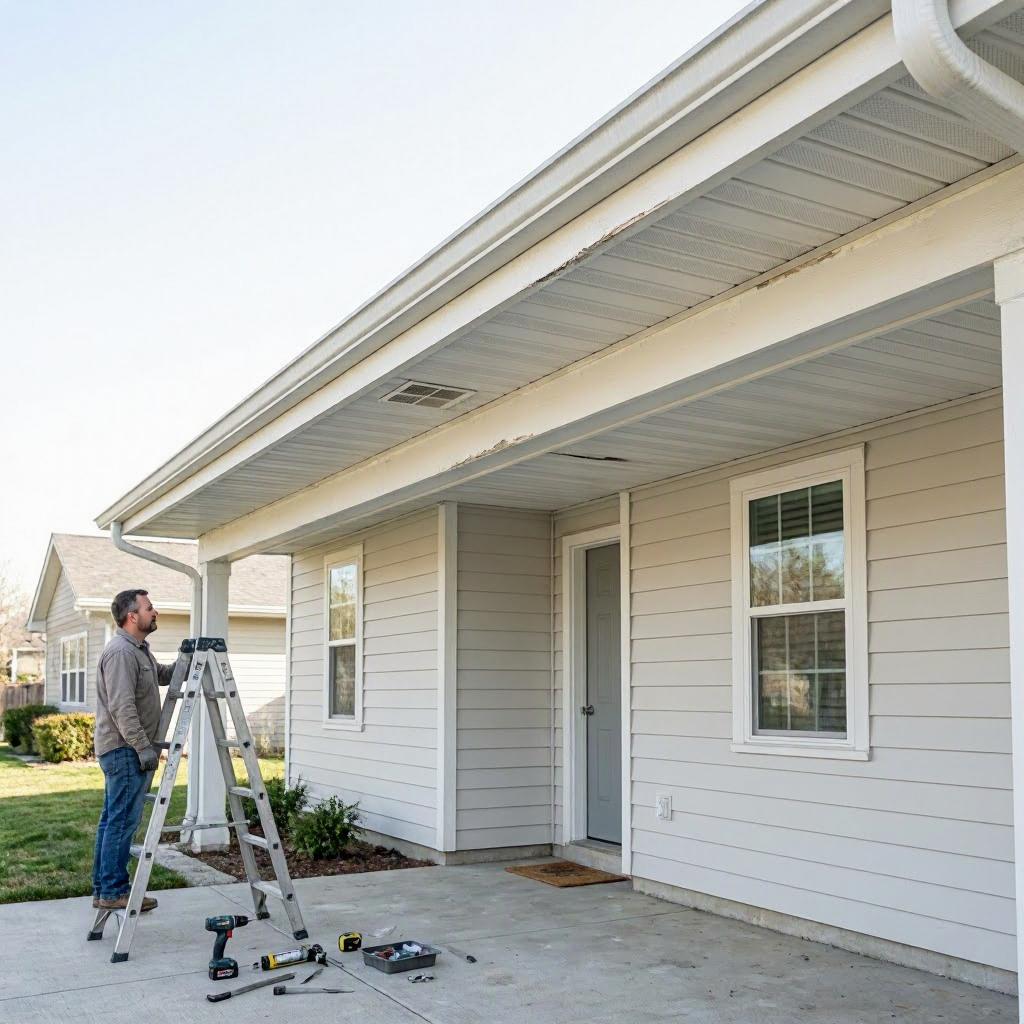
Soffit and Fascia Repair Cost
Your home's soffit and fascia are more than just trim. They are critical components that protect your roof's edge, provide essential attic ventilation, and keep pests and water out. When they fail, the damage can spread quickly. This guide provides the practical cost estimates, step-by-step contacts, and verification checks you need to plan a safe and legitimate repair, without the overwhelm.
Repairing soffit and fascia can cost anywhere from $300 for a small fascia board repair to over $6,000 for a full section replacement. The final price depends on the linear feet, extent of rot, whether gutters need to be removed, and how difficult the area is to access. Contact a licensed roofing or exterior trim contractor first for an inspection; if you suspect animal or insect damage, a pest professional may also be needed.
Cost and Labor Breakdown - DIY vs
- Cost and Labor Breakdown
- DIY vs. Professional Service
- Who to Contact First
- Official Brand and Agency Contacts
- Warranty and Claim Steps
- State and Local Verification
- Hiring Questions and Red Flags
- Practical Step-by-Step Guidance
- Frequently Asked Questions
Additional reference details:
- Item: Typical cost range , Detail: $600–$6,000+
- Item: Best first contact , Detail: Licensed roofing/exterior trim contractor
- Item: Main safety warning , Detail: Call 911 for fire, structural collapse, or active electrical hazard from water damage.
- Item: Warranty proof needed , Detail: Photos, invoice, model/brand, contractor diagnosis, warranty documents, insurance claim number.
- Item: When to call a pro , Detail: For any leak, rot, structural issue, pest damage, or work involving height and fall risk.
Who to call first: A licensed roofer or exterior trim
- Who to call first: A licensed roofer or exterior trim contractor.
- What it will cost: Expect a range of $600 to $6,000+, with specific line items detailed later.
- What proof is needed: Take photos before, during, and after any damage or repair.
- Which office to check: Always verify a contractor with your local building department and state license board.
- Warning signs: High-pressure sales after a storm, vague quotes, requests to skip permits.
- Avoid DIY for: Any repair involving leaks, structural rot, flashing, or significant height.
| Customer Question | Fact from Source |
|---|---|
| Estimated Cost Range | $600–$6,000+ nationally. |
| Best First Contact | Licensed roofing or exterior trim contractor. |
| Labor Charges | Included in project quotes from carpenters, roofers, or siding pros. |
| Official Brand Contacts | GAF, Owens Corning, CertainTeed for roofing product warranties. |
| Retailer Contacts | Home Depot: 1-800-466-3337; Lowe's: 1-800-445-6937. |
| Warranty Documents Needed | Photos, invoice, product model/brand, contractor diagnosis. |
| State Agency to Check | Verify with your state's contractor license board (e.g., CA CSLB, FL DBPR). |
| Safety Warning | 911 for fire, structural danger, or active electrical hazards. |
| Important URL | Local building department website for permit rules. |
The total cost for soffit and fascia work is not a single flat fee. It is built from several line items. Use the table below as a reference when reviewing written quotes. A legitimate contractor should separate these costs clearly.
Additional reference details:
- Line Item: Small fascia board repair , Typical Planning Range / Note: $300–$1,000
- Line Item: Soffit panel repair , Typical Planning Range / Note: $400–$1,500
- Line Item: Full fascia/soffit section replacement , Typical Planning Range / Note: $1,500–$6,000+
- Line Item: Gutter removal/reinstall add-on , Typical Planning Range / Note: $300–$1,500+
- Line Item: Pest damage/attic cleanup , Typical Planning Range / Note: $300–$2,000+ (separately)
These ranges are planning estimates. Your final price is shaped by local labor rates, the urgency of the repair, the material grade you choose, and the difficulty of accessing your roof line.
Average Cost: The national planning range is $600 to $6,000+, but always get a written, itemized quote.
A surprisingly low quote may be missing critical items like permit fees, disposal costs, code upgrades, or an allowance for hidden damage found after work begins. Conversely, a high quote can be reasonable if your home has difficult access, requires premium materials, or the work is done under emergency timing.
Always ask what is included, what is excluded, and what the process will be if hidden rot or damage is discovered once the work starts.
For a homeowner, a simple visual inspection or cleaning of vent screens might be within reach. However, actual repair work comes with significant risks.
DIY may be possible only for minor, cosmetic touch-ups if you have experience working at height, own the proper safety and carpentry tools, and are certain there is no underlying water damage or rot. Any mistake can lead to a voided warranty, improper ventilation, or an undetected leak that causes far costlier damage.
Call a Pro If: You see rot, sagging gutters, animal entry points, or blocked vents. This work involves fall risk, complex water management, and often requires permits.
You should always call a licensed professional for any repair involving leaks, structural rot, pest damage, flashing, or vent installation. Professionals carry insurance, know local building codes, and can spot related issues in your roof system that you might miss. Their workmanship warranty also provides you with crucial protection.
Knowing whom to call saves time and prevents misdirected efforts. Your first contact depends on the situation.
- For an active emergency like electrical danger, fire, or structural collapse, call 911.
- For damage from a storm, hail, or a sudden major leak, contact your homeowners insurance carrier using your policy's claim phone number or app. Ask if an adjuster must inspect before permanent repairs begin.
- For a standard inspection, repair, or replacement, contact a licensed roofing contractor. They are trained to handle the interconnected systems of roof, flashing, vents, fascia, and soffit.
- If animals or insects have caused the damage, you may also need to contact a pest control professional for cleanup and exclusion work.
When dealing with product warranties or material issues, use these official contacts from the source.
Roofing Product Manufacturers:
- GAF Warranty Claims: Online claim center at gaf.com/en-us/resources/warranties/claims.
- Owens Corning Roofing: Call 1-800-ROOFING (1-800-766-3464) or visit owenscorning.com.
- CertainTeed Roofing: Call 800-345-1145 or visit certainteed.com.
Major Retailers:
- Home Depot: Customer service at 1-800-HOME-DEPOT (1-800-466-3337) or corporate.homedepot.com.
- Lowe’s: Customer care at 1-800-44LOWES (1-800-445-6937) or corporate.lowes.com.
Navigating a warranty claim requires preparation. Follow these steps to improve your chances of a smooth process.
- Document everything immediately. Before any permanent repair, photograph the damaged area from multiple angles. Include the roof, attic, ceilings, damaged materials, and any water entry points. Note the date and time of any storm.
- Determine the claim type.
- - For storm or accidental damage, call your homeowners insurance carrier first.
- - For a suspected product defect, contact the manufacturer (GAF, Owens Corning, CertainTeed) named on your shingles or documents. Have your installation date, contractor name, photos, invoices, and warranty registration ready.
- - For workmanship problems, contact the original installing roofer in writing, requesting a warranty response. Keep copies of all communication.
- Do not bypass official channels. For permit or unsafe-work issues, contact your local building department and state contractor board. Never rely solely on a contractor's verbal promises.
Warranty Documents Needed: Always have photos, original invoices, warranty paperwork, and your contractor's diagnosis ready before you call.
State-Specific or Local Checks
Rules vary widely by location. Before hiring any contractor, complete these verification steps. This list is a starting point; always confirm with your own city and state agencies.
| State / Area | What to Do Before Work Starts | Where to Check |
|---|---|---|
| All U.S. States | Ask your local building department if a permit or inspection is required. | Local Building Department |
| California | Check the contractor's CSLB license classification. | cslb.ca.gov |
| Florida | Verify license status via DBPR. Florida has high scam risk after storms. | myfloridalicense.com |
| Texas | Check city/county permit rules, insurance, and local registration. | tdlr.texas.gov |
| Illinois | Verify license type through IDFPR. | idfpr.illinois.gov |
| New Jersey | Check Home Improvement Contractor registration. | njconsumeraffairs.gov |
| New York / NYC | Check local contractor and building-code rules. | nyc.gov/site/buildings |
| Washington | Verify registration and bonding through WA L&I. | lni.wa.gov/verify |
| Arizona | Check the Arizona Registrar of Contractors. | roc.az.gov |
A trustworthy contractor will answer these questions clearly. Get all answers in writing before signing a contract.
- Can you provide your license/registration number and a certificate of insurance, including workers' compensation?
- Does this quote include the cost of tear-off, underlayment, flashing, drip edge, ventilation, disposal, permits, and final cleanup?
- What is the brand and specific model of the materials you will use?
- Can you provide before-and-after photos of the damaged areas and repairs, especially for decking and flashing?
- What is your process if you find hidden rot or damage after starting work?
- What are the specific terms of your workmanship warranty, and how do I register the manufacturer's product warranty?
Be alert for these warning signs during the hiring process. They are strong indicators of a problematic contractor.
- A roofer appears unsolicited after a storm and pressures you to sign a contract immediately or to hand over your insurance check directly to them.
- The written quote is vague and does not specify material brands, square footage, warranty details, ventilation scope, or flashing work.
- The contractor asks you to skip pulling permits, avoid talking to your insurance company, or hide pre-existing damage from an adjuster.
Do Not Ignore: Any request to skip permits or mislead your insurance company is a major red flag and may be illegal.
Practical Step-by-Step Guidance
Follow this sequence to manage your soffit and fascia repair confidently and safely.
- Assess and Document: Safely inspect the damage. Take clear, dated photos from the ground and attic if possible. Look for signs of active water, rot, pests, or sagging.
- Mitigate Immediate Danger: If there is an active leak, you may need emergency tarping. Keep all receipts and photos for insurance. For true emergencies (structural, electrical), call 911.
- Contact Insurance (If Applicable): If the damage is from a covered peril like a storm, call your insurance carrier to start a claim before arranging permanent repairs.
- Get Multiple Quotes: For non-emergency work, obtain at least two or three written, itemized quotes from licensed contractors for the same scope of work.
- Verify the Contractor: Check their license, insurance, and references with your state agency and local building department.
- Review and Sign the Contract: Ensure it includes all discussed items, warranty terms, a payment schedule, and a process for handling hidden damage.
- Monitor the Work: Request photo updates, especially of critical areas like decking and flashing once the old materials are removed.
- Finalize Paperwork: Upon completion, ensure you receive all warranty documents, proof of final inspection if required, and a lien waiver.
Frequently Asked Questions
Should I get more than one quote? Yes. For non-emergency work, get at least two or three written quotes. Ensure they are for the same scope, materials, and include the same assumptions about permits and warranties for a fair comparison.
Should I pay the full amount upfront? No. A reasonable deposit may be normal, but paying in full before work begins is risky. Check your state’s rules on deposit limits and use a traceable payment method like a credit card or check.
Can I use my home warranty? Maybe. Coverage depends entirely on your specific contract, maintenance history, and exclusions. Call your home warranty company before authorizing any non-emergency work if you hope for reimbursement.
Should I call insurance before a roofer? For damage from storms, hail, wind, or tree impact, call your insurance carrier first when possible. They will advise on the claims process. Emergency mitigation like tarping may still be needed immediately.
Do roofing warranties cover labor? Sometimes, but not always. Manufacturer product warranties, enhanced system warranties, and contractor workmanship warranties are different. Read your documents carefully or ask the contractor to explain what labor is covered and for how long.
Can I repair a roof myself? Small maintenance like cleaning gutters or vents can be possible. However, any repair involving leaks, flashing, structural components, or significant height carries a high fall risk and can void existing warranties. These jobs are best left to qualified professionals.
This article was fact-checked against industry sources for accuracy. Key references include:
- Angi Roof Repair Cost: angi.com/articles/how-much-do-roof-repairs-cost.htm
- HomeAdvisor Roof Replacement Cost: homeadvisor.com/cost/roofing/install-a-roof/
- Manufacturer Warranty Pages: GAF, Owens Corning, CertainTeed (links provided in Official Contacts section).
- State License Verification Websites: California CSLB, Florida DBPR, Illinois IDFPR, etc. (links provided in State-Specific Checks section).
This guide provides a framework for planning and executing a soffit and fascia repair. Before you act, remember to verify all information. Prices change, warranty terms are updated, and local building codes vary. Always confirm details with licensed professionals, official brand support channels, and your local building department. Your due diligence is the best tool for a successful, long-lasting repair.

About the TDL Expert Panel
TDL Expert Panel · TheDigitalLife Editorial Team
TDL Expert Panel is the editorial team behind TheDigitalLife. The team researches, reviews, and creates practical guides to help everyday readers make better decisions about home repair costs, refunds, AI tools, digital safety, productivity, and useful online resources. Each guide is written to be clear, useful, and easy to understand.