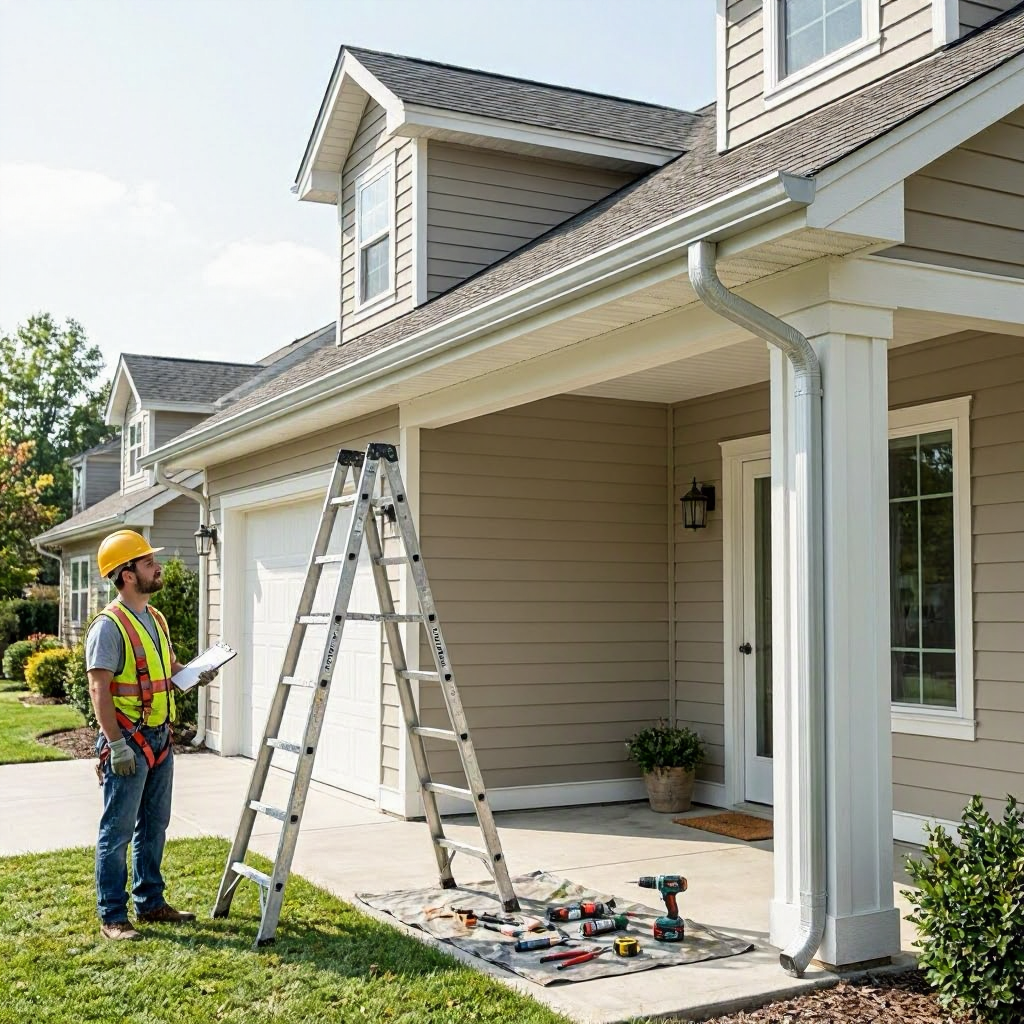
Seamless Gutter Installation Cost
Seamless gutters are formed on site from a coil of metal, so each run is one continuous piece from corner to corner. With no joints along the straight sections, there are fewer places to leak, and the gutters usually look cleaner than sectional gutters snapped together from short lengths. They cost more to install than DIY sectional gutters, but most of the price comes from choices you can control: material, size, the number of downspouts and where the water ends up. This guide explains those choices, what installation involves, and how to compare quotes.
Seamless versus sectional
- Sectional gutters come in 10- or 20-foot pieces joined with connectors and sealant. They are sold at home centers and are DIY-friendly, but every joint is a potential leak as sealant ages.
- Seamless gutters are rolled to exact length by a machine on the installer's truck. Joints exist only at corners, end caps and downspout outlets.
Because seamless gutters require the forming machine, they are almost always professionally installed.
Materials
- Aluminum. The most common choice: light, rust-resistant and available in many colors. Thicker gauges resist denting from ladders and ice better.
- Galvanized or galvalume steel. Stronger than aluminum but heavier, and it can rust where the coating is scratched.
- Copper. Expensive and long-lasting, develops a patina, and is often chosen for historic or high-end homes.
- Vinyl is generally sold in sectional form and can become brittle in extreme temperatures.
In wildfire areas, metal is the safer choice. CAL FIRE's home hardening guidance recommends replacing gutters with a noncombustible option such as metal when it is time to replace them, and adding a noncombustible gutter cover.
Size and profile
Most homes use 5-inch K-style gutters, named for their profile. Larger 6-inch gutters carry more water and suit large or steep roof areas, homes in heavy-rain regions, and roofs where several slopes drain into one valley. Half-round gutters are common on older and historic houses. Downspouts come in 2-by-3-inch and larger 3-by-4-inch sizes; larger downspouts clog less and move more water. Ask the installer how they sized the system for your roof, rather than defaulting to the smallest option.
Where the water goes matters as much as the gutter
A gutter that drops water at the foundation defeats its own purpose. The Department of Energy's Building America Solution Center explains in its guide to gutters and downspouts that downspouts should discharge to a sloping grade at least 5 feet from the foundation, or to an underground catchment system at least 10 feet away that is not connected to the foundation drain system. Ask that downspout extensions or buried drain lines be part of the quote, and check that the ground near the house slopes away.
What seamless gutter installation involves
- Removing and disposing of old gutters.
- Inspecting the fascia and replacing rotted sections; see soffit and fascia repair.
- Forming each run to length on site.
- Setting hangers at close intervals with screws into the fascia or rafter tails, with a slight slope toward the downspouts.
- Installing end caps, corners (mitered or pre-made) and outlets, sealed with gutter sealant.
- Installing downspouts, elbows and extensions.
- Optional: installing gutter guards; see gutter guard installation.
What drives the cost of seamless gutter installation
- Linear feet of gutter and the number of corners, each needing a sealed joint.
- Material and gauge.
- Gutter size (6-inch costs more than 5-inch).
- Number and length of downspouts and any underground drain lines.
- Home height, steep sites and difficult access.
- Fascia repair found during removal.
- Hanger type and spacing. Hidden hangers screwed in closely spaced hold up better under snow and ice.
- Add-ons such as guards, heat cables or decorative half-round systems.
Worked example (illustrative numbers)
A one-story ranch home needs 150 feet of gutter with six corners and four downspouts. A local installer quotes 5-inch aluminum seamless gutters at $9 per foot ($1,350), $40 per corner ($240), four downspouts with elbows at $75 each ($300), and 10-foot extensions for each downspout at $25 each ($100), plus $150 for removal and disposal of the old gutters, for $2,140. Upgrading to 6-inch gutters with 3-by-4-inch downspouts adds $1.50 per foot and $15 per downspout, or $285. On a house with long roof slopes draining into one side, that extra capacity may be worth it.
Comparing seamless gutter installation quotes
Ask each installer for:
- Material, gauge and color.
- Gutter and downspout sizes.
- Hanger type and spacing.
- How corners are made and sealed.
- Number of downspouts, extensions and where each will discharge.
- Whether fascia repair is included or priced separately.
- Workmanship warranty and the manufacturer's finish warranty.
A low bid that skips extensions or uses widely spaced hangers can cost more in foundation and fascia problems later. If you are replacing existing gutters, see our guide to gutter replacement.
Sources: BASC: gutters and downspouts; CAL FIRE: home hardening.

Written by TheDigitalLife Editorial Team
Edited by R. K. Tiwari
Owner & Editor
R. K. Tiwari is the owner and editor of TheDigitalLife. He checks each guide against official U.S. sources before it is published.
About the editor and our editorial standards