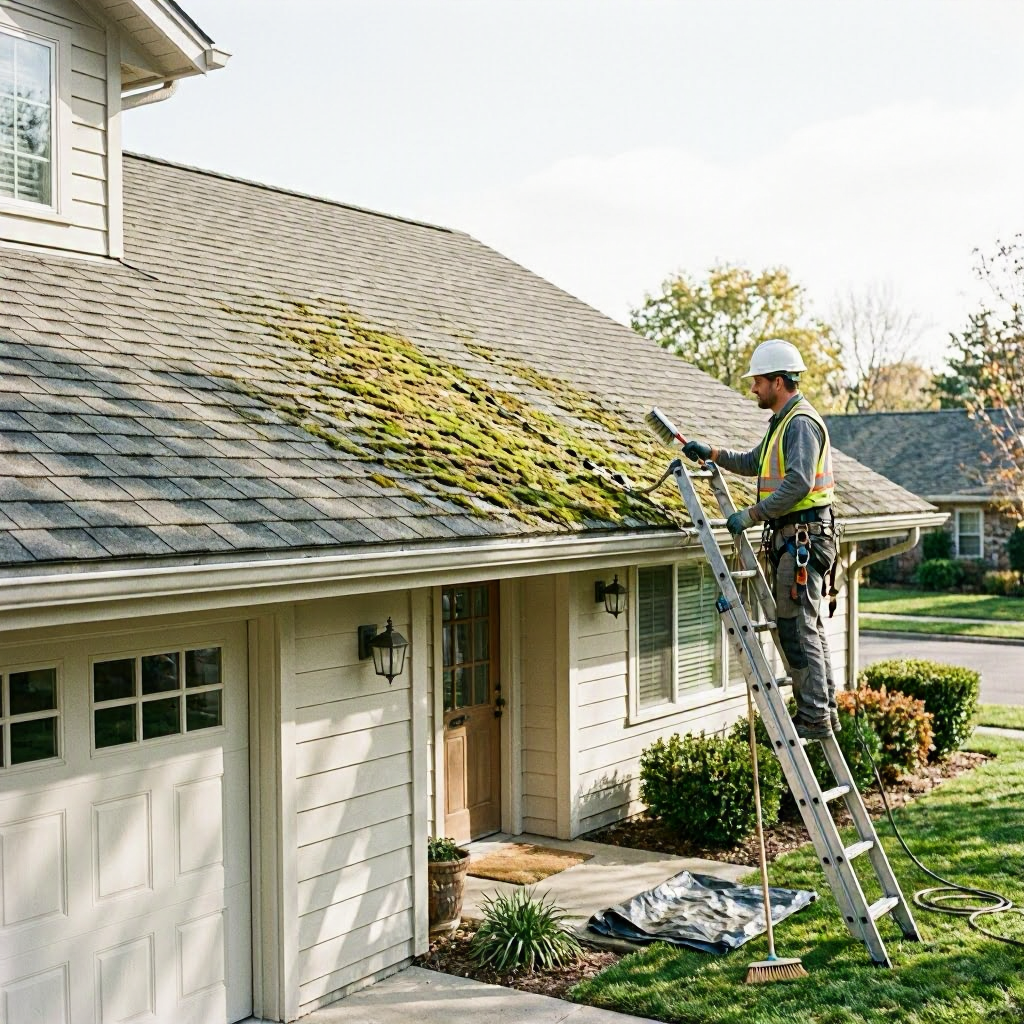
Roof Moss Removal Cost
Discovering moss on your roof can be unsettling. This guide helps you understand the realistic costs involved in having it professionally removed and treated. We’ll walk you through what to expect from quotes, who to call, how to handle warranty claims, and the important local checks to perform before hiring anyone. Our goal is to give you the practical information needed to make an informed decision and avoid common pitfalls.
The typical cost for professional roof moss removal ranges from $250 to $1,500. The final price depends heavily on your roof's size, pitch, accessibility, and the severity of the growth, which may reveal underlying repair needs. For the best results, contact a licensed roofer or soft-wash contractor who uses low-pressure methods, as high-pressure washing can damage shingles.
Quick Summary of Costs and Contacts - Quick Help Topics -
- Quick Summary of Costs and Contacts
- Quick Help Topics
- Quick Reference Table
- Detailed Cost and Labor Breakdown
- DIY vs. Professional Service
- Who to Contact for Different Situations
- Official Brand and Retailer Contacts
- Warranty and Refund Claim Steps
- State-Specific Hiring Checks
- Questions to Ask Before Paying
- Hiring Red Flags
- Practical Step-by-Step Hiring Guide
- Frequently Asked Questions
Additional reference details:
- Item: Typical cost , Detail: $250 - $1,500
- Item: Best first contact , Detail: Licensed roofer or soft-wash contractor
- Item: Main safety warning , Detail: Avoid high-pressure washing on shingles.
- Item: Warranty proof needed , Detail: Photos, receipts, contract, warranty registration
- Item: When to call a pro , Detail: For high/steep roofs, active leaks, or suspected structural damage
Who should I call first
- Who should I call first? A licensed roofer or storm restoration contractor for an assessment.
- What will it cost? Plan for $250 to $1,500, with add-ons for gutters or repairs increasing the total.
- What proof is needed for a warranty? Date-stamped photos, receipts, the installation contract, and warranty documents.
- Which state or local office should I check? Your city/county building department and state contractor license board.
- What are the warning signs? Pressure to sign immediately, vague quotes, cash-only demands, or no proof of insurance.
- When should I avoid DIY? For high roofs, steep pitches, active leaks, or if you're unsure about safety and warranty implications.
| Field | Detail |
|---|---|
| Main customer question | Realistic price range, who to call, and how to avoid overpaying for moss removal. |
| Best first contact | Licensed roofer / storm restoration contractor. |
| Estimated cost range | $250–$1,500 typical planning range. |
| Labor charges | Roof cleaning crew, soft-wash contractor, or roofer. |
| Official brand contacts | GAF: 1-800-458-1860; Owens Corning: 1-800-GET-PINK; CertainTeed: 800-345-1145. |
| Retailer contacts | Home Depot: 1-800-466-3337; Lowe's: 1-800-445-6937. |
| Warranty documents needed | Photos, invoices, product receipts, warranty docs, installation contract, permits. |
| State agency to check | State contractor license board and local building department. |
| Safety warning | Avoid high-pressure washing on shingles, as it can cause damage. |
| Important URLs | GAF Warranty: gaf.com/claims; CA License Check: cslb.ca.gov; NYC DOB: nyc.gov/site/buildings |
The total cost of roof moss removal is not a single flat fee. It's a combination of the basic cleaning service, any necessary treatments, and potential repairs uncovered during the process. Understanding these line items will help you compare quotes accurately.
Here is a breakdown of typical costs you can expect to see on an estimate:
Additional reference details:
- Line Item: Basic roof moss treatment , Typical Planning Range / Note: $250 – $600
- Line Item: Soft wash plus treatment , Typical Planning Range / Note: $500 – $1,500
- Line Item: Gutter cleaning add-on , Typical Planning Range / Note: $100 – $300
- Line Item: Damaged shingle replacement , Typical Planning Range / Note: $150 – $1,000+
- Line Item: Preventive zinc/copper strips , Typical Planning Range / Note: $300 – $1,500+
Average Cost: The typical planning range is $250 to $1,500, but severe growth can reveal repair needs that increase the total.
Several key factors will move your quote within or beyond this range:
- Roof Size & Pitch: Larger, steeper roofs are more difficult and time-consuming to work on.
- Access: Multi-story homes or properties with difficult access may require special equipment.
- Severity of Growth: Light moss is simpler than thick, established growth that may be hiding rot.
- Location: Local labor and material costs vary across the country.
- Repairs: The quote may only be for cleaning. If damaged decking or shingles are found, that will be an additional change order.
A low quote might be missing crucial items like permit fees, disposal costs, warranty registration, or an allowance for hidden damage. A high quote can be reasonable if it includes difficult access, premium materials, full permit handling, and strong warranties.
Tackling a mossy roof yourself can be tempting, but it's important to weigh the risks against the potential savings.
When DIY May Be Safe:
- For small, single-story roofs with a low, walkable pitch.
- If you are experienced with ladder and roof safety.
- For light moss that can be treated with approved, gentle cleaners.
When to Call a Licensed Professional:
- For any roof that is high, steep, or otherwise unsafe to access.
- If you see signs of an active leak, sagging, or major water damage.
- When the job involves treating large areas or applying preventive metal strips.
- If your roof is under a manufacturer's or installer's warranty, as DIY work may void coverage.
Call a Pro If: You notice active water entry, sagging structures, or unsafe roof access. These are emergency situations.
The primary risks of DIY are safety (falls from heights) and causing inadvertent damage to your shingles. Professionals use soft-wash or low-pressure systems specifically designed not to harm roofing materials. They also carry insurance and can spot underlying issues you might miss.
Your first call should be based on your specific situation. Don't just search for a company name; look for a licensed professional in the correct trade.
- For an Assessment, Cleaning, or Repair: Contact a licensed roofer or soft-wash contractor. They can trace leaks, provide cleaning, and assess shingle, flashing, and decking conditions.
- For Potential Insurance Claims: Call your homeowners insurance carrier before permanent repairs if the damage is from a sudden event like a storm. Ask if an adjuster must inspect and if mitigation receipts are reimbursable.
- For Product Defects: If you believe the shingles themselves are faulty, contact the manufacturer (e.g., GAF, Owens Corning) using their warranty claim process.
- For Workmanship Issues: Notify the original installing contractor in writing if their work has failed.
- For Retailer Issues: Contact Home Depot or Lowe's for problems with materials you purchased or installation you ordered through them.
When you need to make a warranty claim or verify a professional's credentials, use these official contacts from the source material.
Shingle Manufacturer Warranty Claims:
- GAF: Warranty claim center at gaf.com/claims. For residential warranty claims, call 1-800-458-1860 or email warrantyclaims@gaf.com.
- Owens Corning: General roofing contact: 1-800-GET-PINK. For warranty claim help, homeowners can call 1-800-ROOFING.
- CertainTeed: Warranty information and claim support at 800-345-1145. The Horizon claim line is 833-797-1001 where applicable.
Major Retailer Contacts:
- Home Depot customer service: 1-800-466-3337
- Lowe's customer service: 1-800-445-6937
Filing a claim requires organization and documentation. Follow these steps to improve your chances of a smooth process.
- Document Everything Immediately. Take clear, date-stamped photos and video of the damaged area before anything is disturbed. Get both wide shots and close-ups.
- Gather Your Paperwork. Collect all related documents: invoices, product receipts, warranty certificates, the original installation contract, permits, and any prior maintenance records.
- Contact the Correct Party.
- - For storm/sudden damage, call your homeowners insurance carrier before permanent repair if safe to do so.
- - For a product defect, contact the manufacturer (e.g., GAF, Owens Corning) using their official claim process.
- - For workmanship problems, notify the installing contractor in writing and request a written cure plan.
- Submit Your Claim. Provide all requested documentation, which may include photos, physical samples of materials, proof of purchase, and proof of warranty registration.
- Follow Up. Keep copies of all submitted forms and correspondence. Note the names of representatives you speak with.
Warranty Documents Needed: Always have date-stamped photos, receipts, the installation contract, and warranty registration ready.
State-Specific or Local Checks
Rules vary by location, and it's your responsibility as the homeowner to verify a contractor's credentials. Always check with your local building department and state licensing board before signing a contract.
| State / Area | What the Homeowner Should Check |
|---|---|
| California | Use the CSLB (Contractors State License Board) to verify a C-39 roofing contractor license. Be aware of strict deposit rules. |
| Florida | Use the DBPR (Department of Business & Professional Regulation) to verify licensing. Be cautious with assignment-of-benefits paperwork after storms. |
| Texas | Licensing varies by city. Confirm local registration, verify insurance, and check permit requirements with your city. |
| New York / NYC | Exterior work often requires DOB (Department of Buildings) permits. In NYC, confirm contractor credentials for roof/scaffold work. |
| Illinois / Snow States | Ask contractors about local rules for ice dams, ventilation, and roofing registration. |
Remember, structural work, roof replacement, and exterior changes often require permits, even if a contractor says they don't.
Asking the right questions protects your investment. Get answers to these in writing before work begins.
- Can you provide proof of a current license, insurance, and workers' compensation?
- Who is responsible for pulling the necessary permits?
- What is the full, written scope of work? Does it list materials, linear feet, disposal, and cleanup?
- Do you use soft-wash/low-pressure methods? (The answer should be "yes.")
- What is your process and pricing if you find hidden damage like rotten decking?
- What warranties are included (both manufacturer product warranty and your workmanship warranty)?
- What is the payment schedule? (Avoid full payment upfront.)
Be alert for these warning signs when talking to contractors. Any one of them is a reason to pause and reconsider.
- Storm Chaser Pressure: A contractor says you must sign a contract immediately or hand over your insurance check.
- Vague Scope: The written quote does not detail materials, labor, removal, disposal, or warranty terms.
- Cash-Only or Full Payment Upfront: This is a major risk. Always use a traceable payment method.
- No Credentials: The contractor cannot or will not provide proof of license, insurance, or local references.
- Hidden Damage Secrecy: A refusal to photograph and show you hidden rot before charging for change orders.
Do Not Ignore: Pressure to sign immediately, vague quotes, or demands for full payment upfront. These are major red flags.
Practical Step-by-Step Guidance
Follow this actionable plan to hire a professional for roof moss removal.
- Assess the Situation: Safely view your roof from the ground or attic. Look for moss, dark streaks, or lifted shingles.
- Get Multiple Quotes: For non-emergency work over $1,000, get at least three written quotes from licensed professionals. Ensure each quote is for the same scope of work.
- Verify Credentials: Use your state's online license lookup and call your local building department to check the contractor's license and see if permits are needed.
- Review the Contract: Before signing, ensure the written quote includes the full scope, materials, warranty details, cleanup, and a clear payment schedule tied to completion milestones.
- Document Pre-Existing Conditions: Take your own date-stamped photos of the roof before any work starts.
- Manage the Job: Ask to be shown any hidden damage (with photos) before approving change orders. Do not make final payment until the job is complete, cleaned up, and you have all warranty documents in hand.
Frequently Asked Questions
Should I get more than one quote? Yes. For any non-emergency job, get at least two or three written quotes. Ensure they are based on the same scope, materials, and assumptions about permits.
Should I pay the full amount upfront? No. A reasonable deposit may be normal, but paying in full before work starts is risky. Use a traceable payment method and follow your state's rules on contractor deposits.
Can a home warranty cover this? Maybe, but home warranty contracts have many exclusions. You must call your warranty company for pre-approval before any non-emergency work if you hope for reimbursement.
Can insurance cover roof moss removal? Insurance is for sudden, accidental damage (like a storm or fallen tree). Normal wear, poor maintenance, and gradual water seepage are often excluded. Always call your insurer to understand your specific coverage.
What should be in the written quote? The scope of work, materials brand/type, labor, permit responsibility, disposal method, warranty terms, timeline, payment schedule, and cleanup details.
Can I DIY roof moss removal? Small maintenance can be DIY for skilled, safety-conscious homeowners. However, work on ladders and roofs carries high fall risk, and improper cleaning can void warranties or cause damage. For most homeowners, hiring a pro is the safer choice.
This guide was compiled using information from the following sources for verification:
- HomeAdvisor Roof Repair Cost Guide: homeadvisor.com
- GAF Residential Warranty Resources: gaf.com
- Owens Corning Warranty Claim Help: warranty.owenscorning.com
- CertainTeed Warranty Information: certainteed.com
- California CSLB License Check: cslb.ca.gov
- Florida DBPR License Search: myfloridalicense.com
- NYC Department of Buildings: nyc.gov
Prices, phone numbers, warranty rules, and local codes can change. Always verify costs, contacts, and requirements with licensed local professionals, official brand support, and your local building department before starting any project.
This guide is for general planning and informational purposes only. It does not replace professional advice. For structural, safety, insurance, or specific warranty questions, consult with licensed local professionals, your insurance carrier, and official agencies. Always get written quotes and verify contractor licenses with your state board before hiring.

About the TDL Expert Panel
TDL Expert Panel · TheDigitalLife Editorial Team
TDL Expert Panel is the editorial team behind TheDigitalLife. The team researches, reviews, and creates practical guides to help everyday readers make better decisions about home repair costs, refunds, AI tools, digital safety, productivity, and useful online resources. Each guide is written to be clear, useful, and easy to understand.