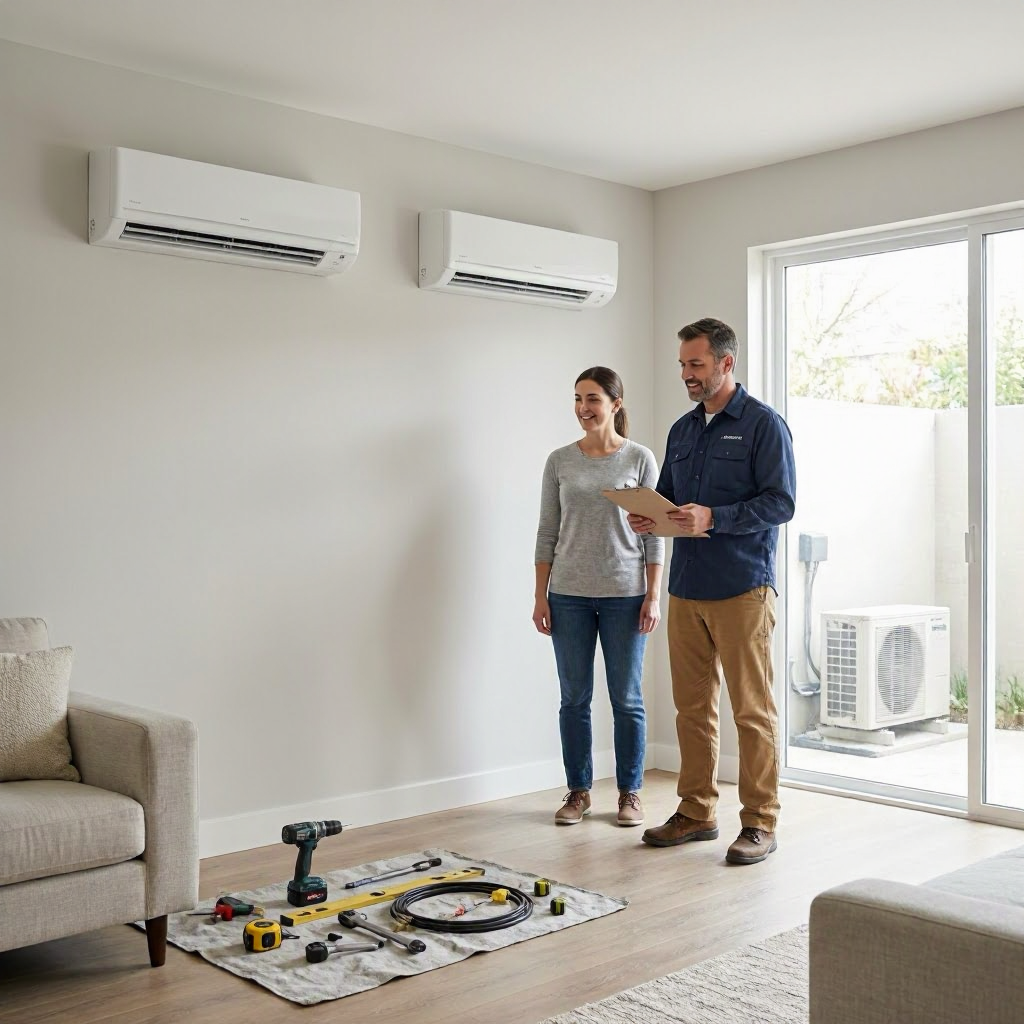
Mini-Split Installation Cost: Single Zone vs Multi-Zone
Choosing the right heating and cooling solution for your home is a significant decision. Mini-split systems, which offer both air conditioning and heating, are a popular choice for room additions, garages, older homes without ducts, and spaces that are hard to keep comfortable. This guide is designed to help you, the homeowner, understand the key differences, costs, and processes involved.
The choice often comes down to two main options: single-zone and multi-zone systems. A single-zone system is typically for one room, while a multi-zone system can serve several rooms from a single outdoor unit. Understanding the installation costs, labor, and necessary planning steps for each type will help you make an informed choice that fits your home and budget.
For a single-zone system serving one room or area, the typical total installation cost ranges from $2,000 to $5,000. For a multi-zone system serving several rooms with one outdoor unit, the cost range is typically $5,000 to $12,000 or more. Labor costs differ significantly, with single-zone installation labor ranging from $300 to $2,000 and multi-zone labor ranging from $700 to $3,000+. The final price depends heavily on the number of indoor units, electrical work, and the complexity of the installation.
| Item | Detail |
|---|---|
| Typical cost (single-zone) | $2,000 - $5,000 |
| Typical cost (multi-zone) | $5,000 - $12,000+ |
| Pro service cost (labor) | Single-zone: $300-$2,000; Multi-zone: $700-$3,000+ |
| Best first contact | Licensed HVAC contractor or manufacturer-authorized dealer |
| Main safety warning | Refrigerant work requires an EPA Section 608 certified technician |
| Warranty proof needed | Product registration, installation documentation, and maintenance records |
| When to call a pro | For refrigerant, electrical work, and to preserve warranty and code compliance |
Who to call first: Contact two or three licensed HVAC
- Who to call first: Contact two or three licensed HVAC contractors.
- What it will cost: Single-zone: $2,000-$5,000; Multi-zone: $5,000-$12,000+.
- Warranty proof: Keep model/serial numbers, installer documentation, and maintenance records.
- State/local check: Verify contractor licensing with your state’s licensing board.
- Warning signs: No written contract, unusually low quote, pressure to sign immediately.
- Avoid DIY: For refrigerant and electrical work, or if you want to preserve your warranty.
Additional reference details:
- Main customer question: Single-zone system for one room , Best first contact: Licensed HVAC contractor , Estimated cost range: $2,000 - $5,000
- Main customer question: Multi-zone system for several rooms , Best first contact: Licensed HVAC contractor , Estimated cost range: $5,000 - $12,000+
Additional reference details:
- Labor charges: Single-zone: $300 - $2,000 , Official brand contacts: Carrier: 1-800-CARRIER
- Labor charges: Multi-zone: $700 - $3,000+ , Official brand contacts: Trane Consumer Relations: 1-800-945-5884
- Labor charges: Electrical circuit: $300 - $1,500+ , Official brand contacts: Lennox: 1-800-953-6669
- Official brand contacts: Goodman / Daikin: 1-877-254-4729
Additional reference details:
- Retailer contacts: Home Depot: 1-800-HOME-DEPOT , Warranty claim documents: Model & serial numbers for outdoor/indoor units
- Retailer contacts: Lowe’s: 1-800-445-6937 , Warranty claim documents: Installer documentation of vacuum test and specs
- Retailer contacts: Lowe's Installation: 1-877-GO-LOWES , Warranty claim documents: Proof of product registration and maintenance records
| State agency to check | Important URLs |
|---|---|
| California: CSLB | HomeAdvisor Mini Split Cost |
| Texas: TDLR Air Conditioning | Angi Mini Split Cost |
| Florida: DBPR/MyFloridaLicense | EPA Section 608 Certification |
| New York/NYC: Check local rules | Carrier Warranty Lookup |
Understanding the cost breakdown is crucial for budgeting. Major cost reporting services provide helpful benchmarks. HomeAdvisor reports mini-split labor ranges from about $300-$2,000 for single-zone systems and $700-$3,000 for multi-zone systems. Angi places many full installations in the $2,000-$5,000 range with an average around $3,000, heavily dependent on the specific setup.
Here’s a more detailed look at typical line items and what can change the price:
- Single-zone mini-split total: $2,000-$5,000. Price changes based on BTU size, difficulty of wall penetration, and electrical work needed.
- Multi-zone mini-split total: $5,000-$12,000+. Price increases with the number of indoor heads and the total length of refrigerant line sets required.
- Labor for single-zone: $300-$2,000. Affected by access to the installation site, mounting difficulty, and the length of the line-set run.
- Labor for multi-zone: $700-$3,000+. Higher due to the complexity of installing multiple indoor heads and their respective line sets.
- Electrical circuit/disconnect: $300-$1,500+. This depends on your electrical panel’s capacity and the distance the new circuit must run.
Average Cost: For a single room, budget $2,000-$5,000. For multiple rooms, budget $5,000-$12,000+.
Some DIY mini-split kits are available on the market. However, professional installation is strongly recommended for most homeowners.
DIY may be considered only if you are highly skilled in both electrical work and handling pressurized refrigerant systems, and you are willing to forgo manufacturer warranties, which often require professional installation.
Call a Pro If: The job involves refrigerant handling, new electrical circuits, or you want to ensure warranty coverage and code compliance.
You should call a licensed professional for several key reasons. Refrigerant work legally requires an EPA Section 608 certified technician. Electrical work often needs a permit and inspection for safety. Most major manufacturers require authorized installation to validate the full equipment warranty. A professional will also perform a Manual J load calculation to correctly size your system for efficiency and comfort.
Your first point of contact should always be a qualified professional.
For a new installation or a replacement job, contact two or three licensed HVAC contractors to obtain estimates. If you are replacing equipment that may still be under warranty, also contact at least one manufacturer-authorized dealer for that specific brand.
For any work involving refrigerant lines or charging the system, you must ask the contractor if their technician holds EPA Section 608 certification. For jobs that also involve a gas furnace, confirm local rules for gas piping and combustion inspections with your building department.
Having the right contact information can save time when you need support, warranty service, or to verify a contractor.
Official Brand Support (for warranty and product questions):
- Carrier: 1-800-CARRIER (1-800-227-7437). Use their warranty lookup and find a local authorized dealer.
- Trane: Consumer Relations at 1-800-945-5884; warranty specialists at 1-855-260-2975. Ask about registered limited warranty and transfer rules.
- Lennox: 1-800-953-6669. Have your model and serial numbers ready.
- Goodman / Daikin: 1-877-254-4729. Use for product registration and warranty lookup.
Retailer Customer Service (for orders, returns, installation complaints):
- Home Depot: 1-800-HOME-DEPOT (1-800-466-3337). For product orders, installation complaints, receipts, and return disputes.
- Lowe’s: 1-800-445-6937. For orders, returns, missing parts, and damage claims.
- Lowe’s Installation Services: 1-877-GO-LOWES (1-877-465-6937). Use only if your job was booked through Lowe’s installation services.
Warranty Documents Needed: Model/serial numbers, installer documentation, and proof of product registration.
Protecting your investment means keeping good records from day one. Follow these steps to ensure a smooth warranty process if needed.
- Confirm and record model and serial numbers for both the outdoor condenser and all indoor air-handling units immediately after installation.
- Register your product warranty with the manufacturer within the required timeframe (often 60-90 days from installation).
- Ask your installer to document the vacuum test, line-set length, refrigerant charge, and electrical specifications. Keep this with your contract.
- Keep maintenance records, including filter changes and notes from any annual service, especially if the warranty requires regular maintenance.
- For refunds or disputes with a retailer, have your original receipt, order number, and photos of any damaged or missing parts ready when you call their customer service line.
State-Specific or Local Checks
Licensing requirements for HVAC contractors vary by state. Always verify a contractor’s license before hiring them.
- California: Verify HVAC contractors through the Contractors State License Board (CSLB). Look for the C-20 warm-air heating, ventilating and air-conditioning classification.
- Texas: Contractors must have a TDLR Air Conditioning and Refrigeration license from the Texas Department of Licensing and Regulation.
- Florida: Verify air-conditioning contractor licensing through DBPR/MyFloridaLicense.
- New York / NYC: Check applicable state and city license requirements. Work in New York City often requires specific permits and qualified tradespeople.
In any state, also check whether local permits are required for the equipment replacement, new electrical disconnects, or any ductwork modifications.
A clear, detailed conversation with your contractor before work begins is your best protection. Ask these questions before approving any job.
- Is the estimate fully itemized for parts, labor, permits, disposal, and any trip or emergency fees?
- Are you licensed for this exact trade in my state or city? Can I verify your license number online?
- Will you pull the required permit, schedule the inspection, and provide proof of final approval?
- Does the quote include cleanup, haul-away, and repair of drywall, flooring, or landscaping?
- What is excluded from the quote, and what conditions would trigger a change order?
- What Manual J/load calculation did you use to size the system correctly?
- Are changes to ductwork, electrical, thermostat, or condensate drain included?
- What are the efficiency rating, refrigerant type, and warranty registration deadline for this equipment?
Be cautious and consider looking for another contractor if you encounter any of the following warning signs.
- A contractor refuses to provide their license number, a written scope of work, proof of insurance, or itemized pricing.
- The quote is unusually low but excludes critical items like excavation, disposal, permits, electrical work, or restoration.
- The salesperson pressures you to sign immediately or claims permits are never needed without checking your local jurisdiction.
- Warranty details are verbal only. Always ask for manufacturer warranty, labor warranty, and the claim process in writing.
- For any job involving digging, a contractor starts before an 811 utility locate or city clearance, creating a serious safety and liability risk.
- A contractor sizes equipment only by matching the old unit without checking current load, insulation, ducts, or windows.
- A bid excludes permits, electrical disconnect, line set, or refrigerant recovery but is advertised as a "complete replacement."
Do Not Ignore: Any contractor who is evasive about licensing, permits, or providing a detailed written contract.
Practical Step-by-Step Guidance
Follow this actionable plan to navigate the process from start to finish.
- Define Your Need: Decide if you need cooling/heating for one room (single-zone) or several (multi-zone).
- Research Local Contractors: Get recommendations and search for licensed HVAC contractors in your area.
- Verify and Contact: Check state licenses online, then contact 2-3 contractors for estimates.
- Ask the Key Questions: Use the list above during each estimate appointment.
- Review Quotes Carefully: Compare itemized bids, ensuring they include all necessary work and clarify exclusions.
- Check References and Reviews: Look at the contractor’s past work and customer feedback.
- Secure the Contract: Sign a detailed contract only after all your questions are answered.
- Document Everything: Record model numbers, keep all paperwork, and take photos before/during/after installation.
- Register Your Warranty: Complete manufacturer product registration promptly after installation.
- Maintain the System: Keep a log of filter changes and schedule annual maintenance as recommended.
Frequently Asked Questions
Is a mini-split cheaper than installing new ductwork? Often, for a single room or an addition, a mini-split is more cost-effective. For whole-home coverage, a multi-zone mini-split system can become expensive, and the cost comparison with new ducts will depend on your home’s layout.
Can I install a mini-split myself? Some DIY kits exist, but refrigerant handling, electrical connections, local building codes, and potential voiding of the manufacturer’s warranty make professional installation the safer and more reliable choice for most homeowners.
How many indoor heads can I use with one outdoor unit? The maximum number depends on the outdoor unit’s total capacity, the calculated heating/cooling load of each room, and line-set length limits. A qualified contractor should perform these calculations to size the system properly.
What’s the most important factor in choosing an installer? Verifying that they are properly licensed for HVAC work in your state and, for refrigerant work, that their technicians are EPA Section 608 certified.
Do I always need a permit for mini-split installation? Not always, but very often. Requirements vary by city and county. Your contractor should know and should pull the permit if required. Be wary of anyone who says permits are never needed.
What if my new system has a problem? Contact the installing contractor first under their labor warranty. For equipment issues, use the manufacturer’s warranty, having your model numbers and proof of registration ready.
This article was prepared using the following sources for cost estimates and official information. Homeowners should verify details locally before proceeding.
- HomeAdvisor Mini Split Cost Guide
- Angi Mini Split Cost Guide
- U.S. EPA Section 608 Technician Certification Program
- Carrier Warranty Lookup
- Goodman Manufacturing Contact Page
- Texas Department of Licensing and Regulation (TDLR) HVAC Licensing
Always re-check local rules, current prices, warranty terms, permit requirements, and official contact information with your local building department and licensed professionals.
This guide provides general information to help you make a more informed decision. Costs, codes, and requirements vary widely by location and specific project details. Always verify contractor licensing with your state’s licensing board, confirm warranty terms with the official brand, and consult with licensed HVAC professionals for final quotes and advice tailored to your home.

About the TDL Expert Panel
TDL Expert Panel · TheDigitalLife Editorial Team
TDL Expert Panel is the editorial team behind TheDigitalLife. The team researches, reviews, and creates practical guides to help everyday readers make better decisions about home repair costs, refunds, AI tools, digital safety, productivity, and useful online resources. Each guide is written to be clear, useful, and easy to understand.