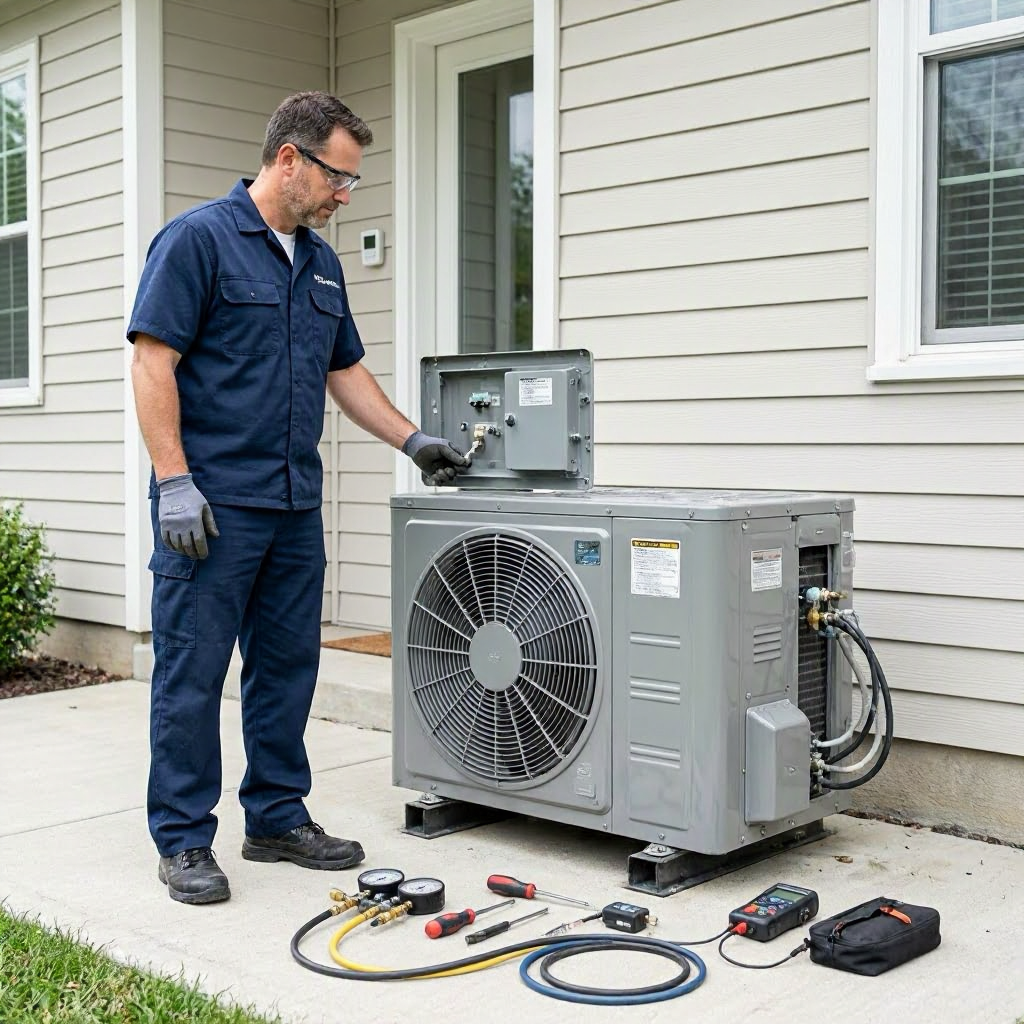
Heat Pump Installation Cost: Is It Cheaper Than AC + Furnace?
When you’re planning your home's comfort system, the choice between a heat pump and a traditional combination of an air conditioner and furnace is a major decision. It involves comparing upfront installation costs, long-term operating expenses, and the suitability for your climate.
This guide is here to help you understand the real costs, from the price of equipment and labor to the impact of rebates. We’ll provide practical steps for hiring the right professional, protecting your warranty, and verifying local requirements. By the end, you’ll have a clear framework to make an informed choice for your home.
So, is a heat pump cheaper to install than an air conditioner and furnace? Sometimes, especially when rebates and efficient operation are favorable. However, the total cost depends heavily on your local climate and electricity rates. In very cold regions or areas with high electricity costs, a dual-fuel system combining a heat pump with a furnace may be a better long-term investment.
Here is a quick overview of the most important facts you should know.
Additional reference details:
- Item: Typical Cost Range , Detail: $5,000 to $18,000+
- Item: Pro Service Needed , Detail: Yes, always for installation
- Item: Best First Contact , Detail: Two or three licensed HVAC contractors
- Item: Warranty Proof Needed , Detail: Model/serial numbers, registration, maintenance records
- Item: Main Safety Warning , Detail: Never dig before an 811 utility locate
- Item: When to Call a Pro , Detail: For all installation, refrigerant, and electrical work
Who should I call first
- Who should I call first? Contact two or three licensed HVAC contractors.
- What will it cost? A standard system is $5,000-$12,500+, but cold-climate or dual-fuel setups can reach $8,000-$18,000+.
- What proof is needed for warranty? Keep the registration confirmation, model/serial numbers, and all maintenance records.
- Which office should I check? Verify your contractor’s license with your state’s licensing board (like CSLB in California or TDLR in Texas).
- What are the warning signs? An unusually low quote, refusal to provide a license number, or pressure to sign immediately.
- When should I avoid DIY? Always. Installation requires EPA certification for refrigerant, electrical knowledge, and permits.
| Main Customer Need | Best First Contact | Details |
|---|---|---|
| Get a Quote | Licensed HVAC Contractor | Get 2-3 bids for replacement jobs. |
| Warranty Service | Manufacturer-Authorized Dealer | Required if equipment is still under warranty. |
| Cost Range | See contractor bids | Standard: $5,000-$12,500+. Cold-climate/Dual-fuel: $8,000-$18,000+. |
| Labor/Other Charges | Itemized contractor quote | Includes permits, disposal, trip fees, potential electrical upgrades ($500-$3,000+). |
| Official Brand Contacts | Manufacturer Support | See contact list below for Carrier, Trane, Lennox, Goodman/Daikin. |
| Retailer Contacts | Store Customer Service | Home Depot (1-800-466-3337) for orders/returns. Lowe's (1-800-445-6937) for similar. |
| Warranty Documents | Manufacturer & Contractor | Registration, AHRI match, commissioning checklist, all receipts. |
| State Agency to Check | State Licensing Board | Examples: CA CSLB, TX TDLR, FL DBPR. |
| Safety Warning | Always call 811 | No digging before a utility locate. Refrigerant work needs EPA 608 certification. |
| Important URL | EPA Technician Certification | epa.gov |
A heat pump installation cost isn't one flat price. It overlaps with standard HVAC replacement pricing but can be affected by several specific factors. The key is to compare annual operating costs, not just the installation price. Your climate, electricity rates, existing ductwork, available rebates, and whether you need backup heat all change the equation.
Here’s a breakdown of typical price ranges and what influences them.
Additional reference details:
- Line Item: Standard Ducted Heat Pump , Typical Range: $5,000 - $12,500+ , What Can Change the Price: System size (tonnage), efficiency rating (SEER/HSPF), condition of existing ducts, local labor rates.
- Line Item: Cold-Climate Heat Pump , Typical Range: $8,000 - $18,000+ , What Can Change the Price: High-performance equipment designed for low temperatures, advanced controls.
- Line Item: Dual-Fuel System (Heat Pump + Furnace) , Typical Range: $8,000 - $18,000+ , What Can Change the Price: Integration of controls, gas furnace cost and installation, gas piping inspection.
- Line Item: Electrical Upgrade/Add-on , Typical Range: $500 - $3,000+ , What Can Change the Price: Home's electrical panel capacity, need for a new disconnect, running new circuits.
- Line Item: Rebates & Tax Credits , Typical Range: Varies , What Can Change the Price: Utility, state, and federal programs. Check DOE and utility programs before purchase.
Average Cost: A standard heat pump installation typically costs between $5,000 and $12,500, but many factors can raise the final price.
Labor charges are part of the total quote. A reliable contractor will provide an itemized estimate that breaks down costs for parts, labor, permits, old equipment disposal, and any potential trip or emergency fees. Be wary of quotes that seem unusually low but exclude these essential items.
Installing a heat pump is not a DIY project. It requires specialized knowledge and certifications that go beyond typical home repair skills.
- When to Call a Licensed Professional: You must hire a pro for the entire installation process. This includes sizing the system with a proper load calculation, handling refrigerant, connecting electrical components, modifying ductwork, and ensuring the system is commissioned correctly.
- Skills and Tools Needed (For Pros): Professionals need EPA Section 608 certification to legally handle refrigerant. They also need knowledge of electrical codes, ductwork design, and local building permit requirements. They use specialized tools for charging the system, brazing copper lines, and testing performance.
- Warranty and Safety Risks: Attempting a DIY installation will almost certainly void the manufacturer's warranty. More importantly, mistakes can lead to dangerous electrical hazards, refrigerant leaks, poor performance, or even damage to the expensive equipment. Incorrect sizing alone can lead to higher bills and uncomfortable temperatures.
Your first step should always be to contact professionals for estimates and advice.
- For Replacement Jobs: Get bids from two or three licensed HVAC contractors. If your existing equipment is still under warranty, you should also contact at least one manufacturer-authorized dealer to perform the work.
- For Specific Work: For any refrigerant work, confirm the technician has EPA Section 608 certification. If the job involves a gas furnace (like in a dual-fuel system), also confirm gas piping and combustion inspection rules with your local building department.
- For Plumbing Emergencies: If your installation involves plumbing work (like a condensate drain) and you have an urgent issue, you can contact services like Roto-Rooter (1-800-438-7686) or Mr. Rooter (855-982-2028). Always confirm a local quote first.
Call a Pro If: You are installing, replacing, or repairing any part of your HVAC system. This work requires licensing, permits, and specialized tools.
When you need support, always go directly to the official source. Here are key contacts from the source document.
| Contact | Best For | Number / Website | What to Prepare |
|---|---|---|---|
| Carrier | HVAC equipment warranty | 1-800-CARRIER (1-800-227-7437) | Use warranty lookup and find a local authorized dealer. |
| Trane | Residential HVAC support | Consumer Relations: 1-800-945-5884; Warranty: 1-855-260-2975 | Ask about registered limited warranty and transfer rules. |
| Lennox | Residential HVAC support | 1-800-953-6669 | Have model and serial numbers from both indoor and outdoor units. |
| Goodman / Daikin | Homeowner support | 1-877-254-4729 | Use product registration and warranty lookup tools. |
| Home Depot | Customer service for products | 1-800-HOME-DEPOT (1-800-466-3337) | Use for product orders, complaints, receipts, and returns. |
| Lowe's | Customer service for products | 1-800-445-6937 | Use for orders, returns, missing parts, and damage claims. |
| Lowe's Installation | Installation scheduling | 1-877-GO-LOWES (1-877-465-6937) | Only if your job was booked through Lowe’s installation services. |
Protecting your investment starts the day your system is installed. Follow these steps to ensure your warranty is valid and claims are processed smoothly.
- Register Immediately: Register your heat pump with the manufacturer as soon as it's installed. Note that the indoor and outdoor unit models must be a matched pair.
- Get Documentation from Contractor: Ask your installer for all rebate application paperwork, the AHRI match certificate (proving the units are rated to work together), and the system commissioning checklist.
- Confirm Backup Heat Settings: If your system includes backup or auxiliary heat, confirm the warranty details and proper control settings with your installer.
- Maintain Records: Keep a dedicated file with the purchase receipt, installation contract, warranty certificate, and all maintenance records. Manufacturers can require proof of annual maintenance for warranty claims.
- Know the Process: If you need to file a claim, contact the manufacturer’s support line or your authorized dealer. Have your model number, serial number, and installation date ready.
Warranty Documents Needed: Keep your product registration, all receipts, and annual maintenance records in a safe place.
State-Specific or Local Checks
Rules and required licenses vary by location. Always verify your contractor’s credentials with the appropriate agency.
- California: Verify HVAC contractors through the CSLB (Contractors State License Board). Look for the C-20 classification for warm-air heating, ventilating, and air-conditioning.
- Texas: Contractors must have a TDLR (Texas Department of Licensing and Regulation) Air Conditioning and Refrigeration license.
- Florida: Verify air-conditioning contractor licensing through the DBPR (Department of Business and Professional Regulation) at MyFloridaLicense.
- New York / NYC: Check specific state and city license requirements. Work in New York City often requires permits and qualified tradespeople, especially for electrical and refrigerant work.
- Any State: Always ask if a permit is required for the replacement work. Also confirm your technician has EPA Section 608 certification for refrigerant handling.
A good contractor will answer these questions willingly. Getting the answers in writing is your best protection.
- Is this estimate fully itemized (parts, labor, permits, disposal, fees)?
- Are you licensed for this exact trade in my city/state, and what is your license number so I can verify it online?
- Will you pull the required permit and schedule the final inspection, providing me with proof of approval?
- Does the quote include full cleanup, haul-away of old equipment, and repair of any disturbed drywall, flooring, or landscaping?
- What is specifically excluded from this quote? What conditions would trigger a change order?
- What Manual J or load calculation did you use to size the new system?
- Are any necessary updates to ductwork, electrical, the thermostat, or the condensate drain included?
- What are the efficiency ratings, refrigerant type, and deadline for warranty registration?
Be cautious and consider looking for another contractor if you encounter any of the following warning signs.
- A contractor refuses to provide their license number, a written scope of work, proof of insurance, or an itemized price.
- The quote is surprisingly low but excludes common charges like permits, disposal, electrical work, or site restoration.
- The salesperson pressures you to sign a contract immediately or claims permits are "never needed" without checking your local jurisdiction.
- Warranty details are discussed only verbally, not provided in writing.
- Anyone starts digging on your property before an 811 utility locate or city clearance has been completed.
- The contractor sizes your new system only by matching the old unit’s size, without checking your home’s current heating/cooling load, insulation, ducts, or windows.
- A bid is labeled "complete replacement" but excludes the permit, electrical disconnect, refrigerant line set, or refrigerant recovery.
Practical Step-by-Step Guidance
Follow this sequence to navigate the process confidently, from planning to completion.
- Research and Budget: Understand the cost ranges and factor in potential rebates. Check federal, state, and utility programs first.
- Find Contractors: Get recommendations and contact 2-3 licensed HVAC contractors for in-home assessments and written bids.
- Verify and Interview: Check each contractor’s license online with your state agency. Ask them the list of questions above and compare their answers.
- Review Quotes: Ensure quotes are itemized and include all work. Be skeptical of the lowest bid if it excludes standard items.
- Sign Contract and Schedule: Once you select a contractor, sign a detailed contract. Ensure they will pull permits. Never allow digging before a utility locate (call 811).
- Oversee Installation: Be available during installation. Confirm the contractor performs a load calculation and commissions the system properly.
- Secure Documentation: Get all warranty paperwork, the AHRI certificate, rebate forms, and proof of final inspection from the contractor. Register the product immediately.
- Maintain the System: Schedule annual professional maintenance and keep all records to protect your warranty and ensure efficiency.
Do Not Ignore: Always call 811 before any digging. This free service marks underground utility lines and prevents serious injury and damage.
Frequently Asked Questions
Is a heat pump cheaper than AC and furnace? Sometimes, especially when rebates and efficient operation are favorable. In very cold regions or high-electric-rate areas, a dual-fuel system (heat pump + furnace) may be a better long-term financial choice.
Do heat pumps work in cold climates? Yes, modern cold-climate heat pump models are designed to work efficiently in low temperatures. However, proper sizing, the potential need for backup heat, and installer experience are critical factors for success.
Can I use my existing ducts with a heat pump? Often, yes, if your existing ducts are properly sized and sealed. However, leaky or poorly sized ducts can significantly reduce the system's performance and efficiency. A good contractor will assess your ductwork.
How do I know what size heat pump I need? A qualified HVAC contractor should perform a Manual J load calculation. This considers your home’s square footage, insulation, windows, and local climate. Sizing by simply matching the old unit is not reliable.
Are permits really necessary for a replacement? In most jurisdictions, yes. Replacing HVAC equipment typically requires a permit to ensure the installation meets electrical, plumbing, and safety codes. The contractor should pull this permit.
The information in this guide is sourced from factual industry and manufacturer references. However, rules, prices, and programs change.
- HomeAdvisor HVAC Replacement Cost Guide: homeadvisor.com
- EPA Section 608 Technician Certification: epa.gov
- Carrier Warranty Lookup: carrier.com
- Trane Contact: trane.com
- Lennox Contact: lennox.com
- Goodman Contact: goodmanmfg.com
- Texas TDLR HVAC Licensing: tdlr.texas.gov
Always re-check local rules, current prices, warranty terms, and official contacts before making a purchase or hiring decision.
This guide provides information to help you make a smart decision. Before you sign a contract or begin any work, verify all details with licensed professionals, official brand support, and your local building department. They can provide the most current, location-specific information on costs, codes, and rebates to ensure your home comfort project is a success.

About the TDL Expert Panel
TDL Expert Panel · TheDigitalLife Editorial Team
TDL Expert Panel is the editorial team behind TheDigitalLife. The team researches, reviews, and creates practical guides to help everyday readers make better decisions about home repair costs, refunds, AI tools, digital safety, productivity, and useful online resources. Each guide is written to be clear, useful, and easy to understand.