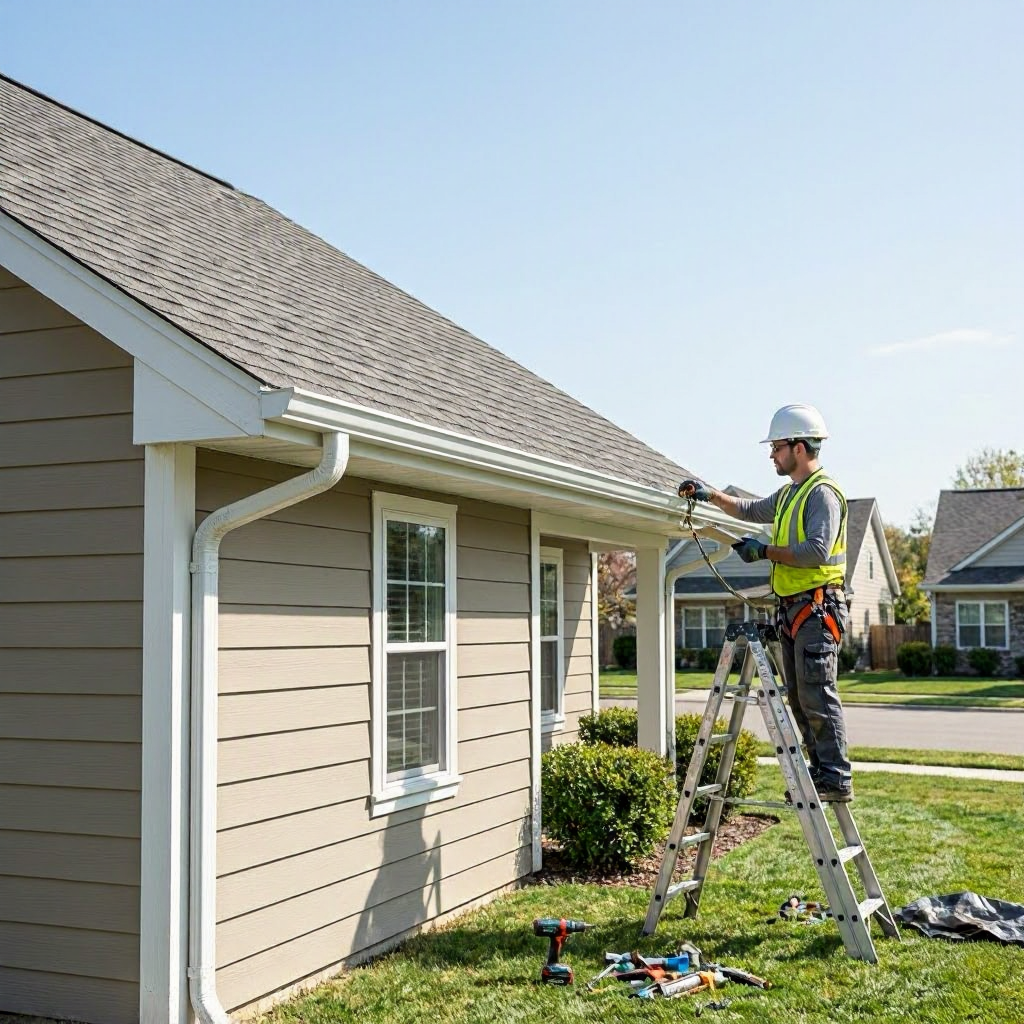
Gutter Replacement Cost
Replacing your home's gutters is a significant investment, but it's essential for protecting your foundation, basement, and landscaping from water damage. This guide walks you through realistic cost ranges, who to contact, and the steps to ensure you get a fair deal. We'll cover what influences the final price, how to handle warranty or insurance claims, and the important local checks to do before any work begins.
Gutter replacement typically costs between $900 and $4,500, with smaller, basic systems starting at $550-$1,500. Premium materials or multi-story homes can push costs over $6,000. Labor is often estimated at $3 to $12+ per linear foot, with an additional $150-$550 to remove and haul away old gutters. Always get detailed, written quotes and check contractor credentials with your state and local building department.
| Item | Detail |
|---|---|
| Typical cost | $900 - $4,500 |
| Best first contact | Local licensed gutter installer or roofer |
| Warranty proof needed | Original contract, warranty documents, receipts, photos |
| Main safety warning | Active leaks, electrical hazards, or unsafe roof access require a pro. |
| When to call a licensed pro | For structural issues, multi-story work, or when permits are required. |
Who to call first
- Who to call first? A local licensed gutter installer or roofer for measurement and a detailed quote.
- What will it cost? Plan for $900-$4,500; labor is $3-$12+ per linear foot.
- What proof is needed for warranty? Keep the original contract, warranty documents, product receipts, and date-stamped photos.
- Which office should I check? Your city/county building department and state contractor license board.
- What are the warning signs? A quote lacking detail, a demand for full payment upfront, or no proof of license/insurance.
- When should I avoid DIY? For high-access work, electrical hazards, structural issues, or if your warranty might be voided.
| Field | Detail |
|---|---|
| Main customer question | Realistic price range, who to call, and how to avoid overpaying. |
| Best first contact | Local gutter installer / roofer. |
| Estimated cost range | $900-$4,500 typical; $550-$1,500 for smaller systems. |
| Labor charges | $3-$12+ per linear foot; removal/haul-away: $150-$550. |
| Official brand contacts | LeafFilter: 1-800-290-6106; LeafGuard: 1-800-LEAFGUARD (800-532-3482). |
| Retailer contacts | Home Depot: 1-800-HOME-DEPOT; Lowe's: 1-800-44LOWES. |
| Warranty claim documents | Invoices, product receipts, warranty docs, installation contract, photos. |
| State agency to check | State contractor board (e.g., California CSLB, Florida DBPR). |
| Safety warning | Do not delay for active leaks, electrical hazards, or unsafe structures. |
| Important URL | Call 811 before digging: call811.com |
The final cost for gutter replacement varies widely based on your home’s size, materials, location, and any hidden damage found. Use the following breakdown as a reference when reviewing quotes.
Average Cost: The typical planning range is $900 to $4,500. Smaller jobs may be $550-$1,500, while premium projects can exceed $6,000.
Line-Item Cost Breakdown:
- Basic aluminum gutter replacement: $900
- $2,500
- Larger two-story home: $2,500
- $5,500+
- Copper/half-round/custom gutters: $4,000
- $12,000+
- Old gutter removal/haul-away: $150
- $550
- Fascia rot allowance: $300
- $2,000+
Labor is a major component. Contractors often quote labor at $3 to $12 or more per linear foot. Be sure the quote clearly separates labor, materials, disposal, and any permit fees.
A surprisingly low quote might be missing critical items like permits, disposal, warranty registration, or an allowance for hidden damage like rotten fascia. A high quote can be reasonable for difficult access, premium materials, emergency timing, or if it includes comprehensive warranties and permit handling.
For skilled homeowners, simple gutter cleaning or minor repairs can be a DIY task. However, full replacement involves significant safety and complexity risks.
When DIY may be feasible:
- You are experienced with roofing, ladders, and basic carpentry.
- The job is on a single-story home with easy, safe access.
- You are only addressing a short, straightforward section.
Call a Pro If: You face high-access work, electrical hazards, structural water damage, or winter ice backup.
When to call a licensed professional:
- The home is multi-story or has difficult roof access.
- There is any sign of structural movement, fascia rot, or electrical issues.
- Local building codes require permits for the work.
- You want to preserve product or workmanship warranties.
- The job involves complex custom materials like copper.
DIY mistakes can lead to improper slope, leaks, and voided warranties, creating more expensive problems down the line.
Your first call should generally be to a local licensed gutter installer or roofer. They are best equipped to measure, assess slope, check for hidden fascia rot, and answer local code and permit questions. Always ask for photos and line-item pricing.
For products purchased through major retailers, you can contact their customer service, but understand that workmanship claims often go through the installer or a separate protection plan.
Keep these contacts handy for questions about products, installations, or service.
Retailer Installation & Service:
- Home Depot: Customer questions: 1-800-HOME-DEPOT (1-800-466-3337). Also listed: 1-800-430-3376 and text support 38698.
- Lowe's: Customer service: 1-800-44LOWES (1-800-445-6937). Protection plan/repair: 1-888-775-6937.
Gutter Protection Brands:
- LeafFilter / Leaf Home: Sales/general: 1-800-290-6106. Service: 800-749-4566. Email: support@leaffilter.com.
- LeafGuard: Free estimate/questions: 1-800-LEAFGUARD (800-532-3482). Service and support: 888-460-6898.
Supplier Contact: - ABC Supply: Supplier for contractors. myABCSupply support: 1-800-226-1280.
Follow these steps to navigate warranty or insurance claims effectively.
- Document Everything. Take date-stamped photos and video before any area is disturbed. Get wide shots and close-ups of the damage.
- Gather Your Paperwork. Collect all invoices, product receipts, warranty documents, the installation contract, permits, and prior maintenance records.
- Contact the Correct Party.
- - For storm or sudden damage, call your homeowners insurance carrier before permanent repairs if it's safe to wait.
- - For product defects, contact the manufacturer or retailer named on your paperwork for a claim form.
- - For workmanship problems, notify the installing contractor in writing and request a written cure plan.
- Escalate if Needed. For unsafe work, permit problems, or suspected unlicensed contracting, contact your local building department and state contractor board.
Warranty Documents Needed: Always keep the original contract, warranty documents, and proof of purchase.
For gutter guards, ask specific questions about what the warranty covers, such as clogs, cleaning labor, reinstallation after roof work, and transfer to a new homeowner.
State-Specific or Local Checks
Rules vary by location. Use this checklist, then verify with your local authorities before signing any contract.
- California: Use the CSLB to verify a C-39 roofing contractor license. Be aware of strict deposit rules.
- Florida: Use the DBPR to verify roofing/building contractors. After storms, be cautious with assignment-of-benefits paperwork.
- Texas: Licensing varies by city. Confirm permits with your city and verify contractor insurance.
- New York / NYC: Exterior work may require DOB permits. In NYC, confirm contractor credentials for scaffold/roof work.
- Illinois / Midwest snow states: Ask contractors about ice-dam prevention, ventilation, and local roofing registration rules.
Remember, structural work, roof replacement, and drainage changes may require permits even if a contractor says they don't.
Before you hire a contractor or approve work, ask these key questions.
- Can you provide a written, line-item quote that separates labor, materials, permits, and disposal?
- What is your license number, and can you show proof of insurance and workers' compensation?
- Who is responsible for obtaining and paying for permits?
- What is the process and pricing if hidden damage (like fascia rot) is found after work begins?
- What is the timeline for cleanup, final inspection, and providing warranty documents?
- What specific warranty do you provide for materials and workmanship?
Watch for these warning signs when getting quotes or dealing with contractors.
- Storm Chaser Pressure: A contractor insists you must sign immediately or hand over an insurance check.
- Vague Scope: The quote doesn't list linear feet, materials, removal, disposal, or warranty details.
- Cash-Only or Full Payment Upfront: A reasonable deposit may be normal, but full upfront payment is risky.
- No Proof of Credentials: The contractor refuses or cannot show license, insurance, or workers' comp proof.
- Hidden Damage Secrecy: They refuse to photograph hidden rot before charging for change orders.
Practical Step-by-Step Guidance
Follow this actionable plan for a smoother gutter replacement process.
- Assess and Measure. Note the problem (leaking, sagging, etc.) and measure total linear feet, corners, stories, and downspouts.
- Research and Verify. Search for local professionals by trade and license type. Check their license with your state board and verify insurance.
- Get Multiple Quotes. For any non-emergency job over $1,000, get at least two or three written quotes with the same scope for a fair comparison.
- Review the Quote Thoroughly. Ensure it includes all line items, material specifications, warranty terms, and a clear payment schedule.
- Secure the Agreement. Sign a written contract only after all details are clarified and state/local checks are complete.
- Document the Process. Take before/during/after photos. Keep all communication and paperwork organized.
- Pay Wisely. Use a traceable payment method. Avoid full payment upfront. Make the final payment only after work is complete, cleaned up, and all warranty documents are received.
Do Not Ignore: Active water entry, sagging structures, or electrical hazards. These are emergencies that require a qualified professional immediately.
Frequently Asked Questions
Should I get more than one quote? Yes. For any non-emergency work, get at least two or three written quotes with the same scope, materials, and warranty terms for a true comparison.
Should I pay the full amount upfront? No. A reasonable deposit may be normal, but paying in full before work starts is a major red flag. Use a traceable payment method and know your state's rules on deposits.
Can a home warranty cover this? Maybe, but home warranty contracts have many exclusions. You must call your warranty company for pre-approval before any non-emergency work if you expect reimbursement.
Can insurance cover this? Insurance typically covers sudden and accidental damage like storm, hail, or a falling tree. Normal wear and tear, poor maintenance, or gradual seepage are usually excluded.
What should be in the written quote? Scope, materials, labor, permit responsibility, disposal, warranty details, timeline, payment schedule, exclusions, and a process for pricing hidden damage.
When is it an emergency? Situations requiring immediate professional help include active water entry into the home, sagging or bowing structures, electrical hazards, or unsafe roof access.
This guide was compiled using information from the following sources for verification:
- HomeAdvisor gutter services and repair cost guides.
- Angi gutter replacement cost article.
- Official contact pages for LeafFilter, Leaf Home, and LeafGuard.
- ABC Supply product and contractor support pages.
- Home Depot and Lowe's corporate contact pages.
- State licensing boards (California CSLB, Florida DBPR).
- Call 811 before digging.
Prices, phone numbers, and warranty rules can change. Always verify costs, contacts, and local regulations with licensed professionals, official brand support, and your local building department before proceeding.
This guide is for general planning and informational purposes only. It does not guarantee prices, insurance coverage, or warranty approval. For structural, electrical, roofing, insurance, or safety questions, always consult licensed local professionals and official agencies. Verify all contractor credentials with your state license board and local building department before hiring.

About the TDL Expert Panel
TDL Expert Panel · TheDigitalLife Editorial Team
TDL Expert Panel is the editorial team behind TheDigitalLife. The team researches, reviews, and creates practical guides to help everyday readers make better decisions about home repair costs, refunds, AI tools, digital safety, productivity, and useful online resources. Each guide is written to be clear, useful, and easy to understand.