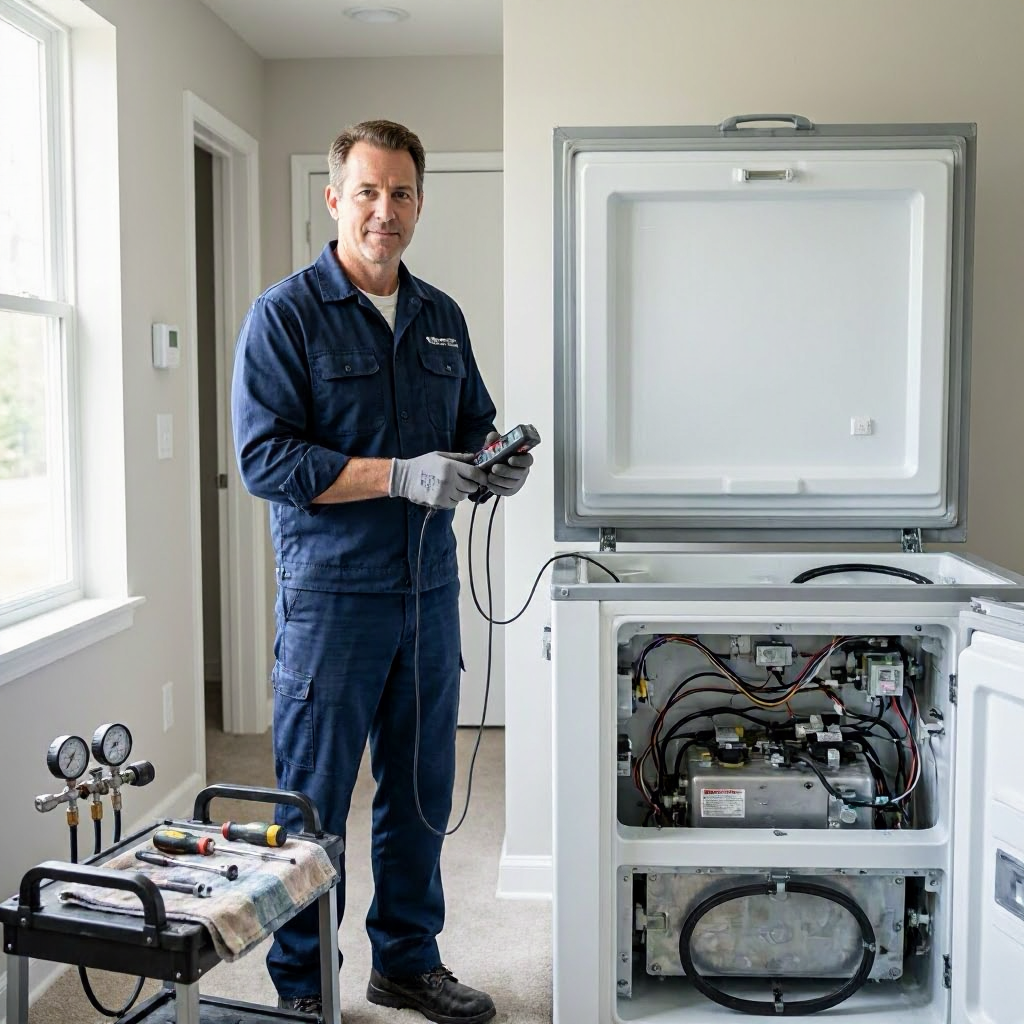
Freezer repair cost: compressor, seal, thermostat, and defrost system
Freezer Repair Basics
Freezer repairs often focus on key components like the compressor, door seal, thermostat, and defrost system. These parts handle cooling, sealing, temperature control, and frost prevention. When they fail, food spoils, energy bills rise, or the unit stops working altogether.
In the United States, freezer repair costs vary widely based on your location, the freezer's age and model, part availability, labor rates, and whether it's a standalone unit or part of a fridge-freezer combo. Urban areas like New York or Los Angeles tend to have higher labor costs than rural Midwest spots. Older freezers from the 1990s or early 2000s may cost more to fix due to scarce parts.
Before spending money, diagnose the issue yourself where safe. Unplug the unit, check power cords, and clean coils. If food thaws or frost builds excessively, note symptoms to share with a technician. This helps avoid unnecessary service calls.
Compressor Issues and Repair Costs
The compressor is the heart of your freezer, pumping refrigerant to create cold air. It runs almost constantly, making it prone to failure after 10-15 years. Common signs include the freezer running but not cooling, unusual humming or clicking noises, or the unit tripping breakers.
Diagnosis often requires a technician to check refrigerant levels and pressures, as low refrigerant can mimic compressor failure. Replacing a compressor involves recovering refrigerant, evacuating the system, installing the new part, and recharging, which demands EPA certification for handling refrigerants.
Compressor replacement typically costs $400 to $1,200, including parts and labor, but this range shifts with factors like unit size (chest vs upright freezers) and brand (Whirlpool, GE, Frigidaire). Parts alone run $200-$600, with labor at $100-$300 per hour in high-cost areas. Emergency weekend service adds 50-100% premiums.
What drives up costs? Custom compressors for high-end or commercial models, sealed system repairs (which include evaporator and tubing), or inaccessible locations like a basement. In older homes, electrical upgrades might be needed if the circuit can't handle the load.
DIY compressor replacement is not recommended for most homeowners. It requires specialized tools, refrigerant handling certification, and risks voiding warranties or causing leaks. Mishandling can release harmful gases or lead to fires. Instead, call a licensed appliance technician through services like Angi or local directories.
Door Seal Replacement Costs
Door seals, or gaskets, keep cold air in and warm air out. Cracks, tears, or warping from age, heat, or heavy use cause frost buildup, poor efficiency, and higher electric bills. Test yours by closing the door on a dollar bill; if it pulls out easily, the seal fails.
Replacement is straightforward compared to other repairs. Measure the old seal, order a model-specific part (often $50-$150), and install by cleaning the groove and pressing it in. No tools beyond a hairdryer for stubborn ones.
Seal replacement usually runs $100 to $400 total. Parts cost $40-$200 depending on freezer size and custom shapes for curved doors. Labor adds $60-$200 if a pro handles it, quicker in apartments than tight garage installs.
Factors influencing price include freezer type (upright seals are taller, chest models wider) and material (magnetic vs adhesive). Vintage freezers might need reproduction parts sourced online, bumping costs. If the door itself is warped, add $200-$500 for alignment or panel repair.
This is a prime DIY candidate for handy homeowners. Watch manufacturer videos on YouTube for your model. Save money by shopping parts at RepairClinic.com or PartSelect.com. Pros make sense for condos with HOA rules or if you're uncomfortable with disassembly.
Thermostat Repair or Replacement Costs
The thermostat regulates temperature by cycling the compressor on and off. Faulty ones cause over-freezing (-10°F extremes), under-cooling (above 0°F), or constant running. Symptoms: fluctuating temps, warm spots, or the dial not responding.
Cold control thermostats are mechanical or digital. Testing involves a multimeter for continuity. Digital ones in smart freezers link to control boards, complicating fixes.
Thermostat repairs cost $150 to $500. Simple mechanical swaps: parts $30-$100, labor $100-$300. Digital or defrost thermostats add $50-$200 for parts due to sensors. Labor rises if accessing behind panels in built-in units.
Cost variations stem from freezer integration (fridge-freezer combos need evaporator access), adaptive defrost models, or failures tied to control boards ($200+ extra). Surge protectors prevent power spikes damaging these parts.
DIY is feasible for mechanical thermostats with basic electrical knowledge. Unplug, discharge capacitors, swap, and test. Avoid if your freezer has sealed electronics or you're unsure—shocks or shorts risk fire. Pros carry insurance for liability.
Defrost System Repair Costs
Defrost systems prevent ice buildup using timers, heaters, termination switches, or adaptive controls. Failures lead to frosted coils, no cooling, or water leaks. Look for heavy frost on back panels, fan blockage, or puddles under the unit.
Components include the defrost heater (melts ice), timer/bimetal switch (starts cycles), and drain line (channels water). Clogged drains from food debris are common.
Defrost repairs range $200 to $700. Heater or timer: $50-$150 parts, $150-$400 labor. Full system (heater, switch, timer): higher end. Drain cleaning: $100-$250 if pro-access needed.
Prices climb with upright vs chest freezers (more disassembly), adaptive defrost in newer Energy Star models, or combined fridge-freezer repairs. Refrigerant recharge if coils iced over adds expense.
Partial DIY works for drain clogs: flush with warm water and baking soda. Heater/timer swaps need multimeter testing but risk electrical hazards. Hire pros for sealed systems to comply with codes and avoid mold from leaks.
Factors That Affect Overall Freezer Repair Costs
Several elements influence your bill beyond the part itself:
- Location and labor rates: $75-$150/hour in cities vs $50-$100 rural. Travel fees $50-$100 for remote areas.
- Freezer specifics: 15+ cu ft units cost more; built-ins or garages add access fees.
- Urgency: Same-day service doubles rates; off-hours triple.
- Age and model: Post-2010 efficient models have pricier proprietary parts; discontinued lines force generics.
- Related issues: Compressor fails often signal low refrigerant ($200+ recharge) or dirty coils (free DIY fix).
- Service type: Diagnostic fees $75-$125, waived if repaired.
| Cost Factor | Why It Matters | Example Impact |
|---|---|---|
| Freezer Location | Access difficulty raises labor time | Basement stairs: +$50-$100 |
| Unit Age | Parts scarcity or obsolescence | 20-year-old: +20-50% for sourcing |
| Service Timing | Demand fluctuates | Weekend: +50-100% premium |
| Combo Unit | Shared components with fridge | Extra disassembly: +$100-$300 |
| Tech Certification | EPA rules for refrigerant | Non-certified: illegal, voids warranty |
Use this table to quiz estimates.
DIY vs Professional Service: When to Choose Each
Safety first: freezers involve electricity, sealed refrigerants, and tight spaces. Never DIY compressors or refrigerant work—federal law requires certification.
| Repair Type | DIY Feasible? | Pro Recommended When |
|---|---|---|
| Door Seal | Yes, basic tools | Warped door or HOA rules |
| Thermostat (mechanical) | Yes, with multimeter | Digital controls or shocks risk |
| Defrost Drain | Yes, cleaning only | Heater/timer electrical |
| Compressor | No | Always—refrigerant handling |
DIY saves 50-70% but demands time and parts research. Buy OEM parts via model number lookup. Pros offer warranties (1-5 years labor/parts) and handle codes.
Getting Reliable Estimates and Avoiding Overcharges
Call 3+ licensed techs via Appliance Repair directories or Nextdoor. Provide model/serial numbers, symptoms, photos of frost/error codes.
Key questions:
- Is diagnostic fee included if I proceed?
- Does quote cover parts, labor, refrigerant, disposal of old parts?
- What's the warranty on labor/parts?
- Any trip or after-hours fees?
- Will you pull the permit if needed (rare for appliances)?
- EPA certified for sealed systems?
Insist on written estimates detailing line items. Compare apples-to-apples: reject vague "full repair $800." Watch for upsells like unnecessary control boards.
FTC warns of scams: avoid door-knockers or cash-only demands. Verify licenses via state contractor boards (e.g., California's CSLB). For more, see FTC home improvement scams and home repair scams.
Sample renter email to landlord: "My freezer gasket failed, causing frost. Lease section X says appliances are your responsibility. Can you arrange repair?"
Insurance, Warranties, and When Repairs Don't Make Sense
Homeowners insurance rarely covers freezer repairs unless sudden damage (e.g., power surge). Wear-and-tear exclusions apply. File claims for lightning strikes; deductibles $500+ often exceed repair costs.
Home warranties (Choice Home Warranty, American Home Shield) cover appliances for $75-$125 service calls, then cap payouts ($500-$1,500). Check your policy.
Manufacturer warranties (1-5 years) may cover parts; extended ones via retailers. If repair >50% new unit cost ($400-$1,000 for basics), replace.
Renters: Review lease—landlords handle major appliances. Document issues with photos/temps for security deposits.
HOA/condo: Shared utility freezers may need board approval.
Maintenance to Prevent Costly Repairs
Regular care extends life to 15-20 years:
- Vacuum coils quarterly (behind/back).
- Level unit for seal contact.
- Check seals yearly with dollar bill test.
- Defrost manual units fully.
- Keep 2-3" space around for airflow.
- Use surge protectors.
- Set 0°F; monitor with thermometer.
Track repairs in a log: dates, parts, invoices. Photos before/after aid future claims.
Signs Your Freezer Needs Full Replacement
Persistent issues across components signal end-of-life. Budget $300-$2,000 new: energy-efficient models save $50/year electricity. Tax credits via Energy Star.
Weigh total ownership: if annual repairs exceed $200, upgrade.
By understanding these costs and steps, you can budget smartly, spot fair deals, and keep your food frozen without surprises. Get local quotes tailored to your setup.

About the TDL Expert Panel
TDL Expert Panel · TheDigitalLife Editorial Team
TDL Expert Panel is the editorial team behind TheDigitalLife. The team researches, reviews, and creates practical guides to help everyday readers make better decisions about home repair costs, refunds, AI tools, digital safety, productivity, and useful online resources. Each guide is written to be clear, useful, and easy to understand.