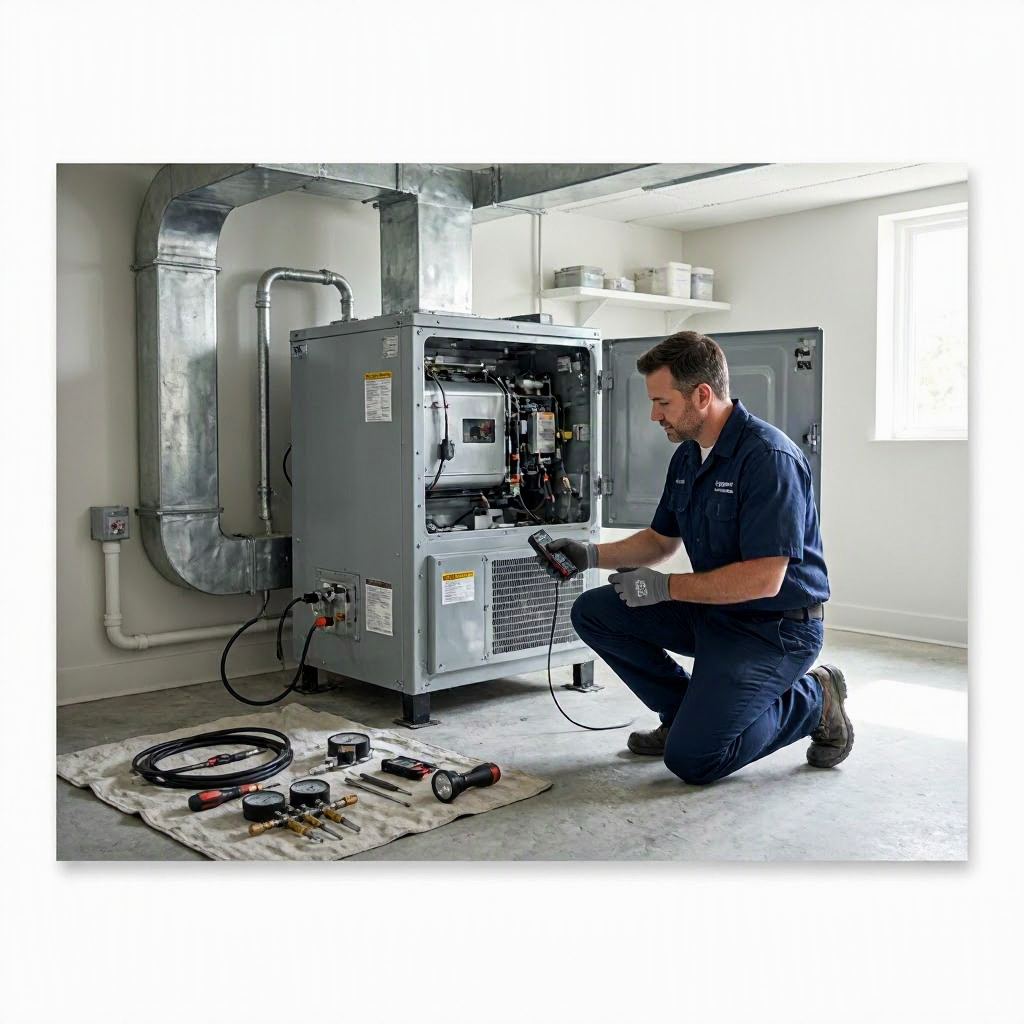
Emergency Furnace Repair Cost During Winter
Your furnace breaking down on a cold winter night is a stressful event. This guide is designed to help you navigate that emergency with clarity. We’ll walk you through realistic cost ranges, who to call first, how to handle warranty claims, and the steps to verify a contractor before you pay.
Our goal is to help you make an informed decision, separate a comfort emergency from a true safety emergency, and ensure you get a fair diagnosis and repair for your home.
Emergency furnace repairs typically cost between $200 and $1,500 or more, depending on the failed part and the timing of the call. An after-hours, weekend, or holiday service call often adds a $100 to $300+ surcharge. For life-safety emergencies like a gas smell, suspected carbon monoxide, fire, or smoke, call your utility company or 911 immediately before contacting an HVAC company.
What you should expect to pay for parts and labor - Decidi
- What you should expect to pay for parts and labor
- Deciding between a repair and a full system replacement
- Who you should contact first based on your situation
- How to find official brand support and verify warranties
- Steps to make a successful warranty claim
- How to check your state or local contractor licensing
- Key questions to ask before approving any work
- Warning signs of overcharging or unsafe practices
Additional reference details:
- Item: Typical emergency repair cost , Detail: $200–$1,500+
- Item: Common after-hours surcharge , Detail: $100–$300+
- Item: Best first contact for no-heat , Detail: Licensed local HVAC contractor
- Item: Main safety warning , Detail: Gas smell, CO, fire, smoke: call utility/911 first
- Item: Warranty proof needed , Detail: Model & serial numbers, installer name, registration proof
- Item: When to call a licensed pro , Detail: For refrigerant, gas, electrical, or complex component repairs
Who to call first
- Who to call first? A local licensed HVAC contractor is a good start. For warranty work, contact a brand-authorized dealer.
- What will it cost? Expect a range from $200 to over $2,000, heavily influenced by the specific part and service timing.
- What proof is needed for warranty? You need the equipment's model and serial number, installation date, and proof of registration.
- Which state office should I check? Verify your contractor's license with your state's licensing board before major work.
- What are the warning signs? Verbal-only quotes, pressure to replace the whole system, and refusal to provide license details are red flags.
- When should I avoid DIY? Any repair involving refrigerant, natural gas, the electrical system, or the heat exchanger requires a licensed professional.
Additional reference details:
- Customer Question: No heat, need diagnostics , Best First Contact & Key Details: Local licensed HVAC contractor. Diagnostic fee: $125–$300+.
- Customer Question: Warranty-covered repair , Best First Contact & Key Details: Brand-authorized dealer. Have model & serial number ready.
- Customer Question: Unit purchased from a big-box store , Best First Contact & Key Details: Retailer’s installation support (e.g., Home Depot: 855-583-0553, Lowe’s: 888-516-1010).
- Customer Question: Gas smell or suspected CO , Best First Contact & Key Details: Utility company or 911 immediately. This is a life-safety emergency.
- Customer Question: Verify contractor license , Best First Contact & Key Details: Your state’s licensing board (e.g., CSLB for CA, TDLR for TX).
- Customer Question: Need brand customer support , Best First Contact & Key Details: Use official numbers: Carrier (1-800-CARRIER), Trane (1-800-945-5884), Lennox (1-800-953-6669).
Understanding the potential costs can help you budget and evaluate quotes. The national cost ranges below are planning estimates, not guaranteed quotes. Your final price can be higher in dense metropolitan areas, for after-hours calls, in extreme weather, for older homes, or if the unit is in a difficult-to-access attic or crawlspace.
Average Cost: A typical emergency furnace repair costs between $200 and $1,500+, with significant after-hours fees.
Here is a breakdown of common repair costs homeowners should know:
Additional reference details:
- Repair / Line Item: After-hours diagnostic fee , Estimated U.S. Cost Range: $125 – $300+
- Repair / Line Item: Ignitor or flame sensor replacement , Estimated U.S. Cost Range: $150 – $500
- Repair / Line Item: Thermostat or control board repair , Estimated U.S. Cost Range: $150 – $600
- Repair / Line Item: Blower motor replacement , Estimated U.S. Cost Range: $300 – $2,000
- Repair / Line Item: Heat exchanger or gas valve repair , Estimated U.S. Cost Range: $600 – $2,000+
These prices usually include the diagnostic fee, the part, and the labor. However, you must ask for a detailed quote that separates each charge. For repairs involving refrigerant (in a heat pump or central AC), ask if the technician has EPA Section 608 certification and if the leak has been located. For gas furnace work, ask how combustion safety and carbon monoxide risk will be checked after the repair.
For any quote above $800 to $1,000, it's wise to ask for the repair-versus-replacement recommendation in writing, including the system's model number, serial number, age, and warranty status.
Some minor furnace issues are safe for a homeowner to check. Others absolutely require a licensed professional.
When DIY May Be Safe:
- Changing the air filter.
- Replacing thermostat batteries.
- Checking and resetting the circuit breaker.
- Ensuring the outdoor unit is clear of debris, snow, or ice.
When to Call a Licensed Professional:
- Any work involving refrigerant, the compressor, or the sealed system.
- Any repair involving natural gas lines, valves, or the heat exchanger.
- Electrical wiring or control board repairs.
- Diagnosing a persistent problem or a complete lack of heat.
Call a Pro If: You smell gas, suspect carbon monoxide, see smoke, or hear unusual electrical sounds. This is not a DIY situation.
Attempting complex repairs yourself can void the manufacturer's warranty, create serious safety hazards, and often leads to more costly damage. The tools, knowledge, and certifications required for HVAC work justify calling a pro.
Your first call depends on the nature of your problem.
- Local Licensed HVAC Contractor: This is your best first call for general diagnostics, emergency service, refrigerant work, furnace safety checks, and ductwork issues. They are equipped for most repairs.
- Brand-Authorized Dealer: If your unit is under warranty or needs a major OEM part (like a compressor, coil, or proprietary control board), start with a dealer authorized by your furnace's brand (e.g., Carrier, Trane, Lennox).
- Retailer / Installer: If you purchased your system through a big-box store's installed-services program, contact Home Depot or Lowe’s installation support with your order number.
- Utility Company or 911: For a gas smell, suspected carbon monoxide (CO), smoke, fire, or electrical hazard, call emergency services or your utility company first. Do not call a repair company for these life-safety emergencies.
Always use official websites and phone numbers to avoid scams. Here are key contacts for support and warranty verification.
| Company / Agency | Purpose | Official Phone | Official Website |
|---|---|---|---|
| Carrier Residential | Warranty lookup / Dealer support | 1-800-CARRIER (1-800-227-7437) | carrier.com |
| Trane Residential | Consumer relations | 1-800-945-5884 | shop.trane.com |
| Lennox Residential | Consumer support | 1-800-953-6669 | lennox.com |
| Goodman / Daikin | Homeowner / warranty support | 1-877-254-4729 | goodmanmfg.com |
| Bryant | Customer relations | 1-800-428-4326 | bryant.com |
| YORK / Johnson Controls | Warranty / product support | 877-874-7378 | york.com |
| Home Depot HVAC Repair | Service line for repairs | (855) 583-0553 | homedepot.com |
| Lowe’s Installation Support | Installation support | 1-888-516-1010 | lowes.com |
| ecobee | Smart thermostat support | 1-877-932-6233 | ecobee.com |
Follow these steps to navigate a warranty claim smoothly.
- Gather Equipment Information: Find the data plate on your furnace and write down the model number, serial number, installation date, and the original installer's name.
- Check Warranty Registration: Determine if the equipment was registered with the manufacturer within their required window. Many full warranties depend on proper registration by the original owner.
- Ask the Contractor: Have the servicing contractor check if the failed part is covered under the manufacturer's parts warranty. Get their answer in writing.
- Ask What’s Not Covered: Understand that labor, refrigerant, shipping, diagnostic fees, and after-hours surcharges are often not covered, even if the part itself is.
- Contact the Retailer if Applicable: If your system was installed via Home Depot, Lowe’s, or another program, call their installation support line with your order number.
- Keep Everything: Maintain a file with photos of the issue, the final invoice, the diagnostic sheet, and all related texts or emails. If a contractor refuses to provide written documentation for a major repair, get a second opinion.
Warranty Documents Needed: Always have your furnace’s model number, serial number, and installation paperwork ready before you call.
State-Specific or Local Checks
HVAC licensing and permit rules vary greatly. Before approving major work, verify your contractor's license and ask if a permit is required.
| State / Area | What to Check | Official Place to Start |
|---|---|---|
| California | Check CSLB contractor license. | cslb.ca.gov |
| Texas | Verify TDLR Air Conditioning license. | tdlr.texas.gov |
| Florida | Use DBPR license search for HVAC contractors. | myfloridalicense.com |
| New Jersey | Verify via NJ Consumer Affairs HVACR Board. | njconsumeraffairs.gov |
| New York (NYC) | Check NYC Dept. of Buildings for permits. | nyc.gov |
| Illinois (Chicago) | Check Chicago Building Department rules. | chicago.gov |
| Arizona | Check Arizona Registrar of Contractors. | roc.az.gov |
| Washington | Verify via WA L&I contractor registration. | secure.lni.wa.gov |
Arm yourself with these questions before you approve any repair.
- What exact part failed, and what test proves it failed?
- Is the replacement part OEM, aftermarket, or rebuilt? What warranty applies to the part and the labor?
- Is refrigerant involved? If yes, what type and how many pounds are needed?
- Are there any additional problems that could cause the new part to fail again?
- Is this repair reasonable for the age and overall condition of my system?
- Does this quote include everything: haul-away, disposal, permit, inspection, taxes, trip fee, and emergency surcharge?
- Can you provide your license number, proof of insurance, and a written scope of work?
Be cautious if you encounter any of these warning signs, which may indicate overcharging or unsafe work.
- The technician recommends adding refrigerant without explaining where the leak is or if a leak search was performed.
- The quote is verbal only, with no written model number, part name, warranty details, or labor description.
- The company pressures you to replace the entire system before showing you the failed component or providing a clear safety reason.
- A contractor claims to be “EPA certified” for duct cleaning. The EPA does not certify duct-cleaning companies.
- A contractor requests full payment up front for major work or refuses to provide license and insurance details.
- A technician offers to “top off” your refrigerant every year without finding and fixing the leak.
Practical Step-by-Step Guidance
Follow this action plan when your furnace fails.
- Assess Safety First: If you smell gas, suspect CO, or see smoke/fire, evacuate and call 911 or your utility. For simple "no heat," proceed.
- Do Basic Checks: Verify your thermostat is set to "heat," check the circuit breaker, and replace the air filter.
- Choose Who to Call: Decide between a local HVAC pro (general repair) or a brand-authorized dealer (warranty work).
- Verify the Contractor: Before they arrive, check their license status with your state board.
- Get a Clear Diagnosis: A proper visit should identify the failed part and the reason it failed.
- Review the Detailed Quote: Ensure it separates diagnostic fee, parts, labor, and any surcharges. Ask the key questions listed above.
- Document Everything: Keep the diagnostic report, written quote, invoice, and all communication.
- Follow Up on Warranty: If applicable, contact the manufacturer or retailer using your gathered documents.
Frequently Asked Questions
Should I call a brand dealer or any local HVAC company? For routine diagnostics and emergency service, a licensed local HVAC company is often fine. For work that may be under warranty, or for major OEM parts on newer systems, start with a brand-authorized dealer or the original installer.
Should I approve the repair immediately? For small, urgent comfort repairs under a few hundred dollars, it's often reasonable to proceed. For repairs above $800 to $1,000, take a moment to get warranty status and consider a second quote, unless it's a severe safety or weather emergency.
Can I do this repair myself? Homeowner-friendly tasks include filter changes, thermostat battery replacement, and checking the breaker. Refrigerant, compressor, gas, and electrical repairs should always be handled by licensed professionals due to safety risks and code requirements.
What documents should I keep? Always keep the final invoice, part numbers, model/serial numbers, photos of the work, any written warranty statement, the contractor's license number, and your payment receipt.
How do I avoid repeat repairs? Preventative maintenance is key. Change filters regularly, keep indoor coils and outdoor units clean and clear, schedule annual professional tune-ups, correct duct airflow problems, and insist on finding and fixing refrigerant leaks instead of just adding more refrigerant.
Do Not Ignore: A contractor who refuses to provide a written, itemized quote for a major repair. This is a sign to get a second opinion.
This article was compiled using information from industry cost guides, official manufacturer resources, and state licensing boards. Prices and regulations change, so always verify details locally.
- Angi Furnace Repair Cost Guide: angi.com
- HomeAdvisor Furnace Repair Cost: homeadvisor.com
- ENERGY STAR HVAC Maintenance Checklist: energystar.gov
- EPA Section 608 Technician Certification: epa.gov
For the most current warranty terms, support contacts, and licensing information, please use the official phone numbers and websites provided in the tables above.
This guide provides general information to help you plan and ask the right questions. It is not a substitute for professional advice. Always verify contractor licenses, warranty terms, and permit requirements with your local and state authorities. For any situation involving immediate danger to life or property, contact emergency services or your utility company without delay.

About the TDL Expert Panel
TDL Expert Panel · TheDigitalLife Editorial Team
TDL Expert Panel is the editorial team behind TheDigitalLife. The team researches, reviews, and creates practical guides to help everyday readers make better decisions about home repair costs, refunds, AI tools, digital safety, productivity, and useful online resources. Each guide is written to be clear, useful, and easy to understand.