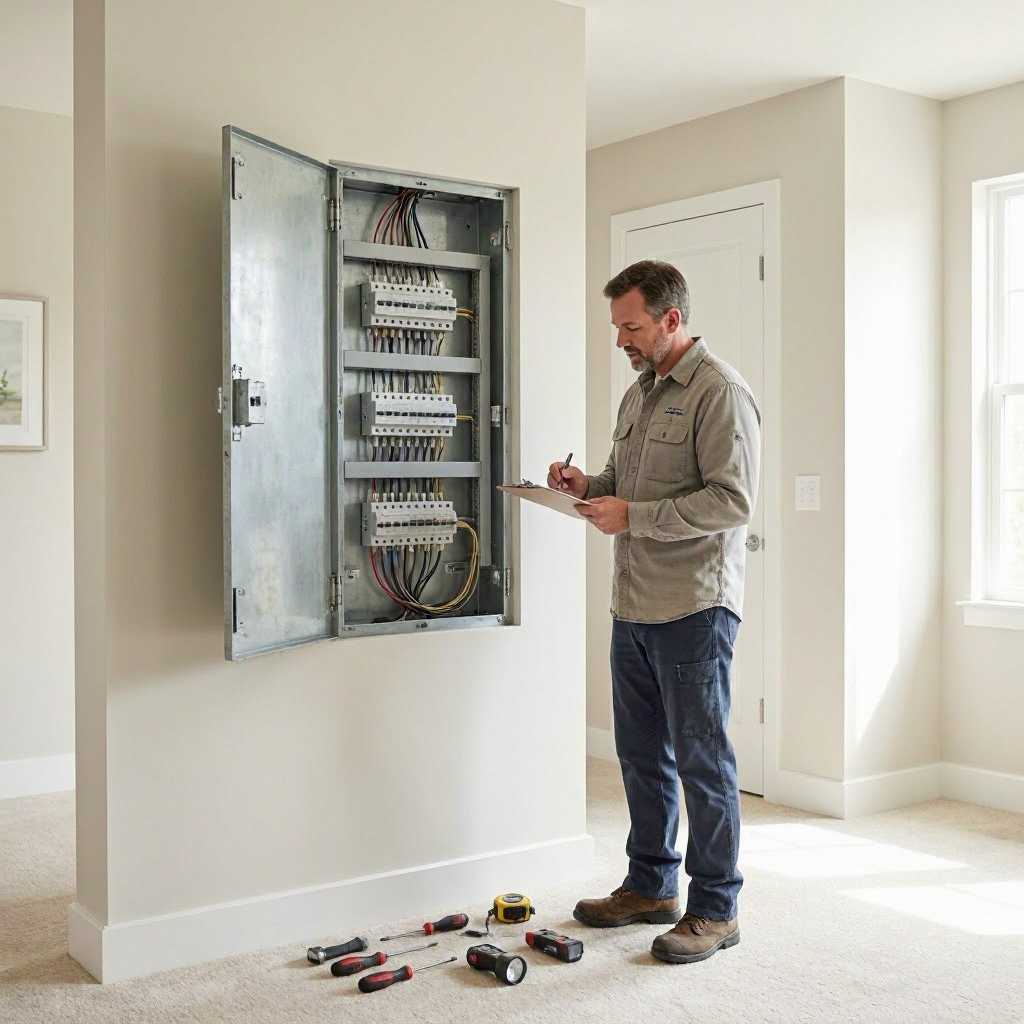
Electrical Inspection Cost Before Buying a House
Buying a home is a huge investment, and the last thing you want is a surprise electrical repair bill after you move in. A pre-purchase electrical inspection gives you a clear picture of the home's wiring, panels, and overall safety. This guide breaks down the typical costs, who to contact, and how to use the findings to negotiate confidently before closing.
The cost of an electrical inspection before buying a house typically ranges from $150 to $800+, depending on the home's size, age, and the scope of the inspection. A basic review of panels and outlets starts around $150-$400, while a detailed inspection for older homes with potential issues like knob-and-tube wiring can run $300-$800+. You should hire a licensed electrician for this job, as a general home inspector is not a substitute for a specialist.
Cost Breakdown and What Changes the Price - DIY vs
- Cost Breakdown and What Changes the Price
- DIY vs. Hiring a Professional
- Who to Contact and When
- Official Brand and Agency Contacts
- Warranty and Claim Steps
- State and Local Verification
- Key Questions to Ask and Red Flags
- Step-by-Step Guidance and FAQs
Additional reference details:
- Item: Typical cost , Detail: $150 - $800+
- Item: Pro service cost , Detail: Licensed electrician inspection; $150 - $800+
- Item: Best first contact , Detail: Licensed electrician
- Item: Main safety warning , Detail: Stop use and call an electrician for burning smell, sparks, hot panels, or repeated breaker trips.
- Item: Warranty proof needed , Detail: Invoice, permit number, inspection record, product model/serial numbers, photos.
- Item: When to call a pro , Detail: For any pre-purchase inspection, diagnosis, or safety-related electrical work.
Who to call first: A licensed electrician for a dedica
- Who to call first: A licensed electrician for a dedicated inspection.
- What it will cost: Expect $150-$400 for a basic check; older homes may cost $300-$800+.
- Proof for warranty: Save the invoice, permit, inspection approval, product model/serial numbers, and photos.
- State/local check: Verify your electrician's license with your state board and check permit rules with your city/county building department.
- Warning signs: Contractor refuses to provide a license number, asks for full payment upfront, or says permits are never needed.
- Avoid DIY: For safety and code compliance, a licensed electrician should handle the inspection and any related repairs.
Average Cost: Most homeowners spend $150 to $400 for a basic electrical inspection before purchase.
| Main Customer Question | Detail |
|---|---|
| Best first contact | Licensed electrician. |
| Estimated cost range | Basic inspection: $150 - $400+. Detailed old-home inspection: $300 - $800+. |
| Labor charges | Often a service-call minimum plus hourly rate. Larger projects may be fixed-price. |
| Fitting/installation contact | Licensed electrician for installation and permits. |
| Official brand contacts | Square D: 888-778-2733. Eaton: 1-800-386-1911. Siemens: 1-800-347-6659. Leviton: 1-800-824-3005 (option 4). |
| Warranty claim documents | Invoice, permit number, inspection record, product model & serial numbers, photos. |
| State/local agency to check | City/county building department for permits; state electrical licensing board to verify the electrician. |
| Safety warning | If you smell burning, see sparks, feel heat, or have repeated breaker trips, stop using the circuit and call a licensed electrician immediately. |
| Important URLs | California CSLB: cslb.ca.gov. Texas TDLR: tdlr.texas.gov. Florida DBPR: myfloridalicense.com. |
The final price depends heavily on local labor rates, permit requirements, the age of the home, and accessibility. Electricians may charge a service-call minimum plus an hourly rate, or provide a fixed-price quote for larger projects.
Here are the common inspection cost ranges:
- **Basic Electrician Inspection ($150
- $400+):** Covers the main electrical panel, outlets, visible wiring, grounding, and general safety notes.
- **Detailed Old-Home Electrical Inspection ($300
- $800+):** Requires more time to inspect for knob-and-tube wiring, aluminum branch wiring, panel defects, and a thorough review of attic and basement spaces.
- **Home Inspector Add-On ($75
- $250+): A general home inspector can provide a useful first pass, but this is not a substitute** for an electrician's expertise on defects.
- **Written Repair Estimate ($100
- $500+):** After the inspection, you can pay for a detailed quote for any needed repairs. Some electricians credit this fee toward the future job.
Always ask what is included in the quoted price. Key factors that affect cost are labor, permit fees, inspection fees, device/material costs, utility coordination, and potential drywall repair.
For safety and legal reasons, a pre-purchase electrical inspection is a job for a licensed electrician. Some states allow homeowners to do limited electrical work on their own property, but permits and inspections are often still required.
A professional electrician brings critical knowledge of local codes, can identify hidden hazards, and provides a written report you can use for negotiation. Attempting a DIY inspection could miss serious safety issues, void potential warranties, and may not be accepted by your home insurance provider or during the sale negotiation process.
Your first and most important contact is a licensed electrician. They can diagnose issues, provide a quote, pull permits, and ensure code compliance.
Here’s who to contact based on your specific need:
- For diagnosis, quote, and installation: Licensed electrician. Always ask for their license number and proof of insurance.
- For permit rules: Your city or county building department (the Authority Having Jurisdiction or AHJ).
- To verify a license: Your state’s electrical licensing board before paying any deposit.
- For a general home inspection: A certified home inspector, but remember this does not replace an electrician's specific evaluation.
- For insurance questions: Your home insurance provider. Ask if old panels, knob-and-tube, or aluminum wiring affect your policy or insurability.
Call a Pro If: You are buying a home, especially one built before 1980, or if a general inspector notes any electrical concerns.
For product support, warranty questions, or breaker compatibility, use these official contacts. Do not rely on random sponsored phone numbers.
Additional reference details:
- Brand / Source: Square D / Schneider Electric , Official Website: se.com/us/en/brands/squared/ , Official Contact: 888-SQUARED (888-778-2733) , Use For: Square D panels, QO/Homeline breakers, warranty support.
- Brand / Source: Eaton / Cutler-Hammer , Official Website: eaton.com/us/en-us/support/customer-support.html , Official Contact: 1-800-386-1911 or 1-877-386-2273 , Use For: BR/CH load centers, breakers, surge devices, warranty support.
- Brand / Source: Siemens , Official Website: siemens.com/en-us/content/power-distribution-systems-product-support/ , Official Contact: 1-800-347-6659 , Use For: Siemens load centers, breakers, meter/main and panel support.
- Brand / Source: Leviton Load Centers , Official Website: leviton.com/support/resources/product-support/decora-smart-support/leviton-load-center/ , Official Contact: 1-800-824-3005 (option 4) , Use For: Leviton smart/load center product support and warranty.
Keep organized records from the start. This makes any future claim process much smoother.
- Save all documents: Keep the electrician's invoice, permit number, final inspection approval record, product model and serial numbers, and before/after photos.
- Identify the issue: If a product fails, contact the installer first. This helps separate labor/workmanship issues from a manufacturer product defect.
- Start the correct claim path:
- - For workmanship disputes, start with the contractor and then contact the state license board or consumer protection agency if unresolved.
- - For defective devices, contact the retailer (with your receipt/order number) or the manufacturer directly using the model/serial numbers and purchase date.
- - If insurance is involved, ask your insurer what documentation they need before repairs begin.
Warranty Documents Needed: Save the invoice, permit, inspection record, and product model/serial numbers.
State-Specific or Local Checks
Electrical rules vary by location. Always verify your electrician's license and check local permit requirements.
| State / Area | What to Do | Official Link / Lookup |
|---|---|---|
| California | Check CSLB license status for a C-10 Electrical Contractor. | cslb.ca.gov/onlineservices/checklicenseII |
| Texas | Verify electricians through TDLR; check local AHJ requirements. | tdlr.texas.gov/verify.htm |
| Florida | Verify electrical contractors through DBPR / MyFloridaLicense. | myfloridalicense.com/wl11.asp |
| New York City | Most work requires a permit and a DOB-licensed electrical contractor. | nyc.gov/site/buildings/property-or-business-owner/electrical-permit.page |
| Washington | Use WA L&I's Verify a Contractor/Tradesperson/Business tool. | lni.wa.gov/licensing-permits/contractors/hiring-a-contractor/verify-contractor-tradesperson-business |
| Minnesota | Homeowners and contractors should use MN DLI electrical permit guidance. | dli.mn.gov/workers/homeowners/electrical-permits-homeowners |
| Other States | Use your city/county building department for permits and your state electrical licensing board for license lookup. | Ask your electrician for their license and permit numbers. |
Before you approve any work or pay a deposit, get clear answers to these questions:
- Is a permit required, and will you pull it under your license?
- What exact brand and model number will be installed? Is it listed/approved for this use?
- What is included in the quote? What is excluded (e.g., drywall repair, painting, trenching, utility fees)?
- How long will the power be off? Who coordinates any required utility shutoff and reconnect?
- Will I receive a final inspection approval or certificate after the job?
- What is the payment schedule? What are the labor and manufacturer warranty terms?
Be cautious if you encounter any of these warning signs: - T
Be cautious if you encounter any of these warning signs:
- The contractor refuses to provide a license number, permit plan, or written scope of work.
- The quote is much lower than others but excludes permits, inspections, or required safety devices.
- The installer asks for full payment before materials are delivered or work starts.
- The contractor states that permits are "never needed" without checking your local rules.
- The contractor cannot clearly explain the difference between labor warranty and manufacturer warranty.
Practical Step-by-Step Guidance
Follow these steps to get a reliable inspection and use it effectively in your home purchase.
- Hire a Licensed Electrician: Find and vet a licensed electrician. Verify their license with your state board.
- Schedule the Inspection: Explain you are a potential buyer and need a thorough pre-purchase inspection. Opt for the detailed inspection if the home is older.
- Get a Written Report: Request a detailed written report of all findings, separating safety defects (like faulty wiring, overloaded circuits) from optional upgrades.
- Use for Negotiation: Present the electrician's report to the seller's agent. Use it to request repair credits, seller-paid repairs, or a price reduction.
- Compare Repair Quotes: If repairs are needed, get at least three written estimates from licensed electricians. Compare the full scope, not just the final price.
- Verify Completion: Ensure all agreed-upon repairs are completed by a licensed professional, with permits pulled and final inspections passed, before closing.
Do Not Ignore: A written electrician's report is a powerful tool for negotiation. Ask them to separate safety defects from optional upgrades.
Frequently Asked Questions
Can I do this job myself? For safety and code reasons, most electrical inspection and repair work should be handled by a licensed electrician. A DIY inspection could miss critical issues and won't hold the same weight in purchase negotiations.
Why do quotes vary so much? Costs vary by local labor rates, permit requirements, the age and size of the home, accessibility, the condition of the panel and wiring, and the brands of materials used.
Should I use a big-box store installation service or a local electrician? Both can work. Big-box programs may simplify purchasing, but local electricians are often faster for custom troubleshooting, permits, and complex work in older homes. Carefully compare the written scope of work from each.
What should I save after the job? Save the electrician's invoice, the permit documentation, the final inspection approval certificate, all product manuals, warranty registrations, model/serial numbers, and before/after photos.
Can I use this inspection to negotiate a home purchase? Yes. A written report from a licensed electrician is strong evidence to support requests for repair credits, seller repairs, or a lower purchase price.
When is a general home inspection not enough? A general inspection is a good first pass, but it is not enough if the home is old, the general inspector notes electrical concerns, or you see signs like a fuse box, frequent breaker trips, or outdated outlets.
This article was fact-checked against reputable cost guides and official agency websites, including:
- HomeAdvisor Electrical Cost Guide (homeadvisor.com/cost/electrical/)
- Angi Electrical Panel Replacement Cost (angi.com/articles/cost-replace-circuit-breaker-box.htm)
- NFPA Electrical Safety in the Home (nfpa.org)
- Official state licensing boards (CSLB, TDLR, DBPR, etc.)
- Official manufacturer support sites (Square D, Eaton, Siemens, Leviton)
Please note: Costs, regulations, and contact information can change. Always re-check local rules, current prices, warranty terms, and official contacts with your licensed electrician, local building department, and product manufacturers before making decisions.
Electrical work involves significant safety and legal considerations. This guide is for informational planning only. Always verify information with licensed professionals, official brand support, your state licensing board, and your local building department. For any emergency situation-such as a burning smell, sparks, or hot electrical panels-stop using the circuit and call a licensed electrician or emergency service immediately.

About the TDL Expert Panel
TDL Expert Panel · TheDigitalLife Editorial Team
TDL Expert Panel is the editorial team behind TheDigitalLife. The team researches, reviews, and creates practical guides to help everyday readers make better decisions about home repair costs, refunds, AI tools, digital safety, productivity, and useful online resources. Each guide is written to be clear, useful, and easy to understand.