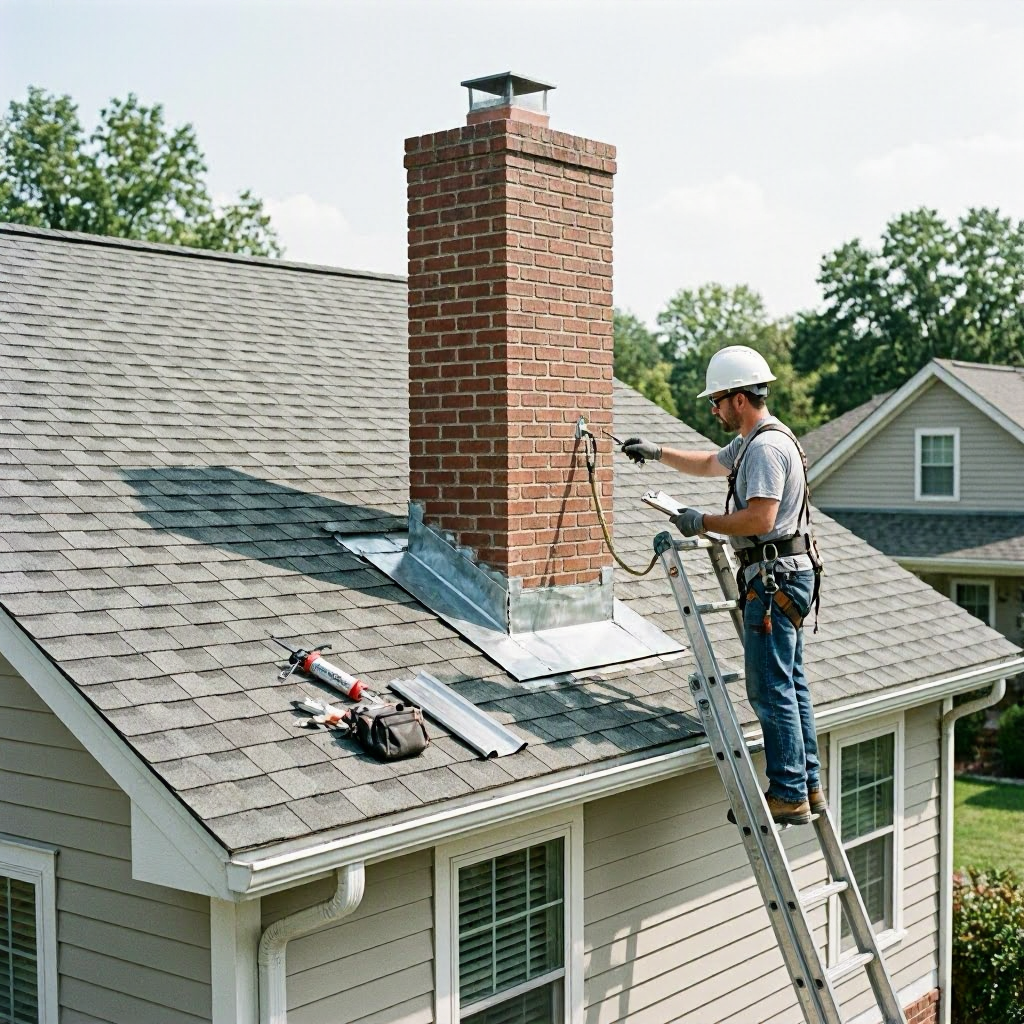
Chimney Flashing Repair Cost
Dealing with a leak around your chimney can be stressful and confusing. This guide is designed to help you understand the potential costs, who to call, and what steps to take. You will get clear, practical information to make an informed decision about this crucial home repair.
Repairing chimney flashing costs between $800 and $3,000+, with the final price depending on chimney size, roof pitch, and the condition of the masonry. For a temporary patch, you might pay $200 to $600. A licensed roofer is typically the best first contact for flashing issues, but you may also need a chimney mason if the brickwork or crown is damaged.
Additional reference details:
- Item: Typical cost , Detail: $800 – $3,000+
- Item: Best first contact , Detail: Licensed roofing contractor
- Item: Main safety warning , Detail: Call 911 for fire, electrical, or structural danger
- Item: Warranty proof needed , Detail: Photos, invoices, warranty docs, contractor diagnosis
- Item: When to call a pro , Detail: For leaks, flashing repairs, structural issues, or fall-risk work
Who to call first
- Who to call first? A licensed roofing contractor for flashing issues; a chimney sweep or mason for structural chimney problems.
- What will it cost? A full reflashing job typically runs $800 to $3,000+, but hidden damage can increase this.
- What proof is needed for warranty? Photos of damage, installation date, contractor info, invoices, and warranty registration.
- Which office should I check? Your local building department for permits, and your state's contractor licensing board.
- What are the warning signs? Contractors pressuring you after a storm, vague quotes, or asking you to skip permits.
- When to avoid DIY? For any work involving leaks, flashing, structural repairs, or high-risk roof access.
| Customer Question | Answer |
|---|---|
| Main cost range | $800–$3,000+ |
| Best first contact | Licensed roofing contractor |
| Estimated labor/material costs | See detailed cost table below. Labor, materials, and permits are separate. |
| Official brand contacts | GAF, Owens Corning, CertainTeed for product warranty claims. |
| Retailer contacts | Home Depot: 1-800-466-3337; Lowe’s: 1-800-445-6937 |
| Warranty claim docs | Photos, invoice, model/brand info, contractor diagnosis, warranty documents. |
| State/local agency to check | Local building department for permits; state licensing board (e.g., CA CSLB, FL DBPR). |
| Safety warning | Call 911 for fire, smoke, structural danger, or active electrical hazard. |
| Important URLs | GAF: gaf.com |
Use the following price breakdown as a reference when reviewing contractor quotes. Always ask for labor, materials, permit fees, disposal, and warranty terms to be listed separately in writing.
Additional reference details:
- Line Item: Minor seal/patch , Typical Planning Range / Note: $200–$600 (often a temporary fix)
- Line Item: Reflashing chimney , Typical Planning Range / Note: $800–$3,000+
- Line Item: Counterflashing cut into masonry , Typical Planning Range / Note: $1,000–$3,500+
- Line Item: Chimney crown/mortar repair , Typical Planning Range / Note: $500–$2,500+
- Line Item: Interior leak damage repair , Typical Planning Range / Note: $300–$2,000+ (separate from roof work)
These are national planning estimates. Your final cost depends on local labor rates, emergency timing, material grade, roof access difficulty, permit needs, and any hidden damage found during the repair.
Average Cost: The most common price range for a full chimney flashing repair is $800 to $3,000+.
A low quote might be missing necessary items like permits, disposal fees, or allowances for hidden damage. A high quote can be reasonable if your roof is steep, access is difficult, materials are premium, or the work is an emergency.
Small, preventative maintenance like cleaning gutters near the chimney might be within a homeowner's capability. However, roof work involves significant fall risk and incorrect repairs can void existing warranties or cause more damage.
You should call a licensed professional for:
- Any active leak diagnosis and repair.
- Work involving step flashing, counterflashing, or a chimney cricket/saddle.
- Any repair to the chimney crown, mortar, or brickwork.
- Installing or repairing vents, fascia, or soffits.
- Any situation where you need to walk on a steep or high roof.
Call a Pro If: You are dealing with leaks, structural issues, or any work that requires you to be on the roof. The safety risks and potential for costly mistakes are too high.
The right contact depends on your specific problem.
- For immediate danger like fire, smoke, or active structural collapse, call 911.
- For storm, hail, or sudden leak damage, call your homeowners insurance carrier using your policy's claim phone number or app. They can advise if an adjuster needs to inspect before permanent repairs.
- For inspection, repair, or replacement of flashing, shingles, or vents, contact a licensed roofing contractor. Always verify their state or local license.
- If the chimney structure itself (brick, crown, mortar) is failing, you may need a chimney sweep or mason.
For product-specific warranty claims or support, use these official contacts.
- GAF (Roofing Products): Online claim center at gaf.com
- Owens Corning Roofing: Call 1-800-ROOFING (1-800-766-3464) or visit owenscorning.com
- CertainTeed Roofing: Call 800-345-1145 or visit certainteed.com
- Home Depot: For material orders or installation support, call 1-800-HOME-DEPOT (1-800-466-3337) or see corporate.homedepot.com
- Lowe’s: For product orders or service complaints, call 1-800-44LOWES (1-800-445-6937) or see corporate.lowes.com
Follow these steps to file a warranty or insurance claim correctly.
- Document Everything: Before any permanent repair, take clear photos of the roof, attic, ceilings, damaged materials, and any water entry points. Note the date and time of any storm.
- Contact Insurance for Storm Damage: If the damage is from a storm, hail, or tree impact, call your insurance carrier. Ask if an adjuster must inspect the damage before you authorize permanent repairs.
- Gather Product Warranty Info: For a potential manufacturer defect, contact the brand (GAF, Owens Corning, CertainTeed). Have the installation date, contractor name, photos, invoices, and warranty registration ready.
- Contact the Installer for Workmanship: If the issue is poor installation, contact the original roofer in writing to request warranty service. Keep copies of all communication.
- Report Permit or Safety Issues: For problems with unpermitted or unsafe work, contact your local building department and your state's contractor licensing board.
Warranty Documents Needed: Always keep photos, invoices, model/brand information, and your contractor's diagnosis report.
State-Specific or Local Checks
Rules vary by location. Verify with your local building department and state licensing board before hiring anyone.
| State / Area | What to Check Before Work Starts |
|---|---|
| All U.S. States | Ask your local building department if a roof permit, final inspection, or special rules apply. |
| California | Verify the contractor's license with the CSLB: cslb.ca.gov |
| Florida | Use the DBPR to check roofing contractor status. Be wary of storm-chasing scams. myfloridalicense.com |
| Texas | Check city/county permit rules, insurance, and local registration. Verify with TDLR: tdlr.texas.gov |
| Illinois | Verify roofing contractor license through IDFPR: idfpr.illinois.gov |
| New Jersey | Check home improvement contractor registration with NJ Consumer Affairs. |
| New York / NYC | Check local contractor and permit rules. In NYC, use Department of Buildings resources. |
| Washington | Verify registration and insurance through WA L&I: secure.lni.wa.gov |
| Arizona | Check the Arizona Registrar of Contractors: roc.az.gov |
A trustworthy contractor will answer these questions clearly.
- Can you provide your license/registration number and certificates for insurance and workers’ compensation?
- Does the written quote include tear-off, underlayment, flashing, drip edge, ventilation, disposal, permits, and final cleanup?
- What is the brand and specific type of materials you will use?
- Can you provide before-and-after photos of the damaged areas and repairs?
- What is your process if hidden damage is found after work begins?
- What are the terms of your workmanship warranty, and how do I register the manufacturer's warranty?
Be cautious if you encounter any of these warning signs.
- A roofer appears unsolicited after a storm and pressures you to sign a contract immediately or hand over an insurance check.
- The written quote is vague and does not specify materials, square footage, warranty details, or the scope of flashing work.
- The contractor asks you to skip pulling permits, avoid talking to your insurance company, or hide existing damage from an adjuster.
- They demand full payment upfront before any work has started.
Do Not Ignore: A contractor who asks you to skip permits or mislead your insurance company is a major red flag.
Practical Step-by-Step Guidance
Follow this sequence for a safe and effective repair process.
- Assess Safety: If there is immediate danger, call 911. For an active leak, you may need emergency tarping. Keep receipts and photos for insurance.
- Document the Damage: Take comprehensive photos from the ground, in the attic, and of any interior water stains.
- Contact Your Insurance: If storm damage is suspected, call your carrier to understand the claims process before scheduling permanent repairs.
- Get Multiple Quotes: For non-emergency work, obtain at least two or three written quotes from licensed contractors. Ensure they are comparing the same scope of work and materials.
- Verify Licenses and Permits: Check your contractor's license with your state agency and confirm with your local building department if a permit is required.
- Review the Contract: Before signing, ensure the contract separates all costs and includes warranty information, a cleanup clause, and a plan for unforeseen damage.
- Use Traceable Payment: Avoid paying in full upfront. Use a check or credit card for better tracking. Understand your state's rules on allowable deposits.
Frequently Asked Questions
Should I get more than one quote? Yes. For non-emergency work, get at least two or three written quotes. Make sure each quote covers the same scope, materials, permit assumptions, and warranty terms for a fair comparison.
Should I pay the full amount upfront? No. A reasonable deposit may be normal, but paying the full amount before work starts is risky. Check your state’s deposit rules and always use a traceable payment method like a check or credit card.
Can I use my home warranty? Maybe. Coverage depends entirely on your specific contract, maintenance history, and exclusions. Call your home warranty company before authorizing any non-emergency work if you hope for reimbursement.
Should I call insurance before a roofer? For damage from a storm, hail, wind, or tree impact, you should call your insurance carrier before authorizing permanent repairs. They will guide you on the claims process, which may require an adjuster's inspection.
Do roofing warranties cover labor? Sometimes, but not always. Manufacturer product warranties, enhanced system warranties, and contractor workmanship warranties are different. Review your specific documents to understand what labor costs, if any, are covered.
Can I repair a roof myself? Small maintenance tasks might be possible, but roof work carries a high fall risk and DIY repairs can void existing manufacturer or workmanship warranties. Leaks, flashing, and structural repairs should be handled by qualified professionals.
This article was fact-checked using the following sources for cost estimates and official contact information:
- Angi roof repair cost guide
- HomeAdvisor roof replacement cost guide
- GAF, Owens Corning, and CertainTeed official warranty claim pages
- State licensing board websites for California, Florida, Texas, Illinois, New Jersey, Washington, and Arizona
- Home Depot and Lowe’s corporate contact pages
Please note: Local building codes, permit requirements, warranty terms, and contractor licensing rules can change. Always verify with your local building department, state licensing board, and official brand support before making final decisions or payments.
This guide provides general information to help you plan and ask the right questions. For your specific situation, always verify details with licensed professionals, official brand support, your insurance company, and relevant local and state authorities. Taking these verification steps is the best way to ensure a safe, compliant, and successful chimney flashing repair.

About the TDL Expert Panel
TDL Expert Panel · TheDigitalLife Editorial Team
TDL Expert Panel is the editorial team behind TheDigitalLife. The team researches, reviews, and creates practical guides to help everyday readers make better decisions about home repair costs, refunds, AI tools, digital safety, productivity, and useful online resources. Each guide is written to be clear, useful, and easy to understand.