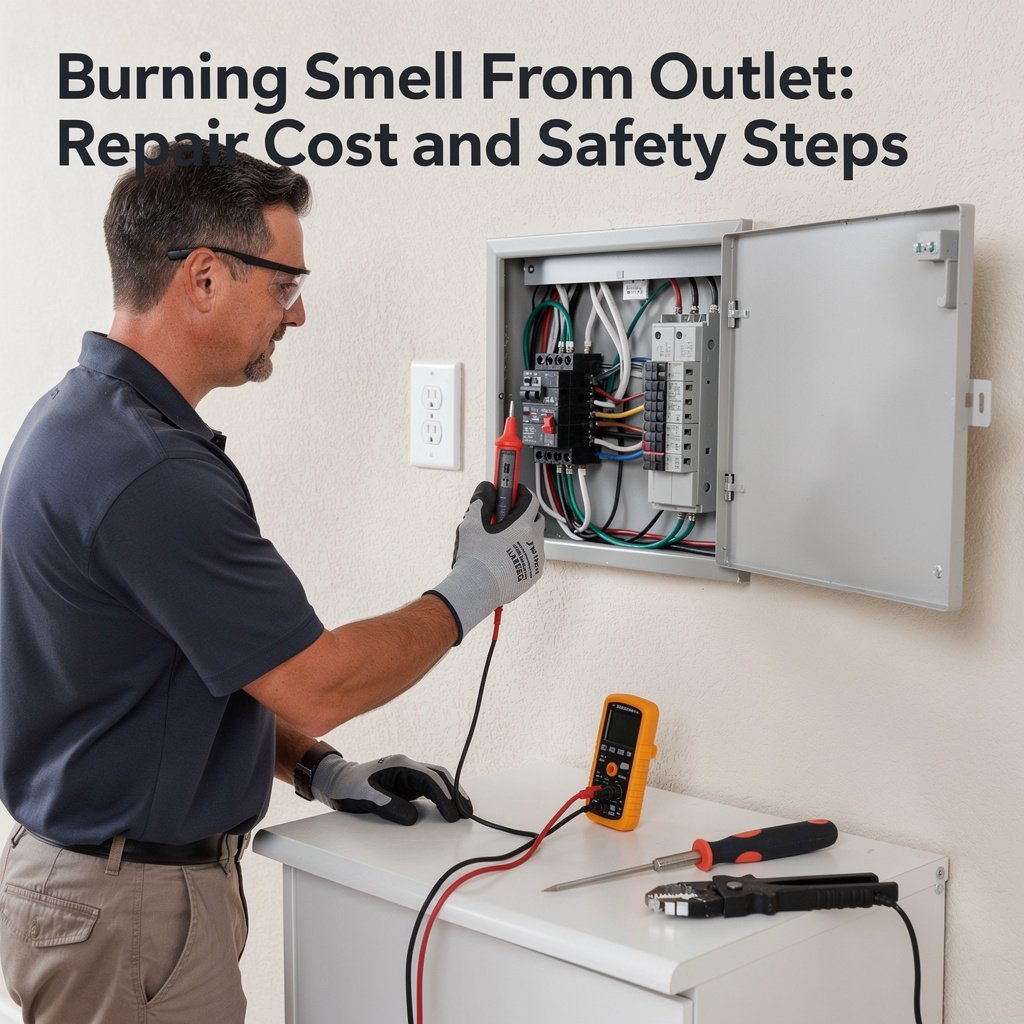
Burning Smell From Outlet: Repair Cost and Safety Steps
Discovering a burning smell from an electrical outlet is a serious safety warning. This guide helps you understand what to do immediately, what the repair might cost, and how to find a trustworthy professional to fix the problem safely and correctly. We cover everything from emergency steps and price breakdowns to warranty claims and local verification checks.
A burning smell from an outlet is an urgent warning sign that requires immediate action for safety. If you see smoke, sparks, or fire, leave the area and call 911. Otherwise, stop using the outlet, turn off its circuit breaker if you can do so safely, and call a licensed electrician to diagnose the problem. The typical repair cost ranges from $130 to $350 for the outlet itself, but if hidden wiring or panel faults are found, the price can rise to $300–$1,500 or more.
Here is a quick overview of the essential facts for this situation.
Additional reference details:
- Item: Typical cost range , Detail: $130–$350 for outlet repair; $300–$1,500+ if wiring is faulty.
- Item: Best first contact , Detail: A licensed electrician after power is safely shut off.
- Item: Main safety warning , Detail: For smoke, fire, sparks, or panel danger: leave and call 911.
- Item: Warranty proof needed , Detail: Receipts, photos, model numbers, and the electrician's written diagnosis.
- Item: When to call a pro , Detail: For any burning smell, grounding issues, old wiring, or troubleshooting.
Who should I call first
- Who should I call first? Call a licensed electrician. For smoke or fire, call 911.
- What will it cost? Expect $130–$350 for an outlet, but be prepared for higher costs if wiring problems are discovered.
- What proof is needed for warranty? You need your receipt, photos of the issue, the product model number, and the electrician's written report.
- Which office should I check? Check your state's licensing board and your local city/county building department.
- What are the warning signs? Burning smell, warm outlets, sparks, repeated breaker trips, or visible damage.
- When should I avoid DIY? Avoid DIY for safety-critical wiring, grounding issues, aluminum or old knob-and-tube wiring, and any troubleshooting of a burning smell.
This table consolidates key contacts and information you might need.
| Item | Detail |
|---|---|
| Main customer question | What is the cost and safety process for a burning outlet smell? |
| Best first contact | Licensed electrician (verify state license). |
| Estimated cost range | $130–$350 for outlet; $150–$600 for troubleshooting; $300–$1,500+ for wiring repair. |
| Emergency safety warning | For smoke, fire, sparks, or active burning: Call 911. |
| Fitting/installation contact | Retailer (if part of an installation order) or manufacturer for product defects. |
| Official brand contacts | Square D: 888-778-2733; Eaton: 877-386-2273; Leviton: 800-824-3005. |
| Retailer contacts | Home Depot: 800-466-3337; Lowe’s: 800-445-6937. |
| Warranty claim documents | Photos, invoice, model/brand info, contractor diagnosis, warranty docs. |
| State agency to check | Verify license with your state's board (e.g., CSLB for CA, TDLR for TX). |
| Important URLs | NFPA Safety: nfpa.org; License checks: Use state-specific links in source. |
Repair costs vary based on the root cause. Use the following table as a reference when reviewing a contractor's written quote. Always ask them to separate labor, materials, permit fees, and any emergency charges.
Additional reference details:
- Line Item: Outlet replacement after overheating , Typical Planning Range / Note: $130–$350
- Line Item: Loose connection or damaged device repair , Typical Planning Range / Note: $150–$500
- Line Item: Circuit troubleshooting , Typical Planning Range / Note: $150–$600+
- Line Item: Wiring repair inside wall , Typical Planning Range / Note: $300–$1,500+
- Line Item: Emergency after-hours call , Typical Planning Range / Note: May add $100–$300+ or more
These are national planning estimates. Your final price depends on local labor rates, the time of service, material quality, how difficult the repair area is to access, permit requirements, and any hidden damage found.
Average Cost: A standard outlet repair typically costs between $130 and $350, but always budget for potential hidden issues.
A very low quote might be missing necessary items like permits, disposal fees, code upgrade allowances, or a proper warranty. A high quote can be reasonable if the job involves difficult access, emergency timing, premium materials, or an older home electrical system.
Always ask what is included, what is excluded, and what the plan is if hidden damage is found after work begins.
For most homeowners, a burning smell is not a DIY project. The risks are too high.
When might DIY be safe? DIY is only potentially safe for a simple, like-for-like replacement of a standard outlet if you have confirmed the problem is solely with the old device and not the wiring, and if you have the proper tools and knowledge to work safely with electricity. This is rare when a burning smell is involved.
When must you call a licensed professional? You must call a licensed electrician for:
- Any burning smell, sparking, or warm outlets.
- Troubleshooting the cause of the problem.
- Any work involving the electrical panel, grounding, or wiring inside walls.
- Homes with aluminum wiring or old knob-and-tube systems.
- Any repair where a permit and inspection might be required.
Call a Pro If: You smell burning, see sparks, or have repeated breaker trips. This is a safety-critical wiring issue.
Using a handyman for safety-critical electrical work is not recommended and may be illegal in your area. A licensed electrician is trained to diagnose hidden issues that a simple outlet swap will not fix.
Your first contact depends on the immediate danger.
Additional reference details:
- Contact: Emergency Services , Use When: Smoke, fire, sparks, panel arcing, or active burning smell. , Phone / Action: Call 911.
- Contact: Local Electric Utility , Use When: Issue may be with the service drop, meter, or utility-owned wire (e.g., after a storm). , Phone / Action: Use the number on your utility bill.
- Contact: Licensed Electrician , Use When: For grounding issues, burning smells, troubleshooting, or any outlet/wiring repair. , Phone / Action: Find a local licensed pro and verify their license.
If the problem might be on the utility side (like the wires from the pole to your house), contact your electric utility. Do not attempt to open sealed meter or service equipment yourself.
For product support, warranty claims, or installation services related to specific brands or retailers, use these official contacts.
- Square D / Schneider Electric: For Square D breakers, panels, and load centers. Phone: 888-SQUARED (888-778-2733). Website: se.com/us/en/brands/squared/
- Eaton / EatonCare: For BR/CH breakers and load centers. Phone: 877-386-2273. Website: eaton.com/us/en-us/locate/electrical/residential.html
- Leviton: For outlets, GFCI/AFCI devices, and switches. Phone: 800-824-3005. Website: leviton.com/support
- Home Depot: For installation orders, receipts, or service complaints. Phone: 800-HOME-DEPOT (800-466-3337). Website: corporate.homedepot.com/contact-us
- Lowe’s: For installation support, receipts, or service complaints. Phone: 800-44LOWES (800-445-6937). Website: corporate.lowes.com/contact-us
Follow these steps to navigate warranty or reimbursement claims effectively.
- Gather all documentation. This includes the original receipt, the electrician's invoice and written diagnosis, the product model and part number, and clear photos of the issue.
- Identify the responsible party.
- - If you suspect a product defect, contact the device or panel manufacturer first using the contacts above.
- - If the work was part of a store installation order, contact the retailer's installation support line with your order number.
- - If the damage was due to faulty installation, contact the original installing contractor for a warranty response.
- Protect evidence. Do not let a new contractor remove or destroy the faulty component until you have taken photos and the original electrician has documented it.
- Contact insurance if needed. If there is smoke, fire, or property damage, notify your homeowners insurance carrier before proceeding with non-emergency repairs.
- File a formal complaint if necessary. If a contractor performed unsafe work or refuses to fix code violations, file a complaint with your state or local licensing board. Attach all photos, permits, invoices, and written quotes.
Warranty Documents Needed: Keep your receipt, photos, model number, and the electrician's written diagnosis.
State-Specific or Local Checks
Electrical licensing and permit rules vary by state and city. Before hiring anyone, verify their license and ask about permits. Below is a checklist for key states; always double-check with your local building department.
| State / Area | What to Do Before Work Starts | Where to Check |
|---|---|---|
| All U.S. States | For burning smells or major work, verify the electrician's license and ask if a permit/inspection is required. | Local building department + state license lookup. |
| California | Check the contractor's CSLB license. Permits are common for safety repairs and new circuits. | cslb.ca.gov/onlineservices/checklicenseII |
| Texas | Verify electrician/contractor status with the Texas Department of Licensing and Regulation (TDLR). | tdlr.texas.gov/electricians/ |
| Florida | Use the DBPR license search and confirm local permit rules. | myfloridalicense.com/wl11.asp |
| New York / NYC | Licensing is highly local. In NYC, verify with the Department of Buildings (DOB). | nyc.gov/site/buildings/ |
| New Jersey | Verify contractor registration with NJ Consumer Affairs and check local permits. | njconsumeraffairs.gov/hec |
| Washington | Verify contractor registration through WA Labor & Industries (L&I). | secure.lni.wa.gov/verify/ |
| Arizona | Check the Arizona Registrar of Contractors for license and complaint history. | roc.az.gov/ |
Before you approve work or make a payment, ask the electrician these important questions.
- "What is your license number?" (Then verify it independently with the state.)
- "Does this job require a permit and final inspection?" (Get the permit number if yes.)
- "Can you provide a written diagnosis before we approve major work?" (Vague answers like "a wiring problem" are not enough.)
- "Will you take before-and-after photos for repairs inside walls or the panel?"
- "What is included in the quote?" (Labor, materials, permits, disposal, warranty.)
- "What happens if you find hidden damage after starting?"
- "What are your payment terms?" (Avoid paying 100% upfront.)
Be cautious if a contractor exhibits any of these warning signs.
- Says permits are unnecessary for major wiring or panel work without checking local rules.
- Asks for cash only, refuses to provide an invoice, or won't give a license number.
- Does not offer clear warranty terms in writing.
- Pressures you to pay the full amount before any work begins.
- Provides a quote that seems unusually low compared to others without a clear explanation.
Do Not Ignore: A contractor who says "no permit is needed" for safety-critical electrical work. Always verify with your local building department.
Practical Step-by-Step Guidance
Follow this actionable sequence if you detect a burning smell from an outlet.
- Assess Immediate Danger: If you see smoke, flames, or sparks, or hear arcing, evacuate the area and call 911 immediately.
- Make the Area Safe: If there is no active fire, unplug any device from the outlet. If you can do so safely, go to your electrical panel and turn off the breaker that controls that circuit.
- Do Not Use Interim Fixes: Do not keep using the outlet, cover it with tape, or attempt to spray anything into it.
- Contact the Right Pro: Call a licensed electrician to diagnose the problem. Do not rely on a handyman for this safety issue.
- Get a Written Diagnosis: Before approving any major work, insist on a written explanation of the problem and the proposed solution.
- Verify and Hire: Check the electrician's license with your state board. Get at least two written quotes for non-emergency work.
- Document Everything: Take photos of the issue, save all receipts and invoices, and note model numbers for any failed devices.
Frequently Asked Questions
Should I get more than one quote? Yes. For non-emergency work, get at least two or three written quotes. Ensure they cover the same scope of work, materials, permit assumptions, and warranty terms for a fair comparison.
Should I pay the full amount upfront? No. A reasonable deposit may be normal, but paying everything before work starts is risky. Check your state's rules on contractor deposits and use a traceable payment method like a check or credit card.
Can I use my home warranty? Maybe. Coverage depends entirely on your specific contract, maintenance history, and exclusions. Call your home warranty company before authorizing any non-emergency work if you hope for reimbursement.
Can a handyman do this electrical repair? For safety-critical issues like burning smells, grounding, old wiring, or troubleshooting, you must use a licensed electrician. Many states and cities prohibit unlicensed individuals from performing electrical work.
Should I shut off the power? If it is safe to do so and you can confidently identify the correct circuit breaker, yes, shut off the power to that outlet. If there is any sign of smoke, fire, or danger at the panel, evacuate and call for help instead.
Will homeowners insurance pay for this? Insurance may cover sudden, accidental damage like a fire caused by the faulty outlet. It typically will not pay to upgrade old or outdated wiring that is simply wearing out. Review your policy and contact your insurer if there is property damage.
This article was compiled using information from the following official and reputable sources for verification:
- NFPA Electrical Safety: nfpa.org/education-and-research/home-fire-safety/electrical-safety-in-the-home
- Angi Outlet Repair Cost Guide: angi.com/articles/electrical-outlet-repair-cost.htm
- State Licensing Boards: California CSLB, Texas TDLR, Florida DBPR, Washington L&I, Arizona ROC (links provided in state table).
- Manufacturer Support: Square D/Schneider Electric, Eaton, Leviton (contact info above).
- Retailer Support: Home Depot, Lowe’s (contact info above).
Local codes, permit requirements, warranty terms, and contact information can change. Always re-check with licensed professionals, official brand support, your local building department, and state licensing boards before proceeding with any repair or claim.
A burning smell from an outlet is a serious warning. Your safety is the top priority. Always start by eliminating immediate danger, then contact a licensed professional for diagnosis and repair. Use the verification steps provided to ensure you hire a qualified electrician, and keep thorough records for any potential warranty or insurance claims. This information is intended as a helpful guide; for final decisions, always confirm details with the relevant licensed professionals, official support channels, and local authorities.

About the TDL Expert Panel
TDL Expert Panel · TheDigitalLife Editorial Team
TDL Expert Panel is the editorial team behind TheDigitalLife. The team researches, reviews, and creates practical guides to help everyday readers make better decisions about home repair costs, refunds, AI tools, digital safety, productivity, and useful online resources. Each guide is written to be clear, useful, and easy to understand.