Hybrid battery replacement cost and signs of battery failure
---
What Is a Hybrid Battery and Why Does It Fail?
Hybrid vehicles combine a gasoline engine with an electric motor powered by a high-voltage battery pack. These batteries, often nickel-metal hydride (NiMH) or lithium-ion (Li-ion), store energy for electric-only driving, regenerative braking, and assisting the engine. Unlike traditional car batteries, hybrid batteries operate under high voltage, typically 200-600 volts, making them more complex and costly to service.
Battery failure happens due to age, heat exposure, deep discharges, or manufacturing defects. Most last 8-10 years or 100,000-150,000 miles, but this varies by model, driving habits, and climate. In hot states like Arizona or Florida, heat accelerates degradation. For U.S. drivers, especially commuters in traffic-heavy areas like Los Angeles or Atlanta, ignoring early signs can lead to sudden breakdowns.
Replacement isn't always needed; sometimes individual cells can be repaired. However, full packs are common due to safety and integration issues. Always prioritize safety: hybrid batteries involve high voltage, so never attempt DIY inspections or repairs. Tow the vehicle if warning lights appear.
Key Signs Your Hybrid Battery Is Failing
Spotting failure early prevents stranding and high repair bills. Hybrid batteries degrade gradually, but certain symptoms signal urgent attention. Pay close attention if your vehicle is over 8 years old or has high mileage.
Common signs include:
- Reduced fuel economy: If MPG drops 20-30% from normal (check your dashboard or FuelEconomy.gov for your model's expected MPG), the battery may not hold charge effectively.
- Warning lights: The hybrid system warning, check engine, or triangle exclamation light on the dash often points to battery issues. Use an OBD-II scanner for codes like P0A80 (Toyota hybrids) or P3000 series.
- Decreased electric-only range: Hybrids like the Toyota Prius normally drive 1-2 miles on battery alone; if this shortens significantly, suspect the pack.
- Overheating or cooling fan noise: Excessive fan activity or hot smells near the battery (usually under rear seats or trunk) indicate thermal management failure.
- Slow acceleration or power loss: The vehicle feels sluggish, especially during EV mode or uphill, as the battery can't deliver power.
- Strange noises: Clicking, humming, or whining from the battery area during operation.
- HVAC issues: Weak air conditioning or heater, since the battery system often shares thermal controls.
- 12V battery drain: Frequent jumps or dead starts, as the hybrid battery charges the low-voltage system.
| Sign | Possible Battery Issue | Action to Take |
|---|---|---|
| Reduced MPG | Poor charge retention | Track MPG over 100 miles; log data for mechanic |
| Dashboard warning lights | Cell imbalance or failure | Scan codes; do not ignore |
| No EV mode | Low state of charge | Test on flat road; check cooling system |
| Overheating fan constant | Thermal runaway risk | Park immediately; call roadside assistance |
| Power hesitation | Voltage drop | Avoid highways; get towed if persistent |
Safety note: If you smell burning, see smoke, or experience sudden power loss, pull over safely, shut off the vehicle, and call for a tow. High-voltage systems can cause fires or shocks.
Steps to Diagnose Hybrid Battery Problems
Don't guess—get a professional diagnosis to avoid unnecessary costs. Start with these steps:
- Check your owner's manual: Note battery warranty details (often 8 years/100,000 miles federally, 10 years/150,000 in CARB states like California).
- Scan for codes: Use an OBD-II reader (under $50 at auto parts stores) or visit AutoZone for a free scan. Hybrid-specific codes require dealer tools.
- Monitor performance: Drive normally and note MPG, EV range, and warnings via the dashboard or apps like those from Toyota or Honda.
- Inspect visually: Look for leaks, corrosion, or damage around the battery compartment (requires lifting panels—leave to pros).
- Visit a certified shop: Seek ASE-certified hybrid technicians or dealer service. Ask for a battery health test using manufacturer software.
Document everything: photos of lights, code readouts, mileage, and dates. This helps for warranty claims or insurance. Costs for diagnostics run $100-300, often applied to repairs.
For popular models, Toyota Prius diagnostics are straightforward at dealers; Ford Escape Hybrids may need Ford-specific tools. If leased, contact the lessor before repairs.
The Hybrid Battery Replacement Process
Replacement involves specialized steps due to high voltage:
- Isolation and discharge: Techs disconnect the 12V battery, then safely discharge high-voltage circuits.
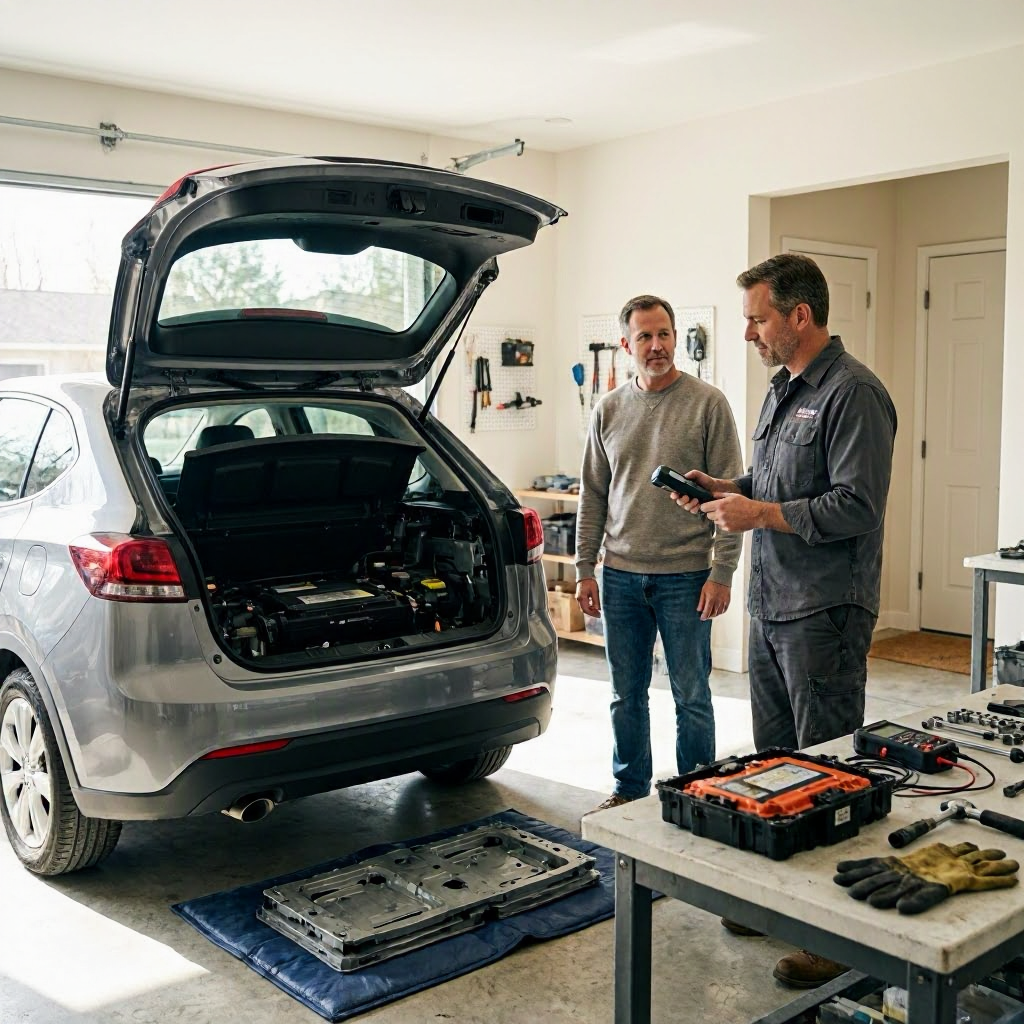
- Pack removal: Remove seats, panels, or trunk components to access the pack (2-4 hours labor).
- New pack installation: Install OEM, remanufactured, or aftermarket pack; reprogram ECU.
- Testing: Full system checks, road test, and balance cells.
- Cleanup: Dispose of old pack per EPA hazardous waste rules (shops handle this).
Expect 8-20 hours labor. Dealerships charge $150-250/hour; independents $100-200. Total time: 1-3 days.
Ask: "Is the pack OEM or remanufactured? What's the warranty? Are taxes, fees, and disposal included?" Get a written estimate breaking down parts ($2,000-15,000+), labor, and extras.
Factors That Affect Hybrid Battery Replacement Costs
Costs vary widely—no single national price exists. Key drivers:
- Vehicle make, model, year: Toyota Prius (2004-2009) packs cost less ($2,500-4,000 parts) than newer Rav4 Hybrids ($5,000-10,000) due to availability.
- Battery type and size: NiMH cheaper than Li-ion; larger packs (e.g., plug-ins like Chevy Volt) higher.
- Parts source: OEM highest ($8,000-18,000 full pack); remanufactured 30-50% less; aftermarket riskier.
- Shop type and location: Dealers pricier in California ($15,000+ total) vs. independents in Texas ($8,000-12,000). Urban areas add 20-30%.
- Labor hours: 10-25 hours; rates $100-300/hour.
- Additional work: Cooling system, wiring, or ECU updates add $500-2,000.
- Taxes and fees: 6-10% sales tax; shop supplies 5-10%; disposal $100-300.
- Urgency: Weekend or mobile service premiums.
| Cost Factor | Why It Matters | How to Verify |
|---|---|---|
| Model/year | Parts scarcity for older cars | Check RockAuto or dealer parts sites |
| Parts type | Warranty length varies (1-10 years) | Ask for part numbers and sourcing |
| Labor rate | Biggest variable | Get 3 written quotes |
| Location | State taxes, shop competition | Compare local vs. dealer |
| Extras | Hidden fees inflate bill | Demand itemized estimate |
Real-world example: A 2010 Prius owner in Ohio might pay $4,000-7,000 total; a 2020 Highlander Hybrid in New York, $12,000-20,000. Always compare 3 quotes.
Typical Cost Ranges for Popular Hybrid Models
While prices fluctuate, here's a cautious overview based on shop reports and forums (verify locally):
- Toyota Prius (Gen 2/3, 2004-2015): Parts $2,000-5,000; total $4,000-9,000.
- Toyota Camry Hybrid (2007+): $5,000-12,000 total.
- Honda Accord Hybrid (2005-2007): $3,000-8,000 (rarer parts).
- Ford Escape Hybrid (2005-2012): $4,500-10,000.
- Lexus RX Hybrid: $8,000-18,000 due to luxury pricing.
Plug-in hybrids like Toyota Prius Prime add $2,000-5,000 for larger packs. These are broad ranges—call shops with your VIN for accuracy. Factor 10-20% inflation yearly.
How to Lower Your Hybrid Battery Replacement Bill
Save without cutting corners:
- Check warranty/recalls: Federal emissions warranty covers 8/100k (10/150k CA/NY/MA); powertrain 5/60k. Search NHTSA.gov with VIN.
- Opt for remanufactured: Certified reconditioned packs from GreenTec or EnnoCar cost 40-60% less, often with 1-4 year warranties.
- Independent shops: Hybrid-specialized independents like those via HybridBatteryRebuild.com beat dealer prices.
- Battery repair: Cell balancing or module replacement ($1,000-3,000) if not full failure.
- Sell/trade privately: If costs exceed vehicle value (use Kelley Blue Book), part out or sell as-is.
- Financing options: Some shops offer 0% plans; check credit unions for low-rate loans.
- Tax credits?: No direct for repairs, but check state incentives for hybrids via FuelEconomy.gov.
Get quotes itemized: "What's included? Any core charge refund for old pack?" Negotiate by showing competitor bids.
Warranty, Extended Coverage, and Recalls
Most hybrids have robust warranties. Toyota: 10 years/150,000 miles on battery in CARB states. Verify via dealer or VIN lookup.
Extended warranties (e.g., from Endurance) cover batteries for $2,000-4,000 upfront, paying 70-100% after deductible. Read fine print for hybrid specifics.
Recalls: Past issues like Prius 2010 inverter failures (NHTSA recall 10V-374). Check SaferCar.gov or manufacturer site.
Keep records: Original warranty card, service history, diagnostic reports. Present before paying.
Repair Checklist: Questions for Your Mechanic
Use this before approving work:
- What codes/scans confirm battery failure?
- Can you test individual modules?
- OEM vs. aftermarket—which and why?
- Full cost breakdown: parts, labor, tax, fees?
- Warranty on work (parts/labor)?
- Time estimate and loaner car?
- Core charge and return process?
Sample message to shop: "Hi, my 2012 Prius shows P0A80 code and low MPG. Please quote full battery replacement with breakdown. Include warranty details."
When Replacement Isn't Worth It
Compare costs to vehicle value (Edmunds.com appraisal). If a 150,000-mile Prius repair is $6,000 but worth $4,000, consider alternatives:
- Rebuilt engine swaps or used hybrids.
- Switch to a new/used EV/hybrid (check FuelEconomy.gov/compare for costs).
- Public transit or rideshares for low-mileage drivers.
Gig workers or families: Weigh downtime vs. a reliable used Camry Hybrid ($15,000-25,000).
Preventing Hybrid Battery Failure: Maintenance Tips
Extend life 20-50% with habits:
- Park in shade/garage; use preconditioning.
- Avoid deep discharges; charge via driving.
- Service cooling system every 30,000 miles.
- Update software at dealer.
- Monitor via apps (Toyota: MyToyota app).
Annual inspections at hybrid specialists cost $150-300, catching issues early.
U.S. example: A Seattle commuter saved $3,000 by replacing coolant at 80,000 miles.
Documents to Keep After Replacement
- Written estimate and final invoice.
- Parts receipts/core refund proof.
- Warranty paperwork.
- Before/after diagnostic reports.
- Photos of old battery.
Store digitally for insurance, resale, or disputes. Boosts trade-in value.
Hybrid ownership saves on gas but demands proactive care. By spotting signs early and shopping smart, you control costs and stay safe on U.S. roads. Verify all with local pros. ---

About the TDL Expert Panel
TDL Expert Panel · TheDigitalLife Editorial Team
TDL Expert Panel is the editorial team behind TheDigitalLife. The team researches, reviews, and creates practical guides to help everyday readers make better decisions about home repair costs, refunds, AI tools, digital safety, productivity, and useful online resources. Each guide is written to be clear, useful, and easy to understand.