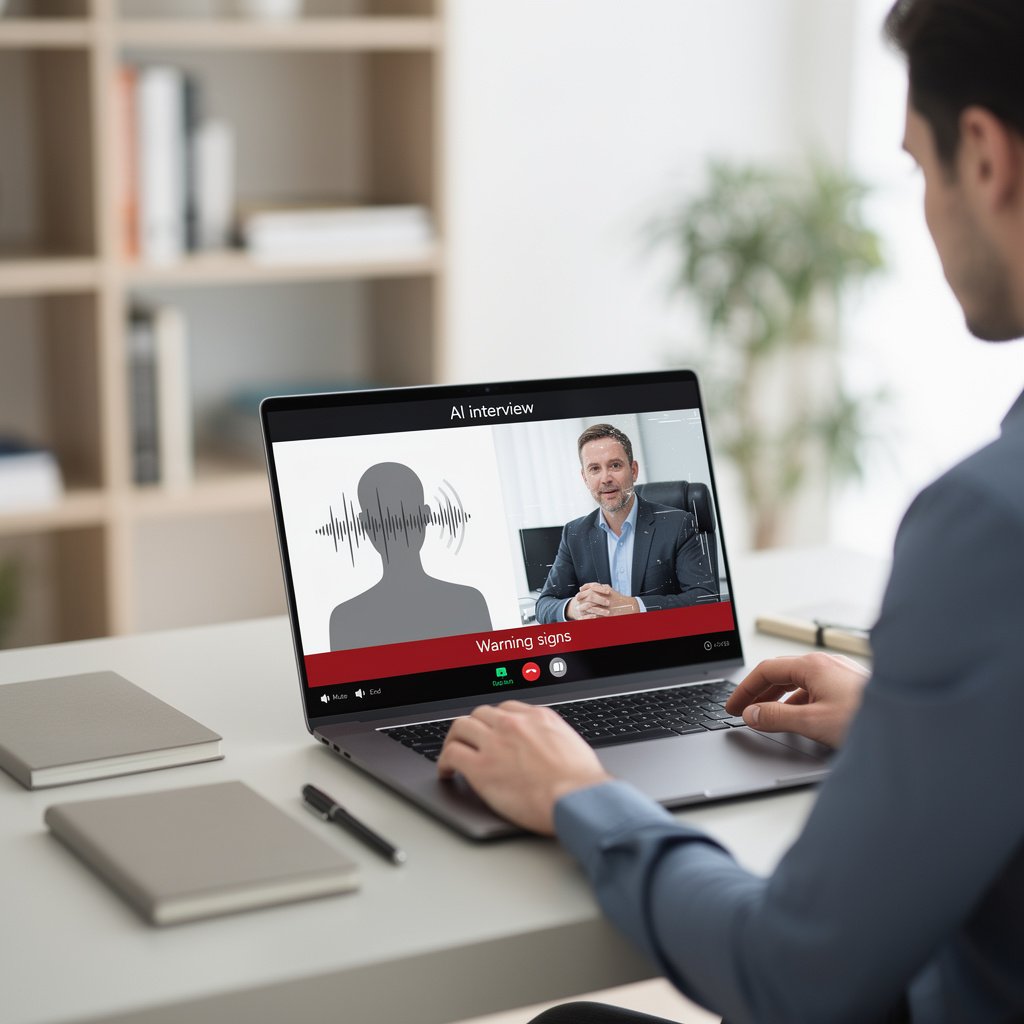
Fake Job Interview With AI Voice or Video: Warning Signs
Online interviews are now a normal part of hiring, and scammers have taken advantage. A video call with a polished background and a friendly "recruiter" does not prove there is a job. Federal agencies describe two related problems: fake employers who run convincing interviews to collect your money or personal information, and the reverse, where fake applicants use deepfakes and stolen identities to get hired. This guide covers both, with the warning signs and checks the FTC and the FBI recommend.
How a fake interview scam runs
The FTC describes a pattern that repeats across job platforms. A "recruiter" contacts you, often by direct message, and says your skills are a match. You get an official-looking invitation to a virtual interview, along with a briefing document about duties and benefits. After the interview comes an offer letter with a real company's name and logo.
Only then does the scam show itself. The FTC says the scammer will push for your money and personal information. You may receive a fake invoice for equipment, such as a computer the "company" says it will order, which you are told to pay for with cash, Zelle or PayPal on the promise of reimbursement. Or you are asked for your driver's license, Social Security or bank account number to fill out "employment paperwork," often before they will answer your questions about the job. The FTC says honest employers never ask you to pay upfront fees for a job or equipment, and they do not ask for payment by cash, Zelle or PayPal.
A related version uses a check. The FTC says that if a "company" sends you a check, tells you to buy equipment and asks you to send back the extra money, the check will bounce and you will have lost the money you sent. Our guide to the mobile deposit and fake check scam explains how this scheme works.
Where AI voice and video come in
In its warning about generative AI fraud, the FBI's Internet Crime Complaint Center (IC3) says criminals generate videos for real-time video chats with alleged company executives, law enforcement or other authority figures, and create videos for private conversations to "prove" the online contact is a real person. The same alert describes AI-generated audio that can imitate people's voices.
The FTC adds a point that applies even without deepfakes. In a 2023 business alert, the agency said the teleconference with a company logo on the screen and the official-looking documents are cut-and-paste fakes. Its December 2023 alert described students contacted by "recruiters" and interviewed by "executives" calling from impressive-looking conference rooms, where the room was a phony background, the logo was pasted in and the details came from public information.
The lesson is that appearances prove little. A recognizable face, a professional voice or a branded virtual background can all be produced. What matters is how the process asks you to behave.
Warning signs
These come from the FTC's job scam alerts. Several of them are visible only after the interview, which is why checking before you share anything is so important.
- The recruiter writes from a personal email address such as Gmail or Yahoo instead of a company account.
- The conversation moves quickly to a text-only app such as Signal, or the interview is done entirely by email or chat.
- You are asked for sensitive information, such as a Social Security number, driver's license or bank account number, before you have actually been hired. A real employer does not need these to interview you.
- You must pay for equipment, training or the job itself, or you are sent a check and told to return part of it.
- The salary is far out of line with the industry, or the unexpected message is vague about the actual work.
- The "recruiter" contacts you out of the blue by text, WhatsApp or Telegram. A 2026 FTC alert says to ignore generic, unexpected messages about jobs and never to pay to get paid.
Checks to run before you share anything
The FTC's consistent advice is to verify independently:
- Look up the company and contact it using a phone number or website you already know is real, not one the recruiter gave you. Confirm that you are under consideration and that the person contacting you works there.
- Visit the official site's careers page and check that the job is listed.
- Search the recruiter's name and the company with words like "scam" or "complaint."
- Talk to someone you trust about the offer. The FTC notes this also gives you time to think.
- Hold back personal and bank details until you have verified the employer. Our guide to fake job offer scams and fake recruiter scams on LinkedIn go through these steps in more detail.
If a video interviewer asks you to do anything unusual, such as installing software or signing in to a link they send, treat it as a reason to stop and verify.
If you shared information or paid
The FTC's guidance is to report fake job offers at ReportFraud.ftc.gov and to the website where you saw the posting. If you gave out personal or financial information, go to IdentityTheft.gov to report it and get a recovery plan. Our identity theft recovery checklist and guide to freezing your credit cover the first steps. If you sent money, contact your bank or payment app right away. That last step is general practical advice rather than an agency rule.
For employers: fake applicants
The problem also runs in the opposite direction. IC3 reported an increase in complaints about deepfakes and stolen personal information used to apply for remote work positions, including information technology, programming and database jobs, some with access to customer data, financial data or corporate systems. Complaints described interviews where the on-camera person's lip movement and actions did not fully match the audio, and where coughing or sneezing did not line up with what was seen. Victims also reported that background checks found the applicant's details belonged to another person. If you hire remotely, those mismatches are worth noting.
IC3's 2025 annual report says victims reported losses of almost $13 million to AI-involved employment scams, which shows this is no longer rare.
Sources:
- Scammers impersonate well-known companies, recruit for fake jobs on LinkedIn and other job platforms, FTC Consumer Alerts
- Job scammers go even lower in the way they "hire," FTC Business Blog
- A job scam that college students and your HR team need to know about, FTC Business Blog
- Job scammers are looking to hire you, FTC Consumer Alerts
- That job offer text is probably a scam, FTC Consumer Alerts
- Looking for a job? Scammers might be looking for you, FTC Consumer Alerts
- Scammers are hijacking job ads. Here's how to spot the fakes, FTC Consumer Alerts
- Searching for a job to work remotely? Avoid scams and identity theft, FTC Consumer Alerts
- Criminals Use Generative Artificial Intelligence to Facilitate Financial Fraud, FBI IC3 PSA
- Deepfakes and Stolen PII Utilized to Apply for Remote Work Positions, FBI IC3 PSA
- 2025 IC3 Annual Report, FBI

Written by TheDigitalLife Editorial Team
Edited by R. K. Tiwari
Owner & Editor
R. K. Tiwari is the owner and editor of TheDigitalLife. He checks each guide against official U.S. sources before it is published.
About the editor and our editorial standards