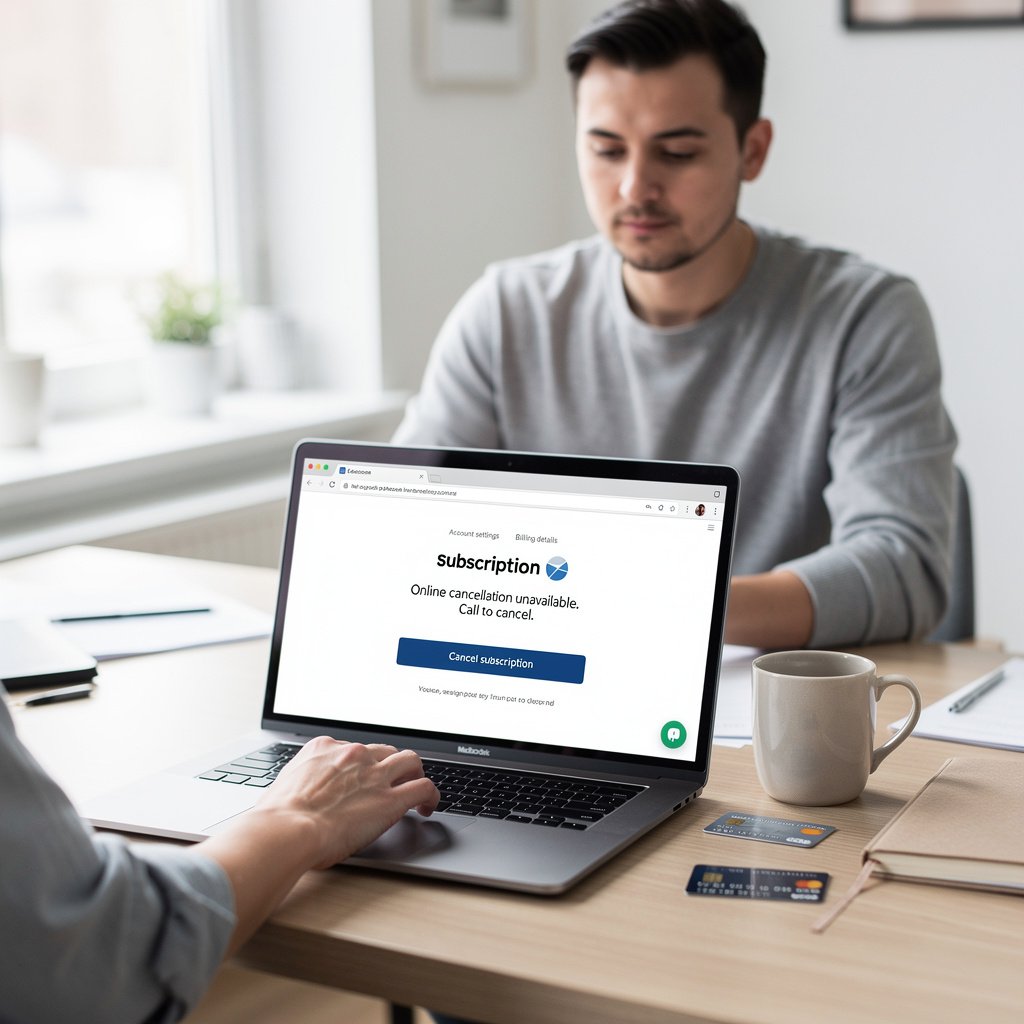
Cancel a Subscription That Won't Let You Cancel Online
A missing cancel button, a page that loops back to the start, or a message telling you to call during hours when you are at work are all signs that a company is making cancellation harder than signing up. Federal law does not give you a single "cancel online" right across every business, but it does give you leverage in many cases, and you can protect yourself while you work around the obstacle. The key is to treat the obstacle as evidence and to keep a clear record.
Know what the law does and does not guarantee
For subscriptions sold online, the Restore Online Shoppers' Confidence Act (ROSCA) requires sellers to provide a simple mechanism to stop recurring charges. The FTC's enforcement policy statement on negative option marketing says negative option sellers should provide cancellation mechanisms at least as easy to use as the method the consumer used to sign up, and it lists behaviors the FTC treats as problems, including keeping consumers on hold for a long time, giving false information about how to cancel and misrepresenting the reasons for delays in processing a cancellation.
A broader federal "click to cancel" rule was finalized in 2024, but it did not survive. Law-firm summaries of the decision, such as Cooley's analysis, report that the Eighth Circuit vacated the entire rule in July 2025 on procedural grounds, while noting that ROSCA remains in force and the FTC can still act against unfair or deceptive subscription practices. Several states have their own automatic-renewal laws, some stricter than the old federal proposal, so a company's practices may break state law even where federal rules are thin. Check your state attorney general's website for the rules that apply to you.
The practical takeaway is that a company's obstruction does not cancel your right to stop paying, but you need to document it.
Record what you are seeing
Before you try workarounds, capture the problem:
- screenshots of the account page, any error message, and the missing or disabled button, with the date visible;
- the support chat transcript or ticket number, or a note of the phone call date, time and representative;
- a copy of the terms you agreed to when you signed up, including the stated cancellation method.
The FTC's advice on subscriptions says to follow the company's cancellation instructions and keep a copy of your request and notes about any conversations. Save emails and screenshots in one folder so you can hand them to a bank or regulator.
Try the channels the company will accept
Work down this list, and stop when you get a written confirmation:
- The account settings under billing, plan or membership, including mobile-app and desktop versions, which sometimes differ.
- A written request by email or the support form, stating your account details, that you are cancelling effective immediately, and asking for confirmation of the end date and that no further charges will occur.
- A phone call if that is the stated method. Note the representative's name and ask for a confirmation number or email while you are on the line.
- A letter to the address in the terms if the company says mail is required. Send it with tracking and keep the receipt.
Also check whether the subscription is billed through someone else. If it is an app-store subscription, cancelling in the company's own app may do nothing. The guides on cancelling Apple subscriptions and cancelling Google Play subscriptions show where those live.
Stop the money anyway
If you have made a reasonable, documented attempt and the company still will not cancel, shut off the flow of money. For bank debits, the CFPB's page on stopping automatic payments says you can revoke permission by telling the company and your bank and following up in writing. It adds that stopping the payments does not end your contract, which is why your written cancellation attempts matter.
For cards, the FTC says that if a company will not stop charging after you tried to cancel, you can file a dispute with your credit or debit card company, and that changing a card number is often not enough. For credit cards, the FTC's page on billing errors says to dispute in writing within 60 days of the first statement showing the error.
Escalate and report
Report the company to the FTC at ReportFraud.ftc.gov and to your state attorney general, both of which the FTC lists for subscription problems. For a membership-style contract where the company is refusing outright, see what to do if a company refuses to cancel your membership. If charges have already posted, how to get a refund when you are charged after cancelling covers the refund request.
Sources:
- Enforcement Policy Statement Regarding Negative Option Marketing, FTC
- Click to Cancel Just Got Cancelled: Eighth Circuit Vacates Entirety of FTC's Negative Option Rule, Cooley
- Getting In and Out of Free Trials, Auto-Renewals, and Negative Option Subscriptions, FTC Consumer Advice
- How do I stop automatic payments from my bank account? CFPB
- LA Fitness made it difficult for people to cancel gym memberships, FTC says, FTC Consumer Advice
- What To Do if You're Billed for Things You Never Got, FTC Consumer Advice

Written by TheDigitalLife Editorial Team
Edited by R. K. Tiwari
Owner & Editor
R. K. Tiwari is the owner and editor of TheDigitalLife. He checks each guide against official U.S. sources before it is published.
About the editor and our editorial standards