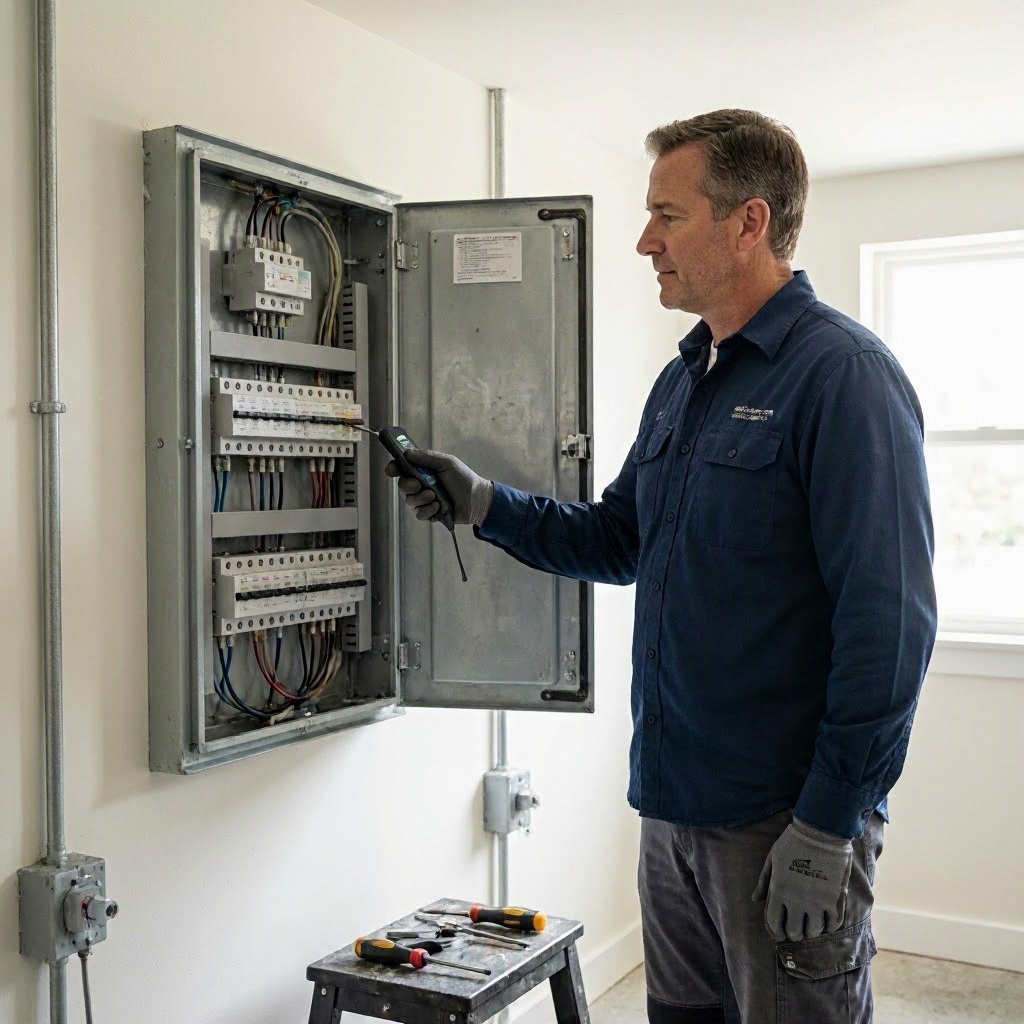
How to become a electrician in the USA
Why Pursue a Career as an Electrician in the USA?
Electricians install, maintain, and repair electrical systems in homes, businesses, factories, and construction sites. They ensure power flows safely and efficiently, working on everything from wiring new buildings to troubleshooting complex industrial setups. This hands-on trade offers stability, as demand stays steady due to construction growth, renewable energy projects, and aging infrastructure.
The U.S. Bureau of Labor Statistics (BLS) projects about 49,200 openings for electricians each year through 2032, driven by retirements and new projects. Check the latest at bls.gov/ooh/construction-and-extraction/electricians.htm for current data. Entry often requires no college degree, making it accessible for high school graduates or career changers.
Expect physical work, including climbing ladders, crawling in tight spaces, and occasional nights or weekends for emergencies. Union jobs through the International Brotherhood of Electrical Workers (IBEW) provide strong benefits, while non-union roles offer flexibility. Start by assessing if you enjoy problem-solving, math, and blueprint reading.
Meet the Basic Entry Requirements
Most electrician positions require a high school diploma or GED. Focus on courses in algebra, physics, and shop classes during high school to build a strong foundation. If you're past high school, earn a GED through your local adult education center or online via ged.com.
No bachelor's degree is needed, unlike many office jobs. Some employers prefer candidates with vocational training, but many hire motivated beginners for apprenticeships. Verify local requirements through your state's department of labor website, as they vary slightly.
Age minimums are typically 18 for apprenticeships due to safety rules. Pass a drug test and background check, common in construction. Physically, you need good vision, hand-eye coordination, and the ability to lift 50 pounds or more.
Choose Your Training Path
Training combines classroom instruction with on-the-job experience. Options include trade schools, community colleges, technical institutes, or direct apprenticeships. Compare programs by location, duration, cost, and job placement support.
Trade Schools and Community Colleges
Enroll in a 6- to 12-month certificate program at a community college or vocational school. These cover electrical theory, National Electrical Code (NEC), blueprint reading, and safety. Examples include programs at institutions like those listed on CareerOneStop.org.
Costs vary by state and school, often $3,000 to $15,000 total, including tools. Check for financial aid via FAFSA at studentaid.gov. Community colleges like those in California or Texas systems offer affordable daytime or evening classes.
Look for programs approved by the National Center for Construction Education and Research (NCCER) or aligned with state licensing. Contact admissions to ask about transfer credits to apprenticeships and partnerships with local unions or contractors.
Apprenticeship Programs
The gold standard is a 4- to 5-year paid apprenticeship, combining 2,000 hours of work per year with 144 hours of classroom time. Earn while learning, starting at 40-50% of journeyman wage, increasing yearly.
Union apprenticeships via IBEW (ibew.org) or Utility Workers Union of America emphasize safety and code compliance. Apply through local Joint Apprenticeship and Training Committees (JATCs). Competitive: prepare for aptitude tests in math, reading, and mechanical reasoning.
Non-union options through Independent Electrical Contractors (IEC) or Associated Builders and Contractors (ABC). IEC offers accelerated programs in some areas, finishing in 3-4 years. Search openings at apprenticeship.gov or careeronestop.org.
To apply:
- Gather diploma, ID, and references.
- Pass aptitude test (study algebra, fractions, spatial reasoning via free Khan Academy resources).
- Interview: explain why electrical work appeals and your work ethic.
- Start as a first-year apprentice, logging hours via state-approved systems.
Track progress with a workbook. Apprenticeships are registered with the U.S. Department of Labor, ensuring quality.
| Training Path | Duration | Cost to You | Paid Work? | Best For |
|---|---|---|---|---|
| Community College Certificate | 6-12 months | $3,000-$15,000 (aid available) | No | Quick entry, flexible schedules |
| Union Apprenticeship (IBEW) | 4-5 years | Free (paid training) | Yes, starting ~$15-20/hour | Benefits, job security |
| Non-Union Apprenticeship (IEC/ABC) | 3-5 years | Low (dues/tools) | Yes, market rate | Faster completion, local contractors |
Pass Your Journeyman Exam and Get Licensed
After 4+ years and 8,000 hours of experience, qualify for the journeyman license. Most states require it for independent work; check your state's licensing board via nicet.org or search "[state] electrician license."
Exam prep: Study NEC, local codes, and calculations. Use books like Mike Holt's or online courses from Electrical Training Alliance. Pass rate improves with practice tests.
Licenses expire every 1-3 years; renew with continuing education (8-24 hours). Specialize in low-voltage, residential, or commercial for higher pay.
Master electrician status requires 2+ years as journeyman, business management exam, and liability insurance. Needed to run your own company.
Avoid unlicensed work: fines up to $10,000 per violation. Verify requirements at dol.gov/agencies/eta/apprenticeship.
Develop Key Skills and Qualities
Success demands technical and soft skills. Master:
- Reading blueprints and schematics: Practice via free O*NET resources at onetonline.org (search electrician).
- Electrical math: Ohm's Law, load calculations.
- Safety protocols: OSHA 10-hour card (get at osha.gov, ~$25 online).
- Troubleshooting: Use multimeters, wire strippers proficiently.
Build qualities like reliability, attention to detail, and customer service. Physical fitness helps with demanding sites.
Practice at home safely: wire a basic outlet (follow NEC, turn off power). Join maker spaces or Habitat for Humanity builds for experience.
Prepare Your Resume and Job Application
Tailor your resume to highlight training, hours logged, and projects. Use action verbs: "Installed 500+ outlets in commercial retrofit" or "Completed NEC calculations for 50-unit residential complex."
For entry-level:
- List education first.
- Include any construction, military, or mechanical experience.
- Add certifications: OSHA, CPR, first aid.
Sample bullet:
- "Apprenticed 2,000 hours under licensed journeyman, wiring panel boards and running conduit in compliance with NEC Article 358."
No experience? Emphasize transferable skills: "Auto mechanic role honed precision tool use and safety adherence."
Build a portfolio: photos of work (with permission), wiring diagrams, completion certificates. Use LinkedIn: profile headline "Aspiring Journeyman Electrician | 1,500 Apprenticeship Hours | NEC Certified."
Cover letter script:
"Dear Hiring Manager,
I'm applying for the apprentice position at ABC Electric. With my community college electrical certificate and strong math background from high school, I'm eager to contribute to your team. I passed the IBEW aptitude test and am committed to safe, code-compliant work.
Thank you for considering me.
Sincerely, [Your Name]"
Find Electrician Jobs and Ace Interviews
Search on Indeed, LinkedIn, or Craigslist under "electrician apprentice." Check union halls, contractor sites like ieci.org/jobs.
Network: attend ABC or IEC job fairs. Message alumni: "Hi [Name], I saw you completed the IEC apprenticeship. Any tips for applying locally?"
Interview prep:
- Dress: clean work boots, jeans, button-up.
- Questions to expect: "Describe troubleshooting a circuit." Answer: "First, verify power off, test voltage, check continuity, isolate fault."
- Behavioral: "Tell me about a time you worked under pressure." Use STAR: Situation, Task, Action, Result.
Ask: "What does a typical first-year project look like? How do you support apprentice advancement?"
Follow up: "Thank you for the interview. I'm excited about the opportunity to grow with your team and can start immediately."
Spot scams: never pay upfront fees for "training" or jobs. Verify employers via BBB.org.
| Common Interview Question | What They Want | Sample Answer Framework |
|---|---|---|
| How do you ensure safety? | Knowledge of protocols | "Always lockout/tagout, PPE, double-check live wires per OSHA." |
| Explain a wiring project. | Hands-on experience | "Situation: faulty panel. Action: traced short, replaced breaker. Result: system operational." |
| Why electrician? | Motivation | "I enjoy solving problems and building infrastructure that powers communities." |
Understand Salary, Benefits, and Career Growth
Median pay is around $60,000 annually (BLS 2023), higher in states like California ($70,000+) or with overtime. Apprentices start $15-25/hour, journeymen $30-50/hour.
Benefits: health insurance, pensions (strong in unions), 401(k). Overtime and travel boost earnings.
Advance to foreman ($80,000+), estimator, project manager, or own business. Specialize in solar, EV chargers, or data centers for growth.
Job outlook strong in Sun Belt states with housing booms. Track via bls.gov.
Common Mistakes to Avoid
- Skipping aptitude test prep: use free practice at ibew.org.
- Ignoring safety: one violation ends careers.
- Not logging hours accurately: use apps like HoursTracker.
- Rushing licensing: incomplete training leads to exam failure.
- Job hopping early: build 1-2 years per role.
Step-by-Step Action Plan
- Earn diploma/GED (1-3 months).
- Research programs on careeronestop.org (1 week).
- Apply to 3-5 apprenticeships (prepare docs, test).
- Complete OSHA 10 (1 day).
- Start training, log hours (4-5 years).
- Pass journeyman exam (study 3 months).
- Build network, apply for jobs.
Checklist:
- [ ] High school diploma or GED.
- [ ] Aptitude test practice scores >70%.
- [ ] Resume with skills section.
- [ ] LinkedIn profile updated.
- [ ] 3 references lined up.
- [ ] Local licensing board bookmarked.
Verify details with state labor departments. Contact local IBEW or IEC chapters for personalized guidance. With persistence, you'll wire your future securely.
(Word count: 3421)

About the TDL Expert Panel
TDL Expert Panel · TheDigitalLife Editorial Team
TDL Expert Panel is the editorial team behind TheDigitalLife. The team researches, reviews, and creates practical guides to help everyday readers make better decisions about home repair costs, refunds, AI tools, digital safety, productivity, and useful online resources. Each guide is written to be clear, useful, and easy to understand.